200 years of Ireland – Australia connections.

VFL Carnival Team, Hobart 1924. Courtesy of Geelong Football Club. Read on to discover the GAA connection!
A Feature by Margaret Coffey
I think of this story as a small tribute to Mícheál Ó Muircheartaigh, ‘High King of Irish Broadcasting’, in its blend of football, Co. Kerry lore, and history. The master Gaelic Athletic Association (GAA) sports commentator died on 25 June at the age of 93. For decades, his match calls delighted with their references to local cultures, identities, geographies, and histories, with their verve and wit, and with his easy use of Irish in primarily English language commentary. He famously drew the Four Masters – the two Ó Cléirighs, Ó Maol Chonaire, and Ó Duibhgeannáin, early seventeenth century preservers of Ireland’s histories and ancient origin stories – into the drama of an All-Ireland Football Final call.[1] Unlike the Annals, the story I tell spans just two hundred years, but it extends Ireland’s reach beyond the Annals’ world all the way to Australia. I begin it with Mícheál’s funeral at the end of June in Dingle, Co. Kerry, and the large number of Kerry players, past and present, who formed a guard of honour. Among them was Eamonn Mac Muiris, principal of Pobailscoil Chorca Dhuibhne (Dingle community school), and a history teacher himself.[2]
Eamonn Mac Muiris is widely known as Eamonn Fitzmaurice, present-day football pundit, and several times over All-Ireland football champion as a player and as the (now former) manager of the GAA’s Senior Kerry Football team.[3]As I write, Kerry’s semi-final nemesis, Armagh, are the 2024 All-Ireland champions.[4] (That’s the men’s team—the Kerry Ladies won the women’s All-Ireland.) On the other hand, one of the Australian Rules football teams to which Eamonn Fitzmaurice can claim a connection promises to reach the Australian Football League (AFL) semi-finals. Eamonn’s connection is via Tom Fitzmaurice, a footballer dubbed an ‘Australian Rules genius’ who played for Essendon, Geelong, and North Melbourne in the pre-War days when the AFL was known as the Victorian Football League.[5] Tom’s roots were, like Eamonn’s, in the vicinity of Lixnaw in north Kerry—Fitzmaurice country. A good 100 years before the Four Masters felt the urgency of telling Ireland’s story, the Fitzmaurice branch of the Geraldines, 12th century Old English (Norman) invaders, were busy initiating their later fame as symbols of Gaelic resistance to the Tudor New English.[6] They were surely enjoying the local ball sport as part of their endeavour.
The association between the Fitzmaurice name and football in Ireland and Australia is a consequence of emigration before aptitude or tradition. The Fitzmaurices were hurlers — unsurprisingly, given their north Kerry homestretch boasts a centuries’ long history of hurling. The proof is in the sliotair or hurley balls lost in local bogs as early as the 12th century and stored now in Dublin’s National Museum.[7] The VFL’s Tom Fitzmaurice was the son of a Kerry hurler, William Fitzmaurice, reputedly a local champion in the days before the GAA. William’s brother, Maurice, was Eamonn Fitzmaurice’s great-grandfather. Maurice, renowned for his long puck, played for the Ballyduff-based team that beat Wexford to make Kerry the 1891 All-Ireland Hurling Champions.[8] That was the first and last time Kerry has won the GAA hurling final. William Fitzmaurice’s 1880 emigration to Australia produced the family’s first footballer in his son Tom. Though Tom’s game was a departure from family tradition, he would demonstrate in his football career the determined sporting purpose modelled by his uncle and the other hurlers who played in the champion 1891 All-Ireland Kerry team.
In 1891, the Gaelic Athletic Association was five years old and embroiled in the controversies that followed one of its three founding patrons, Irish Parliamentary Party leader Charles Stewart Parnell. The other patrons, chosen alongside Parnell to represent a spectrum of nationalist attachment, had become Parnell critics, unlike the GAA leadership. These dissenting patrons were the Irish Land League’s Michael Davitt and the Catholic Archbishop of Cashel and Emly, Thomas Croke. The GAA was already affected by the severe agricultural depression and intensifying emigration of the period, so that anti-Parnell feeling almost snuffed it out as an organisation. Membership was in effect distilled to those whose love of the games eclipsed the influence of most bishops and certain local clergy and/or who were influenced by the Parnell-linked Irish Republican Brotherhood. In Kerry, attachment to the sports and to radical nationalism were fortifying influences and Kerry clubs would go on to play an important part in revivifying the GAA once the years of bitter controversy receded. It is a question, however, whether any of the victorious Kerry team were among the 2000 ‘Gaels’, each carrying a camán (hurling stick) draped in black, who marched in a body in Parnell’s late 1891 Dublin funeral procession.[9] Whatever the players’ individual opinions of Parnell, they probably could not afford to get there. The GAA had been unable to recompense them for the costs of travelling to Dublin for the Final – considerable costs for farmers and rural labourers. Nearly 50 years later, in 1938, a schoolboy named Ned Flanagan wrote the team’s story as his contribution to the Schools’ Collection of Folklore.
The men that were in the team, were labourers and farmers, and they left their work after them, and went and played the matches. They did not train before they played the all-Ireland, but every evening after stopping work, they went practising in some field around the place. At that time they didn’t buy the hurleys, but they picked them in Rattoo, from the ash trees, and made them themselves. They had no hurling shoes that time, but they played bare-footed. The evening before the all-Ireland they went up to Dublin.[10]
And when their train returned to Kerry in the small hours of the morning after the match, the
Kerry bare-foot hurlers went to work in the fields—celebrations awaited the evening.
For champion hurler Maurice Fitzmaurice and his family, any tensions over Parnell may have been resolved under influence from far-away Australia where Irish emigrants lamented the disunity among nationalists. Four of his brothers had gone there, one of whom was a priest of the Ballarat diocese.[1] Maynooth-educated Fr Edmond Fitzmaurice arrived in Melbourne in October 1885, a passenger on the ship that returned Patrick Moran to Australia as its first Cardinal. He was four months ordained and on loan to Ballarat from the Kerry diocese. For ten years he ranged over western Victoria, serving mostly Irish immigrants on country wrested less than fifty years prior from diverse Aboriginal language groups.[2] Charles Gavan Duffy’s 1859 green light, as Victorian Minister for Lands, for a Taungurung-requested tract of land had almost immediately proved ineffectual – a presage of what followed for Victorian Aboriginal people in their struggles for land rights.[3] The year following Fr Fitzmaurice’s arrival, Victorian law mandated the removal of ‘half-caste’ people (those sharing Aboriginal and European ancestry) from surviving Aboriginal communities, in order to enforce a policy of assimilation. Even as Irish people in Ireland sought access to land, in the Colony of Victoria they were witnesses to and—as immigrants—implicated in cementing Aboriginal people’s loss of command over land and liberty.
In his journeying around western and central Victoria, Fr Fitzmaurice inevitably encountered Aboriginal people, including some who also had Irish heritage, or who were in intimate relationships with Irish people. Parish ministry in places like Colac and Horsham would have introduced him to Aboriginal people employed on farms and stations, in other rural industries, and living in or about the developing towns. He very likely shared Michael Davitt’s view of the ‘infamies of conquest’ and the ‘whole “civilizing” system of combined murder and hypocrisy’, even as he may have used Davitt’s vocabulary of ‘savage races’.[14] Doubtless he supported Davitt’s argument that Aboriginal children were ‘eminently teachable’, just as he urged ‘self-education’ upon young members of his parish communities as a means to climbing in social equality to ‘the high-born and noble’.[15] He is unlikely to have differed from the view expressed in a Ballarat Catholic context that Aboriginal people were ‘so heartlessly driven’ from lands ‘once their own’.[16] What is on record is his focus throughout his time in Victoria on access to land ownership in Ireland, and what that access implied for the liberty of Irish people.
Edmond Fitzmaurice served as curate at Creswick, Colac, Camperdown, Horsham, Warrnambool. Then, in 1894 he was appointed to Ballarat as the bishop’s secretary. In Ballarat, as elsewhere, he was assigned ‘spiritual director’ of the local branch of the Catholic Young Men’s Society (CYMS).[17] He was involved long enough with the Ballarat branch—that ‘fertile training ground for Labor-socialist orators’—to have crossed paths with James Scullin. Aside from being a ‘zealous worker’ and an affecting preacher, he emerges from press reports, even with the mandatory pinch of salt, as generous and lively, a friend across sectarian boundaries, and on the podium a ‘splendid speaker’.[18] Perhaps tellingly, not two years into his life in Victoria he had lectured the Camperdown CYMS on ‘The Utility of the Study of History’: in the mid-1890s, his views appear to have straddled the strands in Irish nationalism represented by the GAA’s three founding patrons.[19] In June 1896, he was explaining to the Ballarat Hibernians ‘How Ireland lost her Parliament’: it was Ireland’s aim to retrieve what had been taken from her ‘by the most nefarious means’, in Byron’s words to detach the prey from a shark, and incidentally achieve one of the dead Parnell’s aims.[20] Twelve months prior, on 4 June 1895, he fronted thousands gathered at Ballarat railway station to welcome Michael Davitt and escort him to Craig’s Royal Hotel, the imposing Gold Rush venue for the Eureka Stockade Royal Commission. There, in the ‘Prince’s Room’, Fr Fitzmaurice proposed the toast to Davitt, it may be with a touch of irony. ‘Though the welcome from the laity was very warm’, he said, ‘under no waistcoat of young or old in Australia did a more enthusiastic feeling or warmer fire of welcome burn than at that moment burned under the soutanes of the clergy.’[21] The following year he announced his donation to an appeal made by Davitt as a contribution to ‘funds to carry on the electoral campaign against the sworn Tory enemies of Ireland and everything Irish’.[22]
When ‘genial’ Fr Edmond Fitzmaurice returned to Kerry in 1900, his brother William remained in Victoria. William’s son Thomas, born in North Fitzroy in 1898 and brought up in Essendon, was formed in the Christian Brothers/CYMS crucible—in his case for a secure job in the Commonwealth Bank and a place in the Essendon VFL team. ‘Sunny’ Tom—192 cm and 96 kgs—played for Essendon in 1918-20 and again from 1922-24. In between football, he rowed for Essendon Rowing club and became Victorian high jumping champion. He sang with a fine baritone voice. Once, it appears, he competed against a teenage Marjorie Lawrence in a Comunn na Feinne (Geelong Highland Society) singing competition.[23] Like his uncle the priest, he was a teetotaller. Like his uncle the hurler, he had a strong sense of sporting purpose.

Tom Fitzmaurice, as a member of the VFL Carnival Team, Hobart 1924. Courtesy of Geelong Football Club.

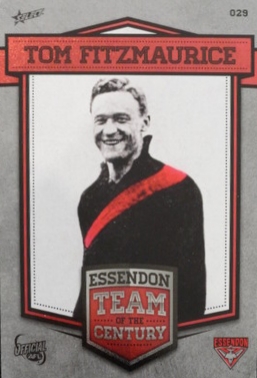
Thanking Essendon 140 Years Trading Card Collection, and North Melbourne Hall of Fame.
Both images are courtesy of Aussie Rules Collectables.
In 1924—at the age of 26—Tom Fitzmaurice left the Essendon club in a dramatic protest against some team-mates’ involvement in efforts to fix a championship match between Essendon and Footscray. He handed in his uniform after the match and vowed to never again play for Essendon. The following year he joined Geelong and in 1928 gained football distinction when he was appointed joint captain and coach—he is remembered for accepting the player/coach position on condition that the extra pay would be split among his team-mates. Between 1932 and 1935, Tom played with North Melbourne. There, he was captain-coach in the two years (1934–5) Gunditjmara man Alf Egan (whose mother was a Farrell) was in the team—Alf Egan was the first known Indigenous player at senior level for Carlton and North Melbourne.[24] In a long and diverse football career, Tom Fitzmaurice was never reported. He repeatedly won best and fairest awards. When in 1935 he relented in the matter of Essendon, club members voted overwhelmingly for him to join the Essendon Club’s board.
Tom Fitzmaurice was 18 and brand new at Essendon in September 1916 when his uncle the priest was given charge of the parish of Beaufort, near Killarney in Co. Kerry. A Melbourne Catholic newspaper advised Fr Edmond’s ‘many friends’ that the parish adjoined the Lakes of Killarney.[25] It was more relevant to the times that the parish’s northern boundary runs along the road west from Killarney town to Killorglin and its southern boundary extends into Ireland’s highest mountain range, a place of refuge through the centuries. It was febrile territory within and without these boundaries.
Even as ANZACS on furlough toured the area’s scenic sites, perhaps having played a part in quashing the Rising in Dublin, Killarney district people swept up in the Rising’s aftermath remained interned at Fron-goch in Wales.[26]There they played Gaelic football, the Kerry team captained by Killarney’s Dick Fitzgerald, who had led Kerry to back-to-back All-Ireland football titles in 1913 and 1914.[27] A good number of Beaufort men, along with Killarney men, had followed the GAA president’s 1914 advice that every member should join the Irish Volunteers and ‘learn to shoot straight’. No shots were fired in Beaufort—or elsewhere in Kerry—in Easter Week 1916, but violence escalated during the War of Independence.[28] In 1919 Beaufort’s police were evacuated and the village’s Royal Irish Constabulary Barracks were burnt to the ground. Then, when Civil War broke out in 1921, most of the local Volunteers turned Republican. Today, roadside headstones around Beaufort, including along that northern boundary, remind that the Civil War was more violent and prolonged in County Kerry than anywhere else in the country—and that more men died as IRA men than as members of the Free State National Army.[29]
When peace came, to be followed closely by the pain of the economic war with Britain, Fr Fitzmaurice was in his sixties. He ‘ruled’ (to quote a local national schoolteacher of the time) a parish where poverty and emigration deepened with the wartime diminution of tourism.[30] It seems that his Victorian sojourn played a part in enabling Australia to enter imaginations as an emigration destination, alongside England and America. (St Kilda Football Club owes its only premiership to Barry Breen, the son of an emigrant from Beaufort, and grandson of Kerry 1914 All-Ireland football champion Paddy Breen.)[31] One story he seems not to have told—his grandfather’s story of early nineteenth century convict life in the Hawkesbury region north of Sydney, a story that he and his older brothers had surely heard from the man himself.
In April 1808, Thomas Fitzmaurice of the townland of Ahabeg near Lixnaw was sentenced to seven years’ transportation to New South Wales.[32] He had been picked up in a campaign against Whiteboys—Lixnaw was long notorious for this agrarian secret society’s so-called outrages against tithe-farmers and -proctors and gun owners. The campaign had begun the previous December when Arthur Wellesley (later Duke of Wellington), Chief Secretary for Ireland, authorised a Lixnaw magistrate (a friend of his Eton youth) to offer inducements for ‘any information which shall tend to the conviction…of those disturbing the public peace’.[33] Thomas’ arrest followed soon after. Detailed records of his charging, trial, and April 1808 conviction in Kerry’s county town Tralee do not survive, but family tradition fills in some gaps. The family story is that Thomas was never a Whiteboy. Rather, he was referred to the authorities by a half-brother and tricked by a magistrate into signing a compromising document.[34] Thomas, a married man with an infant child, not only denied the charge—he refused to name any individuals present in the public house. The tradition is that he was variously forced to stand for hours hip deep in cold water and placed in the stocks, to no avail. A newspaper report shows that his sentence was, if anything, more ignominious—in addition to transportation, he was obliged to stand two hours in Tralee’s Market Square, head and arms bolted into the pillory, defenceless before insult and ridicule.[35] Then, in March 1809, with 138 other prisoners, he was loaded on to the West Indiaman turned convict transport Boyd. The Boyd’s owner, Boddington, a London merchant deeply embedded in the slave-based economy, had recently added convict transport to his profit model.[36] It was curious timing, and more than likely evidence of nifty Whig footwork, that for a few brief months from January 1807 Samuel Boddington represented Tralee at the Westminster Parliament. He was put in the 13-voters seat—controlled by Tralee’s largest landlord Sir Edward Denny—just as Parliament began to debate the prohibition of the slave trade. There he stayed until May when the Slave Trade Act became effective and Arthur Wellesley took his place.[37] The political footwork becomes less paradoxical with the knowledge that Boddington, a Whig himself, was to be among the top thirty mercantile awardees of slave compensation, receiving more than £30,000 in thirteen awards across Antigua, Jamaica, Nevis, St Kitts, and St Vincent.[38] It was an amount equivalent in purchasing power to that of more than three million pounds today.
By the time Thomas arrived in Darug Country—the Hawkesbury district north of Sydney —its people were suffering the cumulative effects of large-scale loss of traditional land and, with that, food and water sources. They had endured introduced disease, deadly conflict with settlers, and colonial military intervention. Pemulwuy, the famed Bidjigal clan Darug warrior leader, had been shot dead and his body desecrated.[39] At one point the Governor had authorised the shooting on sight of any Aboriginal person in an area immediately south of the district to which Thomas was assigned. Thomas’ convict status made him an involuntary agent in the ensuing consolidation of British settlement, but the family story, as it has survived, elides these convict years. It picks him up on the eve of renewal and expansion of frontier war, when Darug, Darawal, and Gandangara, whose Countries encircled Sydney, consolidated their much-diminished forces to launch a new phase of resistance. It is 1814 and Thomas, his sentence completed, is standing on Sydney’s dock, a free man; his eyes are on a vessel about to set sail for England; he strikes a deal and takes passage as the ship butcher. Then, probably in 1815, he reaches the town of Tralee. Someone recognises him, grabs his hat from his head, and runs brandishing it through the streets shouting ‘Sé seo hata Thomáis Mac Muiris’.
Thomas’ wife may not have lived to greet him at home in Lixnaw—she died at an unknown date around the time of his return—and his second and third marriages were similarly foreshortened: an undeclared thread in this story is the suffering of women and children, Aboriginal and Irish, in contexts of violence, poverty, maternal health stressors, and endemic disease. Worse was to come. The post-1815 peace rendered many soldiers and agricultural labourers alike redundant. Wellington’s Peninsular War officers would disperse to make their imperially minded, battle-honed, and Protestant sensibilities felt in New South Wales and in Ireland.[40] In Kerry, a new season of agrarian unrest, Whiteboy activity, and martial law would unfold in response to economic distress, episodic famine, and the re-assigning of land use by landlords. And beyond all that, there would yet be the Great Famine. Thomas Fitzmaurice was reportedly 98 when he died in in 1868. His grandson, the future priest, was eight.

“Shared history” does not seem to quite cut it as an account of the viscerally experienced and mutually (Aboriginal and Irish) constructing interactions that are the stuff of this story—including its sporting strands. Nor does reference to their British colonial/imperial context get at just how densely woven, penetrating, and determining—as well as framing—that context was. Mícheál Ó Muircheartaigh, I like to think, would have enjoyed finding the words for the story’s long puck of history. He would have paid dues to the Essendon Football Club’s celebration of Tom Fitzmaurice as ‘one of [its] greatest…players of all time’.[41] And he would have relished the range of possible meanings in that shouted news of an encounter with a hat in the street in Tralee.
Margaret Coffey
Margaret has had a long career as a broadcaster with the Australian Broadcasting Corporation’s Radio National. Her 2024 Monash University PhD thesis connected Irish colonial experience to settler invasion and the founding of the Port Phillip District colony, centring and complicating connections via the interwoven lives and histories of selected individuals in Ireland, in the new colony, and on other imperial terrains.
[1] ‘Micheál Ó Muircheartaigh Was the “High King” of Irish Broadcasting, Funeral Hears’, Irish Times, 29 June 2024,https://www.irishtimes.com/ireland/2024/06/29/micheal-o-muircheartaigh-was-the-high-king-of-irish-broadcasting-funeral-hears/; ‘All Ireland Football Final Dublin v Donegal’, audio, RTÉ Archives, https://www.rte.ie/archives/exhibitions/1411-radio-sports-commentary/1454-micheal-o-muircheartaigh/365777-annals-of-the-four-masters/; John O’Donovan, trans., Annala Rioghachta Eireann: Annals of the Kingdom of Ireland, by the Four Masters, from the Earliest Period to the Year 1616, 2nd ed., 7 vols (Dublin: Royal Irish Academy, 1856).
[2] ‘Focal Ón bPríomhoide’, Pobalscoil Chorca Dhuibhne, https://pcd07.ie/focal-on-bpriomhoide/.
[3] John O’Mahony, ‘Eamonn Takes over as School Principal’, KillarneyToday.com (blog), 12 June 2018,https://www.killarneytoday.com/eamonn-takes-school-principal/.
[4] Conor Neville, ‘O’Connor: Armagh Crowd a Big Factor in the Game’, Radio Telefis Eireann, 13 July 2024,https://www.rte.ie/sport/football/2024/0713/1459759-oconnor-armagh-crowd-a-huge-factor-in-the-game/.
[5] ‘Unforgettable Characters In Football’, Sporting Globe, 6 September 1941, 5. http://nla.gov.au/nla.news-article181712241.
[6] John Grenham, ‘Fitzmaurice – Fitzmaurice Households in Mid-Nineteenth Century Ireland’, Irish Ancestors, https://www.johngrenham.com/findasurname.php?surname=Fitzmaurice.
[7] ‘Hair Hurling Balls’, National Museum of Ireland, https://www.museum.ie/en-IE/Museums/Country-Life/Exhibitions/Previous-Exhibitions/Hair-Hurling-Balls.
[8] ‘Ballyduff GAA Club | Founded in 1887’, http://ballyduffgaa.com/; ‘Hurling Match – Ballyduff vs Lixnaw Again’, Kerry Weekly Reporter, 1 May 1897.
[9] ‘The Lying in State’, Freeman’s Journal, 12 October 1891.
[10] Ned Flanagan, ‘The Ballyduff Hurling Team’, in The Schools’ Collection (University College Dublin: dúchas.ie), Volume 0415, p 061-2,https://www.duchas.ie/en/cbes/4666608/4666366.
[11] Three brothers – Patrick, Edmond, William – were alive in Australia in 1891. Thomas, the eldest child of the family, who emigrated in 1875, died in Queensland in 1889.
[12] Aboriginal Languages of Victoria Map (Victorian Aboriginal Corporation for Languages, 2016), http://www.vaclang.org.au/item/aboriginal-languages-of-victoria.html.
[13] ‘Our History’, Coranderrk – Wandoon Estate Aboriginal Corporation, https://www.coranderrk.com/our-history.
[14] Michael Davitt, Life and Progress in Australasia (London: Methuen & Co, 1898), 39, 38.
[15] Ibid., 36; ‘Diocese of Ballarat’, Advocate, 28 April 1894.
[16] Wollondilly, ‘Bowning Hill’, in St Patrick’s College Annual (Ballarat, 1900), 15–18,19.
[17] Frank Bongiorno, ‘Bernard O’Dowd’s Socialism’, Labour History, no. 77 (1999): 97–116, 100.
[18]‘News in Brief’, Colac Herald, 10 April 1894.
[19] ‘Diocese of Ballarat’, Advocate, 20 August 1887.
[20] ‘Diocese of Ballarat’, Advocate, 27 June 1896. The Hibernian Australasian Catholic Benefit Society was known colloquially as the Hibernians.
[21] ‘Michael Davitt’, Ballarat Star, 5 June 1895.
[22] ‘To the Editor of the Advocate’, Advocate, 27 July 1895.
[23] ‘Unforgettable Characters In Football’, Sporting Globe, 6 September 1941, http://nla.gov.au/nla.news-article181712241; Pete Diggins, ‘Comunn Na Feinne’, 9 December 2017, https://comunnnafeinne.wordpress.com/.
[24] Tony De Bolfo, ‘John Finds His Father on a Sentimental Carlton Journey’, carltonfc.com.au, 23 March 2023, https://www.carltonfc.com.au/news/1288809/john-finds-his-father-on-a-sentimental-carlton-journey.
[25] Advocate, 28 April 1917.
[26] See: Jeff Kildea, Anzacs and Ireland (Sydney: UNSW Press, 2007).
[27] https://www.historyireland.com/countdown-to-2016-sport-in-frongoch/; https://ggcb.org.uk/events/frongoch/; https://www.dib.ie/biography/fitzgerald-richard-dick-dickeen-a3187. The Killarney GAA stadium is named after Dick Fitzgerald.
[28] https://www.ucc.ie/en/theirishrevolution/collections/the-story-of-1916/chapter-4-the-uprising-itself/the-only-shots-fired-in-kerry-in-1916/https://www.beaufort-parish.com/the-tan-war-and-the-civil-war/ ; https://owenoshea.ie/the-war-of-independence-in-kerry-the-dracula-connection/
[29] https://www.ucc.ie/en/theirishrevolution/irish-civil-war-fatalities-project/research-findings/
[30] Pete Coghlan, ‘TUOGH’, Beaufort (blog), 6 August 2014, https://www.beaufort-parish.com/tuogh/.
[31] The Complete Handbook of Gaelic Games (Blackrock, Co. Dublin: DBA Publications Limited, 2021), 159.
[32] ‘FITZMAURICE Thomas’, Convicts Index 1791-1873, [4/4427; COD18, Reel 601 page 404; Entry No: 14/48], NSW State Archives & Records.
[33] Arthur Wellesley, ‘To William Ponsonby, Esq., 17 December 1807’, in Civil Correspondence and Memoranda (London: John Murray, 1860), 232-233.
[34] Personal communication from the late Eamonn Fitzmaurice senior, Lixnaw, 26 July 2016.
[35] ‘The General Advertiser’, Limerick Gazette, 26 April 1808,4.
[36] ‘Details of Firm – Boddington & Co.’, in Legacies of British Slavery (University College London, n.d.).
https://www.ucl.ac.uk/lbs/firm/view/-1616666440.
[37] P. J. Jupp, ‘Tralee’, History of Parliament Online, https://www.historyofparliamentonline.org/volume/1790-1820/constituencies/tralee. The Act to end the trans-Atlantic trade in slaves took effect on 1 May 1807. Sir Arthur Wellesley replaced Boddington on 17 May.
[38] ‘Samuel Boddington, Profile & Legacies Summary, 19th Jun 1766 – 19th Apr 1843’, in Legacies of British Slavery (University College London, n.d.).
[39] J. L. Kohen, ‘Pemulwuy (1750–1802)’, in Australian Dictionary of Biography (Canberra: National Centre of Biography, Australian National University), https://adb.anu.edu.au/biography/pemulwuy-13147; National Museum of Australia, ‘Pemulwuy’ (National Museum of Australia), https://www.nma.gov.au/defining-moments/resources/pemulwuy. At the instruction of the then Governor, Pemulwuy’s head was cut off and sent to naturalist and botanist Joseph Banks.
[40] See, for example: Christine Wright, Wellington’s Men in Australia – Peninsular War Veterans and the Making of Empire c. 1820-1840(United Kingdom: Palgrave Macmillan, 2011).
[41] ‘Tom Fitzmaurice’, essendonfc.com.au, https://www.essendonfc.com.au/club/history/champions-of-essendon/tom-fitzmaurice.
Acknowledgements: Col Hutchinson, AFL Statistics & History Consultant, and Barb Cullen, Secretary of the Australian Football Heritage Group.
 Tinteán