A Music Feature by Felix Meagher

Accompanied by my other half, Christine, and Vince and Margie Brophy, I attended days 2, 3 and 4 of the 52nd Willie Clancy School, Miltown Malbay, County Clare, Ireland July 6-14 2024. With a fiddle on my back, the lady behind the counter at a chemist in Ennistymon asked me, ‘Are you here for Willie Week?’ ‘Yes, I think I am,’ I hesitantly replied.
That’s how I found out how the school is referred to by the locals. Not unlike an event closer to home in Australia, the Port Fairy Folk Festival is called “The Folky.”
The Willie Clancy school, created in remembrance of the Irish musician and uilleann piper, Willie Clancy, is a week-long school of classes, workshops and concerts teaching and demonstrating the traditional music and arts of Ireland. Milton Malbay is a village in West Clare situated on the coast, with views of the Atlantic Ocean.
Having been Program Director of Lake School, Koroit, in the South West of Victoria, for its first 25 years, and having modelled the event on Willie Clancy without having ever attended, I was keen to observe the similarities and differences and the kinds of things we had gotten right or wrong. Happily, I can say that the Willie Clancy School is everything I dreamed and hoped it could be. For its attendees, it was clearly a profound and deep learning experience. It was charming, it was chaotic and it was inspiring.
For the benefit of the South West Victorian festival goer, Willie Clancy is like a combination of Lake School, Koroit Irish Festival (KIF) and Port Fairy Folk Festival (PFFF) rolled into one. It has 1500 students, five times the number of Lake School students. It’s like the Koroit Irish Festival in its energy on the street. It’s probably about twice the size, in terms of attendance, of the KIF, but similar in that people come from everywhere for the heritage, the craic and the drink. It’s probably about half to a third the size of the PFFF, but like it, in that it has great concerts and recitals, and a large audience that comes to watch and ‘soak it up’ as well as those who have come to learn or play. Many of the Willie Clancy concerts demonstrate and reflect the differing regional musical and dance styles in Ireland, a subtlety that was something new to me as an Australian.

Stepping into the street in Milton Malbay, one of the first things that occurred to me was how alike Miltown Malbay and Koroit are. Both are situated a few kilometres from the ocean, and have a main street with heritage buildings. Miltown, I was told has eleven pubs, although it feels like more, down from about 25 a few years ago. Unlike the wide streets of Koroit, however, space is at a premium. In Miltown people are crowded into every corner: the roads are extremely narrow and clogged with traffic jams. Near misses on the street happen about every minute, and the drivers are both reckless with their speed and yet conspicuously polite. One of the delights of the street was the large numbers of young children busking. Groups of young girls playing a sophisticated reel – ‘Speed The Plough’, ranging to what looked like a five-year-old boy playing ‘Bog Down In The Valley’ on a scratchy fiddle. Families gathered around the Willie Clancy statue, one girl with her Dad playing ‘O’Keeffe’s Slide’ at her first Willie Clancy, on the other side of the statue adoring parents applauding a two-year-old blonde boy strumming a ukulele upwards. While we didn’t get into a camping ground, the lack of trees and shade, and the long lines of caravans made me wonder if the camping at Willie Clancy was filled with the magic of Lake School days and nights at the Koroit Botanical Gardens.
Down at the St Joseph’s Secondary College at Spanish Point, a venue almost entirely devoted to fiddles, we really started to feel a parallel experience to Lake School. The sun was out and busy parents were hurriedly dropping off kids for their lessons. In one room Siobhan Peoples was leading a group of 26 young intermediate fiddlers. Daughter of a legend – a commanding, though diminutive, presence, brooking not a moment’s hesitation, she led her charges relentlessly repeating the tunes without a break. In another room, an advanced class, a student wanted to go over the previous day’s tunes, but the tutor said, ‘No, there isn’t time.’ Unlike Lake School, classes at Willie Clancy run only in the mornings -10am to 1pm. One amazing event was called ‘The House of Lords’, where old fiddlers swapped stories and tunes… Memories of sets played in the Kilfenora Ceili Band, and tunes being learnt by ear from old 78s on the gramophone… Meanwhile images of legends like Junior Crehan were being flashed up on a screen. It was a class worth travelling around the world to see and was interrupted by something just as remarkable – organisers hurrying everyone outside for the fiddlers’ photo. We stood with them 400-strong. The photographer directed (as politely as possible) students where to stand, just like Lake School. Unlike Lake School, a drone hovered up above, capturing images.
The lack of space leads to some creative venue programming at Willie Clancy. Possibly the most unique was the little village of demountable units in a small privately owned caravan park, with classes of concertinas in each. We stopped to watch a young female tutor teaching a group of young girls ‘The Hag At The Churn’. Like Lake School, the kids were playing and talking over the teacher, but the learning was definitely going in. The one boy in the class, about 8 years old, asked what the time was. His face fell when he was told it was 12.10pm, another 50 minutes to go.
We dropped into a set dance class led by Martin Hughes, from Mayo. It was very reminiscent of Marie Brouder’s classes at Koroit. Lots of fun, humour and the craic. They danced some Clare Sets, which I hadn’t seen before. We also passed by a sean nos dance class, which had a good crowd.
Willie Clancy is dominated by fiddles, uilleann pipes and concertinas. Flutes, whistles, harps, banjos and singers are there to a lesser extent, but Willie Clancy doesn’t appear to have the cellos, guitars, DADGAD, mandolins, songwriting and poetry that Lake School has. Cellos, which are a real feature at Lake School… I don’t recall seeing one in Miltown.
The sessions at Willie Clancy are everywhere. Pass any pub, restaurant and bookshop and there is a high quality session in progress. Fellow Kiwi/Aussie, Jamie Molloy, reported sitting next to Jackie Daly and playing great tunes for ten hours. While it’s hard to get into a session, either to watch or play in the crammed corners the sessions are situated, the space appears to expand for the many big personalities. We were fortunate to meet Seamus Bugler, a man from the same area of East Clare as our Australian Irish music legends Joe and the late Paddy Fitzgerald, and a man after their own hearts in his musicality and generosity of spirit.

Music lessons and sessions are also held in numerous private houses. We spent a lovely evening with Fintan Vallely (of The Companion to Irish Music fame) and author, Evelyn Conlon and family. It was an evening in the old style, sitting around the kitchen table, sharing tunes, songs and stories. We bumped into them at a book launch, and remembered them, and they us, from one of their visits to Australia, our loud Aussie accents instantly identifying us. The book and CD launches are a real feature of Willie Clancy and the literary culture in Ireland is very present and alive. Bookshops everywhere.
To the casual observer the economy in Ireland looks to be booming. The food, almost all of it locally grown and produced, is amazing. Funky cafes and art galleries, buildings painted in bright colours, are replacing drab older facades. From the road, the houses look large and very well kept. One musician commented that previously poor countries like Ireland and Spain are getting a real economic bounce from the EU, while England and Scotland since Brexit are struggling.
Like Australians, the Irish are truly sports-mad. Unlike Australians their arts and music sit comfortably next to, and in equal high regard to their sport. We watched a group of musicians playing ‘The Bucks of Oranmore’ in a session, eyes glued to the Cork/Limerick hurling semi-final. Cork won by two points. Throughout the county, the yellow and blue Clare flags, their team colours, decorated nearly every residence.
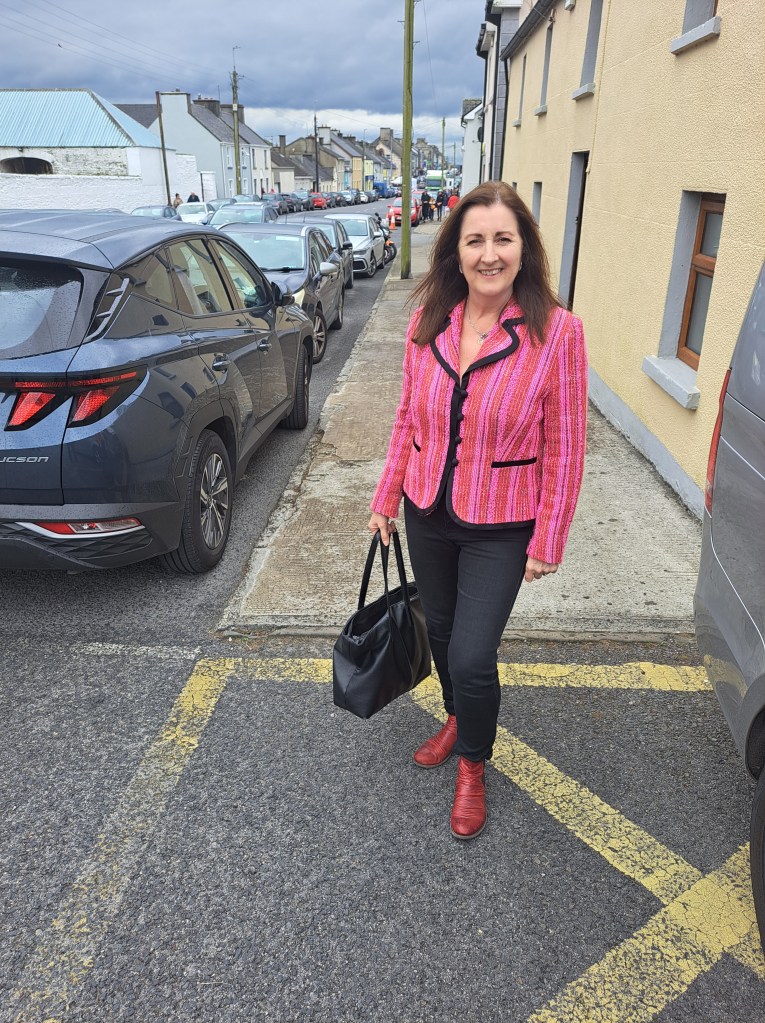
I was happy and proud to observe that Willie Clancy, like Lake School, carries itself with an absolute lack of pretentiousness. There was visibly room for the most celebrated, like Martin Hayes, to the complete beginner, the oldest, the youngest and all in between. People were unfailingly warm and courteous, and curious to hear our story. In the space of a few hours, we were interviewed by Clare FM radio and RTE television. Like Lake School, Willie Clancy is very well (and harmoniously) organised by a small committee. The Director of the school, Harry Hughes, made us welcome and showed us around, as did the Fiddle Co-ordinator, John Kelly. Harry Hughes also paid us the compliment of referring to Lake School as ‘Our Sister School’.
All in all, attending Willie Clancy was both an enthralling and exciting time, and we are keen to get back there next year. In the meantime, I look forward to returning to Koroit for the 26th Lake School, January 2-7 2025.
Felix Meagher
Felix is a stalwart of the Irish-Australian music scene. Classically trained, he has made a career in traditional Irish music. He is the founder of Lake School, an annual weeklong music workshop for all ages, but especially the young, and he has contributed to the Port Fairy Folk Festival for decades. He is the author and composer of several musical plays, Barry vs Kelly, which tells the story of Ned’s trial, The Man They Call the Banjo (the story of Waltzing Matilda), Adventure before Dementia (a celebration of the life in music of Lou Hesterman) and Runaway Priest (an upbeat musical about clerical abuse and survival).
 Tinteán