A Book Review by Felix Meagher
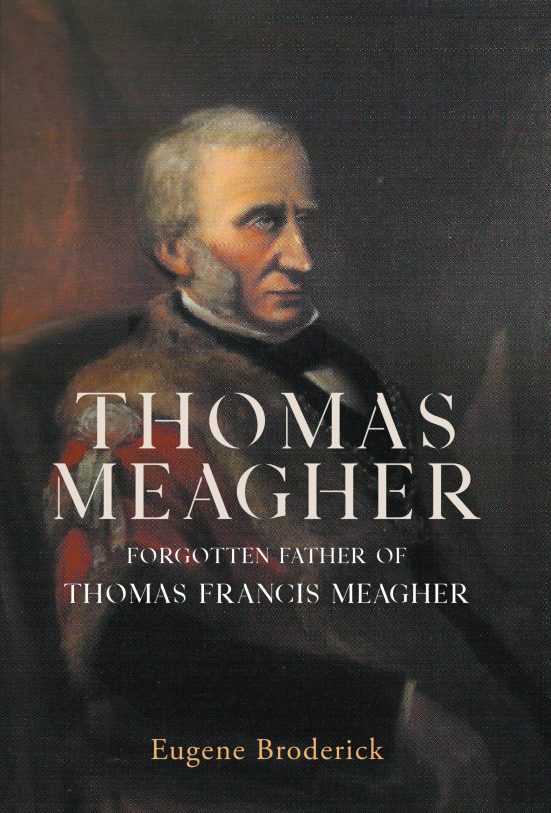
Eugene Broderick: Thomas Meagher, Forgotten Father of Thomas Francis Meagher, Irish Academic Press, Dublin, 2022.
RRP: €29.95
ISBN: 9781788552196
Thomas Meagher, Forgotten Father of Thomas Francis Meagher by Eugene Broderick, published by Irish Academic Press 2022, is meticulously researched and referenced. It is a finely crafted, carefully woven, sympathetic portrait of a Waterford politician and philanthropist who on history’s page lives in the shadow of his dashing and revolutionary son. Quite unlike his son, the ‘Young Irelander‘ who survived a death sentence, exile, and escape from Tasmania to become an American civil war hero, Thomas Meagher’s achievements reflect a steady, sober and consistent approach to the challenges thrown up by the turmoil and tempest of a public life in Ireland 1819-1874.
The author, Dr Eugene Broderick, is well-credentialled. A Waterford resident, he is the author of numerous books and publications including, John Hearne: Architect of the 1937 Constitution of Ireland. He is an advisor to The Waterford Museum of Treasures and is a Fellow of The Royal Historical Society.
Thomas Meagher’s was an era that included the rise and fall of the career of Daniel O’Connell, the Catholic Emancipation Act of 1829, the 1848 revolution overthrowing King Louis Phillipe and the founding of the Second Republic in France, the 1848 Rising in Ireland, and The Great Hunger – the Irish famine of 1845-1849. During the 1840s, Meagher served as the first Catholic Mayor of Waterford in almost a millennium and then as a member of the British Parliament until 1857. The back leaf of the book features a quote from Daniel O’Connell, ‘Thomas Meagher, one of the best men that ever lived.‘
Meagher was born in Newfoundland in about 1789 and inherited a business and considerable wealth from his father, also Thomas, who had emigrated from Tipperary and had made a fortune trading cod to Waterford. Meagher eventually settled in Waterford in 1819, and throughout his life continued the liberal politics and philanthropic works which first found expression in his work with the Irish Benevolent Society in Newfoundland.
Broderick details Meagher’s liberal and constitutionalist approach on several issues – the formation and dissolution of the Catholic Association 1823-1825, the ‘Catholic Rent’, the campaigns for The Repeal of the Union and Catholic Emancipation, municipal reform and the works of the Waterford Corporation, famine relief, the Poor Laws, the Fever Hospital, various battles for the independence and equality of Catholic education, the Tenancy League and laws, as well as loyalty to independent opposition in parliament. Meagher is portrayed as a devout Catholic, a staunch supporter of his church, and of Daniel O’Connell’s non–violent approach to The British and Protestant Ascendancy’s many strategies in denying Irish and Catholic independence and equality.
The failure of The Repeal of The Union campaign, the outlawing of the Clontarf ‘Monster Meeting‘ of 8 October 1843, and the arrest and gaoling of Daniel O’Connell on top of the extraordinary hardship in the wake of the famine led to a crisis of leadership for ‘Old Ireland,‘ and the emergence of the radical policies of the Young Ireland, movement and an Irish Confederation. The Young Irelanders first found expression through the poetry and journalism of Thomas Davis published in The Nation newspaper. Joining the Young Irelanders with enthusiasm and flair was the son of Thomas Meagher, Thomas Francis Meagher, who rose to notoriety and fame as an orator with his ‘Meagher of the Sword‘ speech of July 28 1846.
I do not disdain the use of arms as immoral,… nor believe that the God of Heaven withholds his sanction from the use of arms…Be it for defence or be it for the assertion of a nation’s liberty, I look upon the sword as a sacred weapon….
Thomas Francis’ abandonment of the ‘Old Ireland’ policies of O’Connell inevitably led to a division with his father. Broderick laments the lack of primary sources describing how the father and son dealt with these matters, but paints a credible picture of them both maintaining love and respect for each other. Meagher Snr supported his son emotionally and financially even when Thomas Francis ignored his guidance and advice. One notable case was Meagher Snr paying for expenses associated with a failed escape by Young Irelander leader, William Smith O’Brien, from custody in Tasmania. Broderick generates a good deal of empathy for Meagher, the father, in his description of Thomas Francis being arrested and taken from the family home in July 1848.
A contemporary relevance that strikes the reader, in the context of the current climate of 2024 challenges to democracy, is the patience of Old Irelanders, how hard-won their reforms were, and how bitterly the government resisted their calls for change. Thomas Francis himself admitted how ineffective the failed 1848 rising was, and it may be true to say that it put the cause of reform back. Broderick demonstrates on a number of issues that O’Connell and Meagher campaigned for, that the struggle for Irish equality and independence paid the price for the lack of a unified front, and an inability to compromise. While Thomas Francis became an inspiration to many, and is credited with creating the Irish tri-colour flag, it is possible that his father, with a ‘slow and steady wins the race’ approach contributed as much and maybe more to the causes they shared.
It says something about our collective love of celebrity, chaos and flashy headlines that Broderick and or the publisher felt compelled to go with the subtitle, ‘Forgotten Father of Thomas Francis Meagher‘, which at first sight seems a touch apologetic. There is no doubt, however, that the life and times of the father is a history worth telling, and the book is a valuable contribution to our understanding of nineteenth-century Irish history and politics. The lack of source material about the relationship of father and son also entices the reader into thinking how a historical fiction about the ‘Constitutionalist Father and Revolutionary Son’ might be a compelling tale for a film or TV series.
Broderick concludes with an Epilogue titled – Thomas Meagher: A Life Considered,
Thomas Meagher lived during a time of great economic, social and political change. He sought to influence that change by active political involvement, especially as the Mayor of Waterford and the city’s national MP for ten years…His years of public service were characterised by integrity, honesty and loyalty…
Felix Meagher
Felix is stalwart of the Irish-Australian music scene. Classically trained, he has made a career in traditional Irish music. He is the founder of Lake School, an annual weeklong music workshop for all ages, but especially the young, and he has contributed to the Port Fairy Folk Festival for decades. He is the author and composer of several musical plays, Barry vs Kelly, which tells the story of Ned’s trial, The Man They Call the Banjo (the story of Waltzing Matilda), Adventure before Dementia (a celebration of the life in music of Lou Hesterman) and Runaway Priest (an upbeat musical about clerical abuse and survival).
 Tinteán