Catherine Joyce (c1831 – 1893) and Honor (Ann) Solen (c1832 – 1920)
A Feature on two Earl Grey Orphans by Lyn-Sharon Nash

In 1923, when my grandparents wanted to marry, there was concern that they may have been second cousins: in exploring their families’ backgrounds, the lore of each family described how one of their grandmothers had arrived with their sister from the west of Ireland as an orphan escaping The Great Famine.
It was only in 2017, when my cousin, Jenny Chester, and Iwere researching our shared family history that we realised that the girls were not sisters by blood, but of the heart. They had arrived aboard the Panama, two of 26 girls from the Ballinrobe Workhouse, Co Mayo, as part of the Earl Grey Scheme. Their experiences of The Famine, the Workhouse and the perilous journey from the west of Ireland to the other side of the world had formed an unbreakable bond.

A new book, Remembrance, describes how the agent for the Earl Grey Scheme, Lieutenant Henry of the Royal Navy, visited Ballinrobe Workhouse in August 1849 and selected girls who were ‘of good appearance and seemingly upright character’ and who were anxious to ‘rescue themselves from a state of pauperism and dependence’. The girls were outfitted by the Poor Union with a trunk containing new clothes, a warm coat and shawl, and, possibly for the first time in their lives, shoes and underwear.
The girls journeyed to Dublin where they boarded a steamer for a two-day voyage across the Irish Sea to Plymouth Harbour. There, in the newly refurbished Elphinstone Emigration Depot, their papers were inspected and their health checked, including vaccination against small pox. The three-masted barque, the Panama, departed Plymouth with a total of 165 orphan girls from across Ireland. They were divided into messes of eight based on friendship and familiarity, with possibly Catherine and Ann together and supporting each other throughout the journey. The provisions on board were very different to those provided in the Workhouse and included meats, peas, rice, sugar and butter.
The Panama made the journey without stop and sailed into Sydney on 12 January 1850. It was a typical summer’s day of 24.5 deg C, with humidity and thunderstorms.
Catherine Joyce was a 19-year-old house servant from Cong. Honor Solen, known also as Ann, from Hallimount, now Hollymount, was an 18 years old nursemaid. Her story has been researched by her great great great granddaughter, Pam Osmond.
Both girls were orphans and could neither read or write. Once they arrived into Sydney, they served their 12 months’ indenture, working for eight pounds per year: Catherine for Reverend Joseph Oram and Ann for Christopher Martin. After that, there is no reason to believe that the young women were ever in contact again. Catherine lived the rest of her life on the edges of colonial expansion and Ann lived in The Rocks in Sydney, except for a brief foray into the goldfields of Victoria.
By 1 October 1851, Catherine was in Clare, South Australia, about 2000 km from Sydney around the coast of southern Australia. There she married Robert John Stuart Robinson. Her first daughter, Anastasia, was born six weeks later and was baptised at St Mary’s of the Angels Church in Port Lincoln, about 350 km from Clare. The journey of Catherine and her family through the gold fields of Victoria and beyond can be tracked by the baptisms of her babies and by the misdeeds of her husband as reported in newspapers. BabiesCharles Edward and Catherine Stewart were born near Moliagul, in Victoria, near where the world-famous Welcome Stranger gold nugget was found in 1869.
Catherine’s husband, Robert John, purported to be a ‘legally qualified medical practitioner’, although no record of his qualifications have been found. In 1858, a patient died under his care, however, he narrowly escaped prosecution. The family moved on and another daughter, Agnes Helena, was born in 1861 in western NSW. Marea Stuart was born in February 1864 near Goondiwindi, in Queensland, almost 800 km north west of Sydney. Marea never married and became a prominent social worker who campaigned for the five-day working week and the abolition of capital punishment and against the introduction of conscription in World War I.
Newspapers reported that Doctor Robinson was remanded in Warialda for passing valueless cheques and for obtaining goods under false pretences. Again he was released without charge.
The family moved to Burwood in Sydney, when another warrant was issued. Robert JS Robertson was described as ‘50 years of age, 5 feet 9 inches (175 cm) high, dark complexion, fair curly hair, blue eyes, slightly pockpitted, sometimes wears a slight moustache parted in the centre; calls himself a Doctor’. Catherine was ‘low and stout, dark complexion, eyes and hair’. The couple ‘had with them three girls, aged respectively 3, 7, and 13 years, a boy 10 years of age, and a baby’. They were charged with assaulting and beating a former servant, Maria. Maria did not appear in court and sothe charges were dismissed.
Robert James was born in September 1866 in Booligal in the Riverina region, over 700 km south west of Sydney. Robert James went on to be a member of the Labor party and of the NSW Legislative Assembly for over 25 years.
In December 1868, it was widely reported that Dr Robinson and three of his children had died of thirst en route from the Lachlan River to the Darling River in western NSW. The bodies of Catherine and of Anastasia were not located. These reports could not be substantiated and it appeared that Robert John may have faked his own death and deserted Catherine and his family.
The Doctor married Elizabeth Hardy in October 1873 and was subsequently convicted of bigamy, as he was still legally married to Catherine. He served two years in Darlinghurst Gaol and died in July 1899 in the George Street Asylum, Parramatta, in Sydney.
Meanwhile, Catherine lived at Trunkey Creek, south of Bathurst and Orange. Catherine’s eldest daughter, my great great grandmother Anastasia, married John Joseph O’Brien in Orange in July 1876. John Joseph was the son of the assisted immigrants, John Bryan (aka O’Brien) of Wexford and Mary, nee Sharkey of Liverpool, England. John Joseph was a brickmaker, and the family moved to Bourke in about 1876-77. At the time, Bourke, in western NSW, was being established, with bricks needed for the new buildings such as the hotels, churches, the court house and post office.
The younger children of Catherine received some education in Bourke, however, her eldest daughter, Anastasia, was illiterate and signed her marriage registration with her mark, X.

Catherine died in Bourke on 5 March 1893 at the age of 58 of uterine cancer. Her son, Robert James, had a headstone placed on her grave.
Ann Solen, on the other hand, married my great great grandfather, Thomas Chester, in St Mary’s Cathedral inSydney in August 1851. Thomas was born in Dover, Kent, in England in 1826, and his obituary claimed that he arrived in Melbourne in 1849. Their first child was Lucy, born in July 1852, while the family lived in Kent Street in The Rocks area of Sydney, near the harbour. Their next child Ann was born in 1854 and baptised in Castlemaine on the Victorian goldfields. At the time, Catherine and Robert John Stuart Robinson were about 70 km away. Both young women were illiterate and there is nothing to suggest that their husbands would have facilitated any communication between them. The rugged and primitive conditions on the goldfields at the time would have made any contact improbable.
Another child, Louisa, was born on the goldfields in April 1855, and she died aged 12 months in Kent Street, Sydney. A further three children, Charlotte, Sarah and Helen, were born there between 1855 and 1860, with baby Ann dying.
By 1864, Thomas and Ann had five children in a four-roomed house, with William born in 1862. Thomas died shortly after his birth in 1864. Another child, Ann, known as Annie, was born in 1865. The family moved to a larger two-storey house at 7 Princes Street, which had seven rooms, by 1867. Their last child, Mary Gertrude, known as Minnie, was born there in 1869.
Thomas had a very successful career as a stevedore. By about 1870, the marriage of Ann and Thomas was breaking down and he began a relationship with 21-year-old Emma Wigginton (aka Allen and Hill). Thomas set up another household with Emma at 4 Princes Street, and between 1872 and 1877, they had four children together, including my great grandfather.
By 1871, Thomas owned a property at 2 Kent Street and other ‘off Kent St’ properties. When Ann and Thomas separated, he transferred these properties into Ann’s name. Unfortunately, a series of newspaper advertisements suggest that Thomas re-considered the transfer and attempted to sell the property without Ann’s knowledge and against her wishes. The tumultuous relationship between Ann, Emma and Thomas can be traced in newspaper reports, for example, with Ann charged with assaulting Emma in 1873, and with the death announcements for daughter, Sarah, and son, William, both of whom died of tuberculosis.
Ann and some of her married children lived in the Kent Street properties from about 1877. Ann continued to assert her place as Thomas’ wife by placing an advertisement in the newspaper in August 1901 in celebration of her and Thomas’ Golden Wedding anniversary.
Thomas resided at 4 Princes Street with Emma until his death on 16 December 1901 at the age of 75 years. Emma was the sole beneficiary of Thomas’ will; however, Ann’s legal right as a ‘tenant for life’ of the Kent Street properties was recognised by the NSW Government when it awarded compensation to her for the resumption of the properties on 29 December 1900. The buildings were finally demolished in 1907 to make way for the Argyle Cut upgrade and the approaches to Darling Harbour. The properties are now under the footprint of the southern pylon of the iconic Sydney Harbour Bridge.
After about 1907, Ann moved with her daughter Annie and son-in-law into a newly built terrace at 3 Windmill Street in The Rocks. She died there of bronchitis in 1920, aged 91.
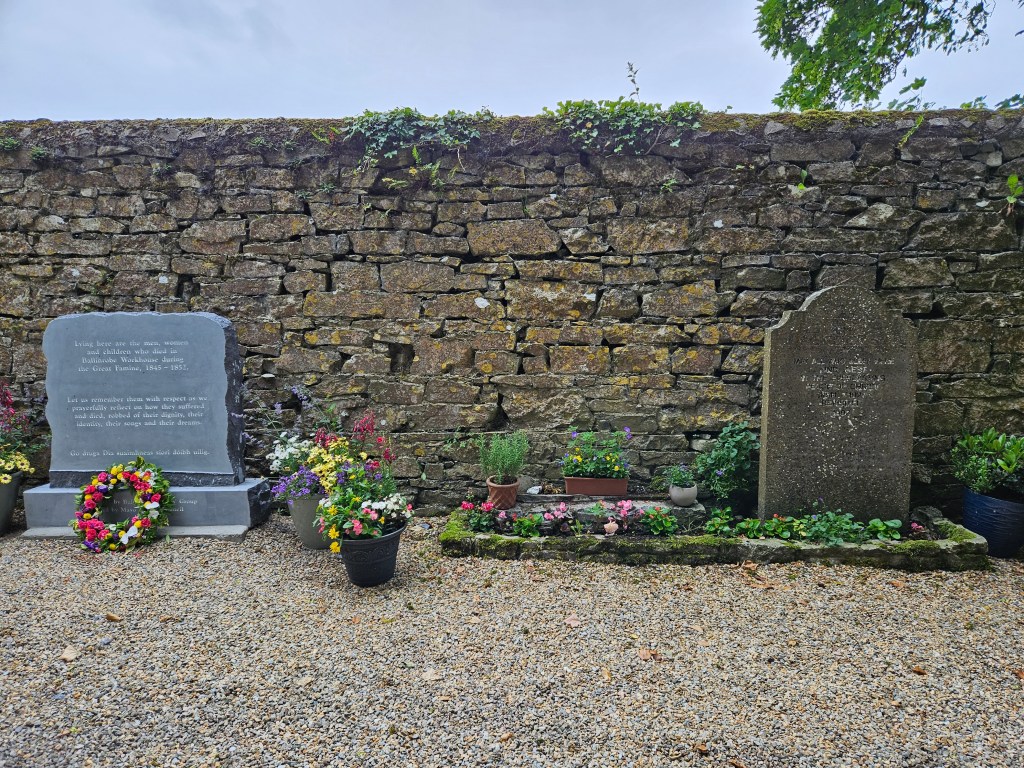
In June 2023, I was thrilled to journey from Sydney to Ballinrobe in Co Mayo, to visit the Workhouse where Catherine and Ann made the momentous decision to take a chance of a better life in Australia. As I travelled from Dublin towards Ballinrobe by Irish Rail, I marvelled at the verdant pastures with white sheep in soft sunlight. I wondered how Catherine and Ann felt in their new sunburnt country,with sheep stained red by the dirt, the smell of eucalyptus, the arc of hard blue sky and of the blaze of stars at night. And snakes.
At Ballinrobe, I met with Averil Staunton, historian, and The Ballinrobe Active Retirement Writers Group. They have just released Remembrance – Ballinrobe Workhouse (ISBN 9798851538346, available on Amazon): ‘creative stories woven into the history of the Ballinrobe Workhouse, Co Mayo’. The book links recent research on the BallinrobeWorkhouse, its history, layout and operation with deeply moving reflections by the Writers Group on the lives of the paupers who died at the Workhouse, and of the girls who survived as part of the Earl Grey Scheme.
At a gathering in the Ballinrobe Library, I was pleased to present a copy of the stories of Catherine and Ann to Mayo County Library. I was honoured to receive hand-made bonnets, similar to those worn by Catherine and Ann in the Workhouse.

A substantial part of the workhouse was sadly destroyed in the 1922 Civil War. Nevertheless, I was able to touch the cold stones of the reception area where Catherine would have been bathed, deloused and dressed in the rough workhouse uniform. I visited the nearby communal burial ground, now with a poignant Memorial Corner.
It was a privilege to be able to be able to reassure those present that both Catherine and Ann lived a full, eventful and fruitful life in Australia. These orphan daughters of Ireland died in their old age, surrounded by their families. And, thus, they became our mothers.
Lyn-Sharon Nash
Lyn had a 35-year career in government affairs in the medical technology industry and has a Bachelor of Science in Agriculture and a Masters of Medical Science. She now spends her retirement honouring the journey of her ancestors.
Lyn and her cousin, Jenny Chester, have documented and published the stories of her maternal grandparents and she is currently continuing to research and record the stories of her paternal ancestors. Lyn’s family come mostly from Munster. Her ancestors include John Purtell of Co Limerick, transported in 1822 per Mangles for insurrection. He became a successful squatter and pastoralist. While in Ireland in June 2023, she also visited the grave of her great great great greatgreat grandparents, Thomas Byrne and Catherine Byrne, nee Carty, in Johnswell, Co Kilkenny. Generations of their children came to Australia as government- and remittance-assisted immigrants.
 Tinteán