Book reviews by Frank O’Shea
PROPHET SONG. By Paul Lynch. One World 2023. 309 pp. $16.99 h/b
This book was briefly but enthusiastically reviewed on ABC morning television in August, a rare occurrence for a book originally published in Ireland. Written by Dublin resident Paul Lynch, whose Beyond the Sea was reviewed here in 2020, the action is set mostly in the south side of Dublin, following the troubles of the Stack family. Larry, the man of the family, is a representative of the TUI, the union that deals with vocational teachers in Ireland.

We are not told how it happened, but it appears that a right-wing Fascist government has been elected in the country and they act to strip citizens of their ordinary rights. Habeas corpus is withdrawn, a new set of friendly judges is hired, the Gardai are brought in to the action, the media is taken over by the government to the extent that the only way people can know what is really happening is from the BBC or overseas media.
Larry is taken in by the Garda National Service Bureau, the GNSB, and he disappears, to take no further part in the story. Eilish, the mother of the family, is left to run things and the story describes her various attempts to find her 17-year old son Mark and his 13-year old brother Bailey who disappear without trace at different times. Later in the book, she finds Bailey horribly mutilated in a morgue. She has an infant son at her breast for much of the story and also looks after a teenage daughter.
At this stage, it is worth referring to the format of the book. Everything is told in long paragraphs, sometimes pages in length. There are no marks to indicate reported speech, though the reader gets used to this, sometimes lost in long sentences describing other things. It is difficult to accept that what is described here could happen in Ireland, particularly the civil war that breaks out, with atrocities on both sides.
The book is one of the six shortlisted for the 2023 Man Booker Prize, so we imagine that this kind of unfriendly writing is approved by the academics. For the ordinary reader, however, some patience is required. Even as you plough your way through, you wonder how it will work out in the end, but this is far from clear. Eilish and her baby and young daughter end up in Northern Ireland and appear about to get on a boat for somewhere.
No doubt the idea of the book is to highlight the role of a mother when her children are in danger and the lengths to which she will go to protect them. It would be easy to imagine that it is an attempt to envisage the civil wars in countries in Africa and the Middle East and the desperate attempts of innocent people to escape those conflicts. It is doubtful if what is described could happen in Ireland or indeed in any modern democracy – though, that being said, Trump and his maga groups in the US leave such a possibility imaginable.
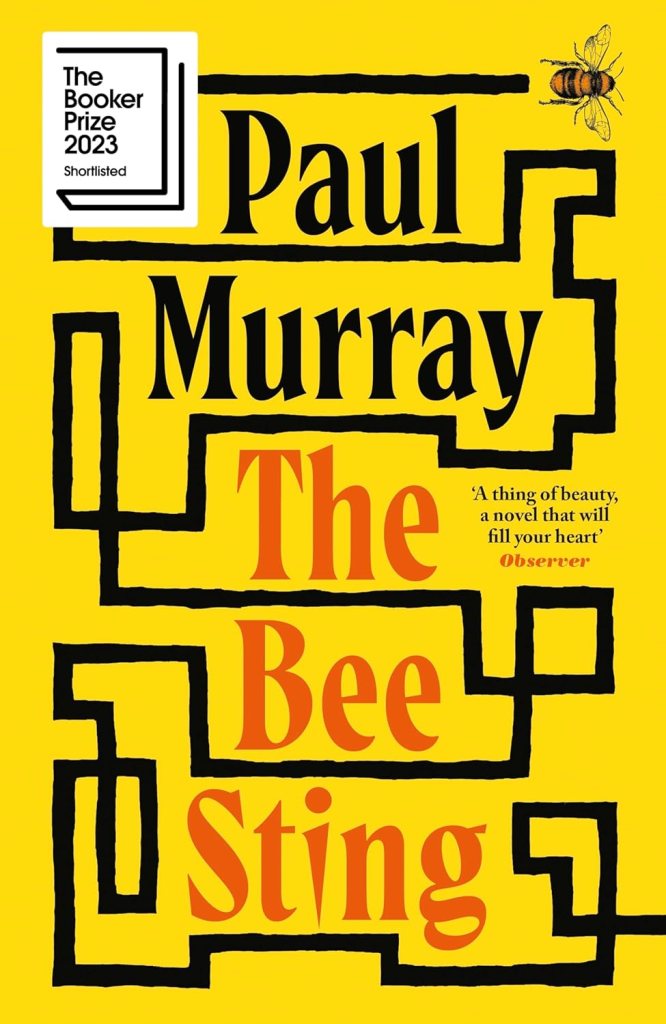
THE BEE STING. By Paul Murray. Hamish Hamilton 2023. 645 pp. €16.77 h/b
You are allowed to like a particular character in a novel, to wish them well or hope they get out of some difficulty. But there is no one here that you can like, except PJ perhaps and he is only 12 years old. You have almost 650 pages to marvel at how a writer can create such thoroughly unlikeable characters. It’s not that they are criminals or abusers, just almost impossibly stupid, reckless and self-centred.
The main ones are members of the Barnes family, from a town about an hour or so from Dublin – think Mountrath or Cootehill say. The leading man is Dickie who runs a prosperous car business, until the economy turns against him and against the town. His wife is the beautiful Imelda, daughter of a local family of transients, a family where the father of the house is a tyrant and his sons are little better. Fortunately, Imelda is able to escape to her aunt Rose who has unusual powers as a fortune teller.
Dickie’s younger brother is Frank and he is the local football hero, winning games in a way that is a rarity for the local GAA club. They actually win the county championship, but lose the first game in the provincial competition. Frank and Imelda are lovers or they would be lovers if she would allow it. ‘Down by the lake in the twilight he’d push the seats back wedge his face between her thighs Your stubble’s itching me she’d squeal … Are you still going to make me wait still he’d say he’d smile Would you not let me now I don’t want to let you I want us both to want it and then do it.’ That absence of comma or full stop happens in all the chapters devoted to Imelda, possibly a reminder of her lack of formal education.
After Frank is killed in a car accident, his brother Dickie takes over and this time, Imelda does not stop his advances. The result is that she is pregnant and they have to get married. The child, some months later, will be Cass and she is the third member of the Barnes family whose growing up and adventures are carefully chronicled. The final member of the family is the father, now living in retirement in Portugal. Named Maurice, he is persuaded to return to try to put the garage business back on its feet.
There are other elements in the story, notably Dickie’s adventures in Trinity College and his homosexuality, which has disastrous effects on all those around him. He is blackmailed by one of his partners and the final chapters are supposed to have him dealing with that situation. In truth, it is not at all clear what happens, though there are guns involved.
Although 650 pages is a trial, the truth is that the writing is so clear that you don’t notice and find yourself dragged along to learn of the troubles of each of the characters. At one stage two school kids are speaking about their history lessons. ‘He knew a lot about Nazis. Some Nazis had fled to Ireland after the war. The big Irish schoolbook company was founded by a Nazi. That was another reason the education system is bullshit.’ The company to which reference is made is Folens Publishers and this reviewer had the happy privilege of writing two mathematics textbooks for that company and objects strenuously to the wrongness of that sentence.
I reviewed Paul Murray’s Skippy Dies (660 pages!) some years ago with limited enthusiasm. Also a Dublin resident, he has made the shortlist for the 2023 Man Booker with this book.
The winner of the 2023 Booker will be announced on November 26th.
Frank is a member of the Tinteán collective
 Tinteán