Book Review by Frances Devlin-Glass
Dermot Bolger: The Family on Paradise Pier, Harper-Collins E-Books, 2005.
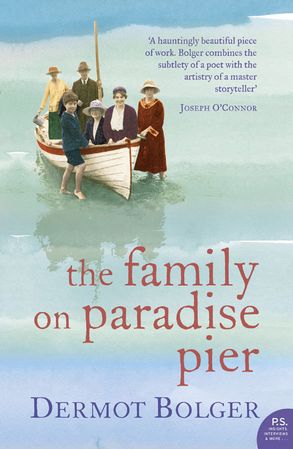
I’ve followed the work of Dermot Bolger for some time but had somehow missed this novel, so it was a delight to discover it, despite its being a very sobering read. Bolger focuses on disillusionment, in childhood and in adult life, and the different forms it may take.
The novelist gives himself a broad historical and geographical canvas, as it covers the period 1915 to 1946, and deals with the decline of the landed Anglo-Irish class, the rise and fall of Soviet-style Socialism in Ireland (a much-neglected topic) after the establishment of the Free State, and also extends to life in Russia after the Revolution, as well as offering a brief segment on Russian engagement in the Spanish civil war.
What most intrigued me was the persistence of the socialist enterprise into the new Free State era. It’s not surprising that the dreams of Socialists did not die with James Connolly’s execution or Jim Larkin’s decamping to the USA and being ‘sidelined in an American jail’. The novelist makes the point that he was unable to emulate Lenin’s seizure of authority and stage a coup d’état during the vacuum created by the Civil War. Larkin’s election as a communist to the Dáil was unique, and the prevention of his taking his seat does not get a mention in this novel but it might well have. Art, the ideologue, laments on his return to Dublin that he cannot be happy in Ireland because he sees ‘children die in Dublin every day from the most curable disease – poverty’, and being dominated by priests (p.243). He’s also aware that in his birth village, ‘villagers were trained like dogs to fawn at our name’. The critique is valid, even if in the mouth of a character who is less than admirable as a human being.
The freedoms of childhood on the west coast in Donegal, well insulated from the Rising in Dublin and to some extent from the worst excesses of the post-Rising wars, are poetically evoked. Alliances and rivalries between teenage siblings in the water off the Pier they dubbed Paradise, lubricated by the eccentric Mrs Ffrench’s ‘trays of homemade lemonade’, are given the quality of a dream, a utopia: ‘beautiful, impractical, living in the moment with no awareness of how short-lived that paradise would be’ (p.19). The same pattern of childhood innocence and joy in the moment is repeated in the next generation with Hazel taking delight in the iridescent bubble that bursts. Eva, Hazel’s mother, is the great survivor, learning to live in a few rooms of the Great House she can’t afford to maintain. But her privations never prevent her from being the careful and loving mother of her children, one of them with a gender orientation that she instinctively knows needs protection.
What follows this arcadian idyll is a rude reality check: the souring of the socialist dream in post-Leninist Russia for the eldest and youngest Goold Verschoyle sons. It is chillingly charted in the 1920s, ’30s and ’40s. Life under Stalin is represented as capricious, cruel and lethal. Art, the elder son, becomes a doctrinaire socialist, putting communism before any family loyalties, even trying to convert Catholics in the Curragh camp to communism during the Second World War by praying the rosary with them. The tender-hearted youngest son, Brendan, is bombed from the air by the all-but-defeated Nazis having formed a bond with a child he hopes to save. His is a wasted life in that he was by Spain utterly alienated from Stalinism, and critical of it, but not allowed to leave. It was indeed surprising to me to experience the Anglo-Irish Ffrenches, with their systematic questioning of the class system, and of the sectarian division between Catholic and Protestant children, as the inspiration for these two boys. Mrs Ffrench is represented as of the Baha’i faith, and doubly alien for that. Her back-story involves losing her brothers in WW1 and becoming a pacifist on the strength of that tragedy. These upper-class families, although from the Catholic point of view Protestant, insist primarily on their shared Irishness. A comic event in which the teenage Maud, ‘fuelled by righteousness’ reclaims the family’s stolen car from IRA combatants using as her reason her mother’s need because of her arthritis is one way in which the point is driven home. She’s more outraged by the damage done to the car (scratches mainly) than by their separatist guerrilla action.
The oddly unfamiliar vantage point from which the Rising is narrated, that of Tim Goold Verschoyle, a cousin of Countess Markievicz, located remotely from Dublin in the far reaches of Donegal, is illuminatingly disorienting. He is witness to a German submarine off St John’s Point (near Dunkineely, Co Donegal) and seemingly is baffled rather than alarmed. To Tim, reports of the Rising are hard to take seriously: it is a ‘shocking fiasco’, the work of hooligans who after returning from internment were strangely transformed into heroes. The point is registered that not only the Goold Verschoyles and the Ffrenches but also more prominent citizens like the Countess were drawn into the Socialist dream. As noted earlier, the Irish Citizen Army prominently features in the narrative of the Rising, but their socialist ideology is perhaps muted in the nationalist account.
This novel gives vivid life to the afterlife of communism in the Free State under a repressive Taoiseach, de Valera. Bolger paints WW1 as the dawn of a new era of uncertainty for the Anglo-Irish class, the end of ‘sleepwalking through life’ and underscores the need (and difficulty) for this class to reinvent purpose in their lives. Both families spiral into poverty and they struggle to retain their humanity, the women less so than the men. The women seem more able to hope for better outcomes than the narrative in fact can furnish.
This is a superior historical novel of a literary cast that casts new light on the convulsions in the body politic in Ireland in the post-revolutionary period. It also does family subtly and well. If the men’s lives and deaths are tragic, the women who work hard to be the spine of their families are even more heroic. I do recommend it.
Frances Devlin-Glass
Frances is a member of the Tinteán collective.
 Tinteán