This is part two of John Long’s story – see October Tinteán for part one
by David Harris


I would like to think that I can identify the beginning and end of John’s life. Above is a copy of the re cord entry for his baptism and the copy of the Certificate of his birth and baptism I received when I visited the Cathedral of the Assumption, in Thurles.
Marriage and Death
John and Emma married on Christmas Day, 1865. He was 23. This entry tells us that they were both living in the same place, Woolundunga, a small township around 17 miles from Port Augusta where John’s ship docked. Marrying the same day was a Henry Mellowship, perhaps Emma’s brother.

I now believe that John Long is buried within 100 metres or so of John O’Dea’s grave in Warrina. Oddly enough, there is no death certificate recording his passing. Odd, as it was the subject of an inquest reported in the Police Gazette and reported in a newspaper.(1)
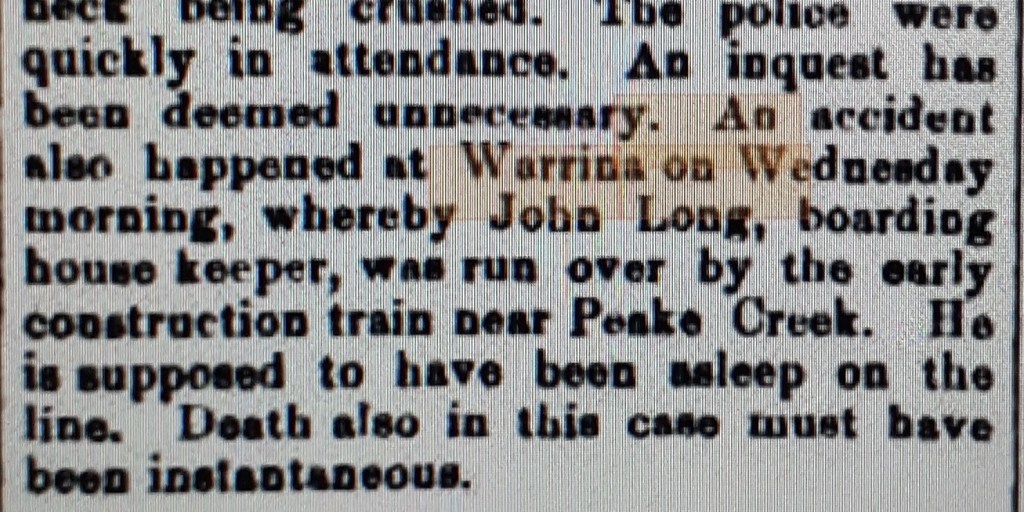
I now intend to arrange for a death certificate to be drawn up, allowing me to book-end his life. I plan to set up a memorial plaque in Warrina cemetery to bring this piece of Long family history – and Thurles’s history – into view.
Into the Diaspora
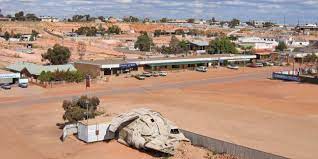
The eldest child of the Long family, Thomas, had left their travelling home. Their second, George, remained in the outback. He would initially have worked on a cattle station – there were few other jobs available. Later he took up prospecting for gold, settling later in an area known as ‘The Breakaways.’ This has now become the bustling town of Coober Pedy (‘white fella in a hole’ in the local Aboriginal language) and supplies around 80% of the world trade in gem opals. Whether or not George was involved in opal mining we do not know. Opals were only discovered there in 1915, with miners moving in from 1916, by which time George was in his 40s. However, in later life, he always said he lived in The Breakaways.
Emma Long stayed with the railway until it reached its end at Oodnadatta. She then gathered up the remaining children, ranging in age from twenty-two down to four, and travelled to the rapidly growing town of Broken Hill, where large deposits of lead and silver had been discovered. The mining company Broken Hill Proprietary Limited was formed in 1885 to exploit this deposit. It has now grown to become the global mining giant, BHP, Australia’s largest company.
Into the West

The children left as they became old enough to fend for themselves, but while she still had a few with her, she moved to the new gold-fields of Western Australia. The first gold discovery there was made by Paddy Hannan, an Irishman from County Clare in 1893. The ore body he discovered is now known as ‘the golden mile’ and is the richest square mile of gold mines in the world. On this was built the town of Kalgoorlie, now a city and still a major producer of gold. Paddy is remembered with a sculpture and a fountain at the main road crossing in the town.
So, where are we today? Jack and Emma’s children became scattered around Australia. Their daughter Emma moved to Perth and married a Scot, Roderick McPherson. Their three boys all served in the Royal Australian Air Force in World War 2, the youngest, being lost in the war. The others remained in Perth, all married, but all have now passed on. The children of the next generation, including me, have children, grandchildren and even a few great-grandchildren. The youngest are sixth-generation Australians, barely aware of their Irish roots.
As is always the case, one becomes interested in these roots in later years, after a life of work, children and community has been lived. By then, those who could have fed a revived interest are very old or have passed on, and the stories we heard from our grandparents disappear in the mists of time. I have made some attempts over the last 10 years to find family links in Ireland. I have visited Thurles several times and have made contact with a couple of families of Longs. We have never been able to come up with matching sets of names to verify a connection.
In migrating from Thurles to Australia, John Long brought an Irish influence to Australia which I am sure has added colour and value to this country. I have now visited Ireland half a dozen times. I love the place, the people, the culture, and the folk-lore. I thank God for this input to my life and my country.
The Long Family: part of a bigger picture
A line in the well-known Dorothea Mackellar poem ‘My Country’ declares that it is a ‘land of droughts and flooding rains.’ The flooding rains, rare and unpredictable, fill the otherwise dry river-beds, washing away bridges and rail infrastructure. Keeping the railway operating was a major struggle. While it was intended that the line would go on to Alice Springs, with road links from there to the north coast, this link did not happen until 1929. The service was boosted, with great expenditure on infrastructure, during World War 2, when thousands of troops were carried to the rail-head, for road transport to Darwin and then overseas to the battlefields of Europe and the Pacific.

The importance of having fast and reliable rail transport from the south to the north was so clear that a major project was undertaken to achieve it. A standard gauge line was completed from Port Augusta to Darwin in 1980. It avoids the path of the Old Ghan line with its ever-present danger of occasional wash-aways. With diesel locomotives, it is not dependent on the availability of water, and it avoids the country of droughts and floods which were such a problem. As well as serving the normal activities of a railway, this line – the New Ghan – has become one of the great railway journeys of the world.
As the rail services displaced the camel trains, the camels were released to fend for themselves. Their numbers have now multiplied into the millions. As an interesting aside, there is a niche business in supplying camels to countries in the Middle East. Australian camels are valued as disease-free, healthy, and strong, and are frequently used there for racing.
Of course, the trying terrain, which had the construction workers having to cope with summer temperatures of 45C and more, is still there. However, while still sparsely inhabited, the area centred around Oodnadatta has become economically highly important. In this area are:
One of the world’s largest deposits of uranium, mined at Roxby Downs; large fields of natural gas mining. Gas is a major Australian export; the world’s largest supplier of gem-quality opals; the world’s largest over-land test range for military and space research; cattle farming;
and

popular tourist areas including such icons as Uluru (formerly Ayers Rock) and the surrounding desert lands. The new rail line also provides access to other significant tourist destinations, such as Kakadu National Park.
The old railway was built, of course, to make money for its investors by providing a freight service to bring products of the area to market and to carry supplies up into the area to support local activities, especially mining. However, perhaps unintentionally, it provided a proof of concept for building and operating significant infrastructure in the new and trying environment. Lessons learned from the construction of this railway have guided every project in the area since.
The Long family supplied a support service of food and accommodation(2) for the workers. They were a small, but indispensable cog in the large wheel of the railway construction, which became a critical lifeline in its own right, and a critical information source for infrastructure development in the growth of Australia. They broke the ground for the generations to follow. The Old Ghan railway was a major achievement, not only providing an essential service but in showing what is required to live and work in this challenging environment.
So what of the family, their nine children and their families, now fourth, fifth and even very young sixth-generation Australians? They have spread around the country, melting into the multi-cultural nation that we are. Connection has been lost, but if we are to set up a plaque in the lonely cemetery in Warrina, we must try to trace and re-establish these links.
We have made some small but unsuccessful attempts to find links to the family in Ireland. It would be fitting if we could find a representative or two from Thurles for the dedication ceremony for the plaque in Warrina cemetery.
[1] Although the police report concluded that it was an accident, they also criticised a local barmaid for continuing to serve him when he had obviously had enough. This could have contributed to his decision, on the way from bar to bed, to rest for a while – on the railway line, which was in use at the time.
[2] And possibly entertainment. We know that they organised a dance when the construction was in Pitchi Ritchi pass. David Harris was born in Perth, Western Australia, in 1937, the son of Cliff and Rae Harris (McPherson). Rae was the daughter of Jack and Emma Long’s eighth child, also named Emma (McPherson).
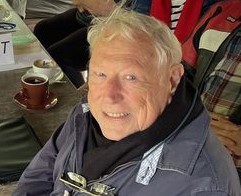
David is a retired mechanical engineer, now living in Adelaide, South Australia. He has two sons, Matthew and Chris. Matthew has no children. Chris has four children, all boys, and three grandchildren so far. David is devoting a large part of his retirement to researching his Irish roots, including studying the Irish language
 Tinteán