Reviews by Frank O’Shea
ALL THE BROKEN PLACES. By John Boyne. Doubleday 2022. 371 pp. $32.99
John Boyne’s book The Boy in the Striped Pyjamas has sold more than 11 million copies. This book is described as a sequel to it, though in fact the story stands on its own and will give great satisfaction even if you have not read Striped Pyjamas or seen the later film. The boy in that original book was a nine-year old Jewish kid behind the wires of Auschwitz; he was befriended by Bruno, a boy of the same age on the other side of the wire.

Bruno was the son of the commandant of that awful place and he has a 14-year old sister named Gretel, whom he describes as ‘A Hopeless Case.’ Now aged 91, she is the central character and first-person narrator of this book.
At this stage, it helps to describe the structure which Boyne uses in the book. He divides it in three sections, one set in Paris in 1946, one in Sydney in 1952 and one in London from 1953 to the present. Within each section, the story is told in chapters that alternate between each of those places and the present day, 2022, in London.
After the end of the war, Gretel’s father is executed by the Allies, while she and her mother manage to escape to Paris. There, they survive an existence much beneath the kind of glamour and success they had enjoyed in Berlin and ‘in that place’ in Poland which is never named. All the time, they must hide their German background and try to forget the horrors of which they were an unwitting part.
After her mother’s death, Gretel manages to get to Australia, settling in Sydney and working in a clothing store. She has a friend whom she met on the voyage, an Irish girl named Cait, who works as a barmaid. One evening while visiting her at the bar, Gretel sees a man she recognises from her life ‘in that place.’ After they meet, she decides that she must leave Sydney lest her background is discovered by some of the Nazi hunters of the day. She makes her way back to London, where she will spend the remaining 70 or so years of her life.
The story of Gretel’s adventures in 1946 Paris, 1952 Sydney and 1953 London are told in chapters that alternate with the present day where, despite her 91 years, she is an active, healthy and intelligent woman. Her main problem happens when a new family with a nine-year old son, moves into the apartment downstairs and she is forced to take the kinds of actions that she scolds herself for not taking when she was a 14-year old.
John Boyne was the subject of some criticism for Striped Pyjamas, from those concerned with Holocaust education. Almost anyone who writes about that awful place and that time would be likely to be subject to similar criticisms. It is difficult for someone not familiar with that history to find fault with this book, particularly when it is read as fiction.
This is a magnificent novel, the ending completely satisfying. The writing is John Boyne at his best. At the risk of cliché, it is the kind of story that you can’t put down, the kind that takes over your mind. You quickly get used to the alternate chapters set in different eras and you realise that while you are probably supposed to be thinking about things like guilt and shame and family sins, the writing keeps you going.
I cannot recommend this book too highly. I want to get on the rooftops and shout it to the world.
The Trial of Lotta Rae. By Siobhan MacGowan. Wellbeck 2022. 383 ppp. €16.99
After living for many years in London, Siobhan MacGowan has returned to live in Ireland. This, her first novel, is set in the London of her childhood. Remembering her young life then, she recalls walking with her brother in ‘King’s Cross, where Lotta abides; we strode together, youthful and sprightly, serenading passersby with uninvited renditions of Peggy Gordon, pennies in scant supply but joy in abundance.’ The brother to whom she refers is Shane MacGowan, leader of The Pogues.
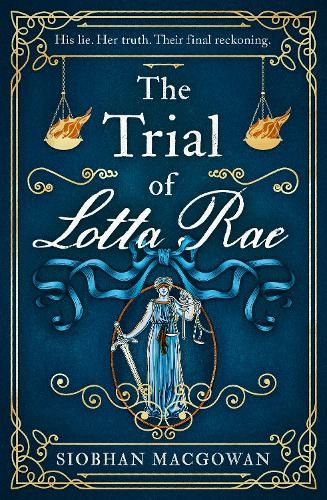
Lotta Rae is only nineteen when she is attacked and raped by a man of wealth and influence. This is Britain 1906, a time and place where the divergence between social status and its absence was a basic aspect and accepted division within society. It was important that the rapist not be convicted, so a group of important legal folk hire William Linden, a prosecution lawyer who had lost a number of important cases and was in fear for his future. They hinted to him that, though he was being hired as a prosecutor, he was required to lose the case, his way of doing so being entirely up to him.
The account of the legal battles in the court is detailed and quite clear. Linden befriends Lotta and manages to extract minor but relevant details from her and secretly passes them to the defence side. He loses the case, and the background clique who have managed the whole thing ensures that his legal practice begins to boom. Lotta is devastated, as are her parents. Her father tries unsuccessfully to repay the rapist with violence and is sentenced to prison where he dies shortly after. His wife does not survive him for long. But Lotta is determined to deliver her own justice, her lawyer Linden rather than the rapist being the object of her efforts.
It is worth noting that at this stage, we are only one-third of the way through the novel. What we have been reading hints to us that justice will be done eventually, perhaps through the efforts of Lotta, and here the reviewer must pause his summary of the story. Lotta finds support among the women of the suffragette movement. She meets Raff, the son and only child of Linden, intending to get at his father through him. Instead she falls in love with him and is accepted by Linden’s wife Margaret. There is an account of the horrors of the Great War and the awful slaughter that would eventually make ordinary people throughout Europe realise how they were being manipulated by their leaders.
Here your reviewer must stop, because Siobhan MacGowan writes a book that is probably more true to life than the usual happy-ever-after kind that we are used to. It is not easy to review the book, beyond saying that it is different and there is much in it that is unexpected, so that a reviewer must be careful not to give away the basis of the story.
When the time comes at the end of the year or whenever awards are handed out for literary work, this should be near the top. It is a wonderful book, beautifully written, the kind that draws the reader in and won’t let go. Haunting and beautiful, it is hard to credit that it is the writer’s first novel.
THE HELPDESK. By Shane Dunphy. Hachette 2023. 338 pp. $32.99
James Fitzpatrick and his wife Bella Murphy are the principal characters in this story. They met when they were both studying at Trinity College Dublin. After graduating, they went to London, each doing further study at City College, before James took up a position with a firm specialising in tax law while she started to study for a PhD in the inexact area of psychology.

At this stage, Shane Dunphy’s book changes the first person narrator between James and Bella with each new chapter. We learn that he is succeeding so well in his position that he has ambitions of becoming a partner in his legal firm. Meanwhile, Bella’s studies have come a cropper after she writes an article about one of the people she was interviewing; her only escape is to take up teaching which she does in a school for the top notch of London society.
In the course of his work, James loses an important file and has to get in touch with a help desk in the hope of finding it. His saviour is Charlotte, who finds his file and puts him right. By this stage, he is working 16-hour days in his pursuit of partnership, and his marriage is suffering. At school, Bella is attacked by three senior students, which brings a new character into our story, Sergeant Harvey Brennan. From now, the narrative jumps between Bella, James, Charlotte and Brennan, getting more and more crazily improbable as the story progresses.
In the end, guns come briefly into the action, but in truth, by then the reader is thankful for anything to relieve the tedious and not always consistent action.
Shane Dunphy, we learn, lives between Wexford, Waterford and Slovakia and has a number of books featuring police detectives. He will be new to many readers, but there is little here that might persuade a reader to chase up some of his other work.
LEARNED BY HEART. By Emma Donoghue. Picador 2023. 323 pp. $34.95
At the end of this book, we learn that one of its two main characters, Anne Aster, is regarded as the first chronicler of love affairs between women. The other character is Eliza Raine, a ‘brown child’ born in India and shipped off to Britain with her older sister, each to attend a school in York for young ladies.

The book is a detailed account of how the two young girls came together in their schoolwork and eventually in their passionate beds. Much of the book is taken up with their classes in poetry, French, Art and other subjects appropriate for young girls not completely welcome in their busy family homes.
The era is the early decades of the 1800s, so the conversations are the kind of stilted ones to be expected from that time. Aster is quite the tomboy, careful not to bother her tutors, but managing tricks and successful escapes from the confines of the school, dragging Eliza along with her. In the last of those escapes, she hurts her leg and has to leave for some time. Eliza is devastated and we learn that some years later, she is confined to a mental institution. She writes letters to her former lover, but cannot post them, because they would be first read by her carers; these letters form short chapters between the long descriptions of the work and adventures in the school.
This is not one of Emma Donoghue’s best books and indeed, your reviewer admits that he employed speed reading for parts of its length.
 Tinteán