By Brendan Corr
The author wishes to advise that spoilers follow.
The Banshees of Inisherin is a highly acclaimed Irish-made movie released in late 2022, nominated for many awards, and granted, several prestigious ones at the Golden Globes, Oscars, BAFTAS and elsewhere. These awards reflect not just the excellent directing and acting, but also the many layered themes running throughout that to me made greater sense on reflection. So, in thinking about the complexity and richness of the movie since I saw it, I’d like to share these thoughts for anyone who has not seen it yet.
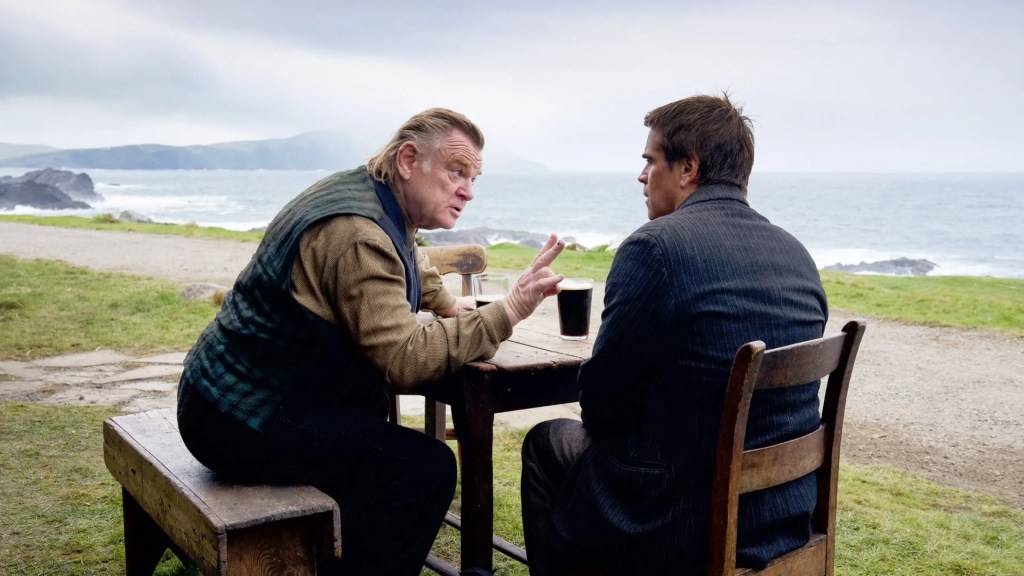
With a soundtrack of a joyous female choir, the vision of a beautiful landscape we’re introduced to Pádraig Süilleabháin (Colin Farrell), a seemingly cheerful, uncomplicated, happy-go-lucky resident of the island who shares a small cottage with his sister Siobhán (Kerry Condon). Soon we witness the breakdown of the close platonic male friendship that Pádraig shares with his neighbour, Colm Doherty (played by Brendan Gleeson). Colm suddenly and shockingly advises the puzzled Pádraig that he ‘doesn’t like him anymore’ and wants nothing further to do with him. No one seems to understand what’s happened between Colm and Pádraig, least of all Pádraig.
The movie is set on 1 April 1923 on a small, fictitious island, Inisherin, off the west coast of Ireland in the newly formed Irish Free State. On the mainland, the Irish Civil War has been raging for nine months over the Treaty that formed the Free State and the excision of the six counties that became Northern Ireland. Many of those in government in the Free State had previously been IRA leaders, members, soldiers and supporters in the fight against the British, but now supported the British-imposed partition of the island into two separate nations. The IRA believed that allowing the British to remain in control of the six northern counties, along with several other unacceptable conditions agreed to, was a betrayal of the sacrifices made to achieve Irish independence. They were determined to stand by their original aim of elimination of British control and the creation of a totally independent Republic as proclaimed in 1916. The Irish Free State was initially somewhat sympathetic to the IRA, but disposed to make the best of the peace compromise, until further freedoms could be obtained. The ensuing Civil War was a tragic, vicious and bloody dispute between two groups of former allies and friends, one committed to the ideal of the Republic and the other to the political compromise.
I read The Banshees of Inisherin as an allegory of this vicious civil conflict, told in a loose but recognisable metaphor of the breakdown of a once close friendship. Not only do the other residents of Inisherin not understand the reasons for the breakdown of the Colm and Pádraig’s friendship. They don’t quite understand why the IRA would want to fight their previous allies after successfully achieving the removal of the British from the 26 counties less than two years earlier. In addition to this none-too-subtle civil war allegory, other themes present reflect the Irish experience in the 1920s and indeed for much of the next 100 years. These include:
Theme – Silence over Difficult Issues
The reluctance to acknowledge and discuss painful issues such as the abuses of the Catholic Church, the brutality of law enforcement officers, domestic violence, child abuse, alcoholism and suicide are powerful themes in this film. We see an example in the demand for silence over these issues by the Police Constable, after Pádraig dares to call him out for beating, and perhaps sexually abusing his own son. This swiftly results in a brutal violent backlash by the policeman. Pádraig is clearly shattered by this event.
Colm witnesses the beating and takes pity upon him, then escorts him most of the way home by driving Padraig’s pony and cart. However, it’s clear the friendship isn’t going to resume when Colm, in complete silence, removes himself from Pádraig’s cart at the fork in the road that separates the rest of the route home for both of them. You go your way, I’ll go mine. Similarly, the Civil War is an under-discussed topic.
Early in the movie, we learn that Pádraig and Siobhan’s parents both passed away six years earlier. We don’t know how they died and if they indeed died together, but concurrent death is suggested in the brief conversation between Siobhan and Banshee Mrs McCormack. Was there a traumatic accident? Was it a joint suicide? A murder-suicide perhaps? We don’t know the details as it is not revealed. Death via suicide was not a speakable matter, not then in 1923, and perhaps not in 2023 either.
Furthermore, we learn that Dominic is seemingly an only child. There are no siblings and he lives with his policeman father. We don’t know where his mother is, or if she’s still alive. It could be presumed she either fled a very violent husband, or perhaps is deceased, but that too is unspeakable.
Theme – The Irish and their Animals
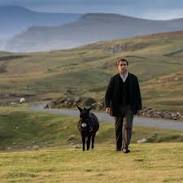
Another key theme of the movie is the love the Irish have for their animals, in this case, Pádraig’s miniature donkey named Jenny, and Colm’s unnamed Border Collie dog.
Pádraig is so fond of Jenny that he permits her to stay inside the small cottage he shares with Siobhán, despite her protestations and decree of ‘no animals in the house’. We see Pádraig rely heavily on Jenny for company after the breakdown of his friendship with Colm, when he declares to an exasperated Siobhán ‘I’m not putting my donkey outside when I’m sad.’
Similarly, Colm shares great affection for his unnamed Border Collie, his sole companion. In one touching scene, we observe Colm dancing with his dog. Later in the movie we see Pádraig protecting Colm’s dog from harm, despite wishing great harm upon Colm himself.
At the heart of Banshees is the tragic but accidental death of the miniature donkey. This death soon leads to a determined act of vengeance by Pádraig against Colm, who is indirectly responsible for this accidental death. Could this perhaps be a metaphor for IRA actions that caused the deaths of innocent civilians during the Civil War? Clearly, none of the townsfolk has any issue with the planned vengeance, despite being informed of what, when and where this revenge will be delivered within 24 hours. No one tries to prevent vengeance, even though it could result in the deliberate death of a human. Later Pádraig lies to Siobhán by advising of the happiness and health of the dead Jenny in order to not cause distress. However, in the same letter, Siobhán is casually advised of the death of Dominic in a rather off-hand manner. Again, the life of the beloved animal is ranked as of more significance than the death of a person extremely well-known to Siobhán and Pádraig.
Theme – Rejection and Mistreatment
Dominic, the most vulnerable character in the film, appears to have been rejected by his mother and is savagely beaten and abused by his father. In addition, he’s been temporarily banned from the pub, is unable to form relationships with women, and is ultimately rejected by Siobhán, albeit in a gentle and kind manner. Dominic responds by rejecting other parties – the Catholic Church, and his only friend, Pádraig.
Colm’s cruel and sudden rejection of best friend Pádraig is at the core of the movie, a rejection that Pádraig struggles to understand, let alone accept, throughout the movie. Pádraig also perhaps feels a form of rejection from his sister Siobhán, when she announces she’s departing the island for the mainland.
Rejection is a familiar Irish experience. It was not uncommon to see signs posted outside English boarding houses and pubs that read:
NO DOGS
NO BLACKS
NO IRISH
Racial discrimination of this kind was commonplace and institutionalised in the United Kingdom. Many were able to understand that emigration for a better life was necessary, but many failed to accept the betrayal of those that departed, often forever.
Church and State – The Twin Powers of Ireland
The Police Constable is the only visible representative of the Irish government on the island. Due to the small population, there isn’t a permanent Catholic priest there. When we see the visiting priest arrive by boat, he is warmly greeted by the Police constable. We now know that church and state heavily collaborated in retaining control over the hearts and minds of the population. The priest appears as an aloof character, not living amongst his congregation, visiting only each Sunday and performing the mass in Latin, a language the population does not largely understand. He seems to care little for his docile congregation beyond the superficial. Within this unquestioning populace, we now know that the church perpetuated many instances of physical, sexual and emotional abuse that only unravelled in the mid-1990s as information regarding horrific orphanages, abusive priests, cruel nuns operating homes for unwed mothers and exploitative laundries that enslaved young women became publicly exposed. Dominic is the only resident of Inisherin that we witness rejecting the Catholic Church. Why is that? Did he seek assistance from the priest over the abuses of this father? Did the priest, a close friend of Dominic’s policeman father, decline to assist? Or, is it fair to ask was there something even more sinister in the form of sexual abuse of Dominic by the island’s sole priest as well as his father?
The title of the movie, The Banshees of Inisherin, comes from the name of a musical piece written for the fiddle that we see composed by Colm Doherty as the story unfolds. In real life, this piece was written by the actor Brendan Gleeson, an accomplished fiddle player. ‘Banshee’ is the name given by the Irish to a mythical female spirit that wails and screeches whilst mourning the death of a beloved family member. In the movie we see a somewhat Banshee-type character appearing before and during many pivotal scenes in the human form of Mrs McCormack. Rather than mourning any deaths, we instead see this human Banshee stirring up ill-will, prodding Pádraig and also predicting ‘one or two deaths’ on the island. Clearly, we see that Siobhán has come to fear the bad omen offered by the Banshee, given her reaction when she sees Mrs McCormack standing on a cliff edge close to, but unseen by, her brother Pádraig. It doesn’t take long for tragic events to unfold.
Concluding Scene
The final scene consists of a beachside meeting between Colm and Pádraig, along with Colm’s beloved dog. Colm expresses his view that the civil war will soon come to an end, which we now know is what happened. We also know that whilst the Irish Civil War did conclude in mid-1923, there was never a reconciliation between the opposing parties. The IRA were often blamed for the rift and has remained largely unforgiven to this day.
At the commencement of the final scene, we can’t help but wonder if the pain and tragedy is finished for Pádraig and Colm and if the friendship can now resume. After all, the once morose and depressed Colm is not expressing a wish for vengeance, is conciliatory and seemingly somewhat optimistic.
But our hopes are dashed as we see that the once cheerful Pádraig is now an embittered man. He’s happy to help Colm look after his dog, but the friendship is no longer of interest to him as he says, ‘Some things there’s no moving on from, and I think that’s a good thing.’ Ultimately these words of Pádraig offer a metaphor for the obdurate positions taken in the Civil War. Both parties initiated a dispute that seemed puzzling and unnecessary by impartial observers, creating much hurt, death and violence. Many would agree that ultimately nothing was achieved, but much loss was experienced.
The scene concludes with a long shot from the foreshore showing the ever-present Banshee observing this meeting and framed between Colm and the departing Pádraig off in the distance. We can’t help but wonder how much this character influenced the break-up of this friendship.
Brendan Corr
Brendan Corr was conceived in Ireland and born in Melbourne soon after his Kilkenny/Monaghan parents arrived in 1968. Brendan was reared and educated in Melbourne, enjoyed a successful career in global finance and continues to live in Melbourne with his wife and young adult sons. Brendan is extremely proud of his Irish heritage and is well-versed in its music, literature, history and cinema. He plans to start spending more time in Ireland, and has recently commenced a study of Irish Gaelic.
 Tinteán