At this year’s Bloomsday in Melbourne seminar, Philip Harvey gave a paper on Bloomsday novels, six in all but there are more. This is fiction in which authors include accounts of the annual phenomenon known as Bloomsday, the international celebration of James Joyce’s novel Ulysses, set on the 16 June, 1904. One of the books was Martin Johnston’s 1983 novel, Cicada Gambit, a work inspired in some ways by Joyce’s experimental manner. Martin Johnston was the famous son of famous literary parents, George Johnston and Charmian Clift.
Cicada Gambit is probably the earliest work of fiction to use Bloomsday itself as an essential element of the story. It is an integral part of the history of Bloomsday celebration in Australia.
In brief, an academic Dr Skogg prepares for his annual solo Bloomsday. Skogg’s Dublin is Sydney and his literary celebration of the day is all in his head. He plays all the characters, something different from the social event as it has come to be known worldwide, where group sharing is a primary motive of the day’s festivities. He re-enacts a literary ritual of one. Possibly Skogg is friendless, with no one to share his annual pastime, though Johnston is also making a point about how any novel reader is playing all the characters during the reading of a book, including and not least Ulysses.
Readers of Ulysses instantly recognise why Skogg prepares a breakfast of what is unpoetically described as ‘offal’, in honourable emulation of Bloom’s more rhythmic ‘the inner organs of beast and fowls. He liked thick giblet soup, nutty gizzards, a stuffed roast heart, liver slices fried with crustcrumbs, fried hencod’s roes.’ (Joyce 48) Skogg’s breakfast is made to sound grossly unappetising, in comic contrast to Bloom’s hearty if un-kosher start to the day. Later we find Skogg in the Wessex Hotel, a pub near Circular Quay, where he connects with Vlastos and starts plying him tipsily and overbearingly with inexplicable questions. Vlastos, the primary narrator, cannot understand why Skogg asks has he read Hamlet, for example, and does he want to go to Kings Cross?
But readers of Ulysses understand instantly. Skogg wishes to relive the episode in the National Library of Ireland where Stephen Dedalus delivers his theories about Shakespeare and Hamlet, even if the location is a seedy bar of downtown Sydney. Skogg would like to visit a brothel with Vlastos, the main reason being that Vlastos can there play Stephen to his Leopold Bloom and so complete one of Joyce’s crucial cyclical themes, the meeting of the lost father with the lost son. Misunderstanding reigns and none of this will happen, due to mutual miscomprehension and Skogg’s increasing state of inebriation.
The Bloomsday section of Cicada Gambit is a satirical portrayal of an academic adrift in his own daydream. It fits into the varying stylistic mode that tells the larger story. It heralds Johnston’s own absorption of Ulysses and the inspired emulation of several of the features of that novel.
Martin Johnston’s close friend Nadia Wheatley writes in an online memoir:
Bloomsday (16 June) was always a milestone in Martin Johnston’s year. Back in 1972, he had hosted a famous Bloomsday party at which the floor-to-ceiling brick-and-board bookshelves had collapsed onto the assembled guests. And in the novel Cicada Gambit, there is a long Bloomsday episode involving the seedy academic Dr Skogg, who gets up that morning knowing (as he always did on Bloomsday) ‘that everything was going to go wrong’. Nevertheless, ‘he went ahead in the same way every year, obliviously expectant that just this once everything would go off perfectly’.
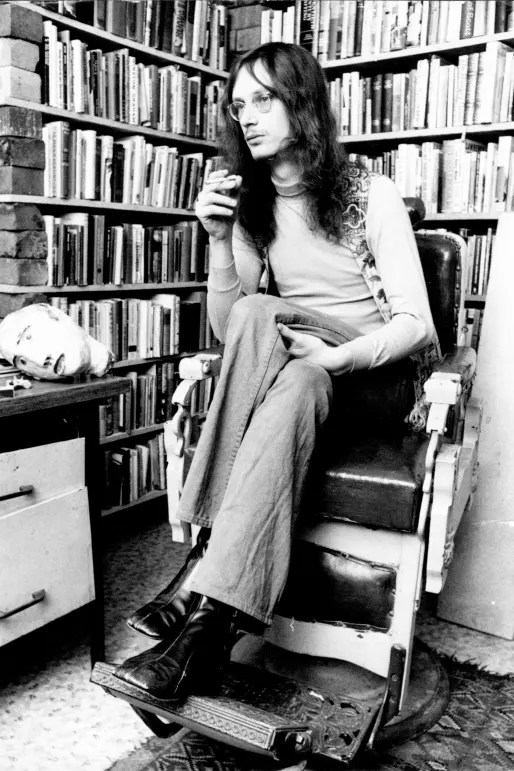
This photograph of Martin Johnston (taken in 1973 in Camperdown) appears in Nadia Wheatley’s elegiac piece on her close friend on the occasion of the publication of and edition of his poetry (Sydney Morning Herald, 9 October 2020)
Cicada Gambit is set in an identifiable present continuous known as the 1970s. Wheatley’s memoir confirms the period setting. More importantly, her words reveal Johnston’s propensity for self-mockery as, in a very evident way Dr Skogg is doing in most outlandish fashion the very thing Martin Johnston did annually for the last eighteen years of his life: he initiates his own Bloomsday celebration. Johnston’s self-observation of his own behavioural fixation has been applied to a character with very different reasons for reliving Bloomsday.
Elsewhere, Wheatley refers to Johnston’s negative reactions to the Sydney University English Department and its Leavisite takeover; his experiences were unhappy. In this context, it makes perfect sense to read Dr Skogg as a satirical reference to Professor Samuel Goldberg, Australian literary critic of Joyce and central promoter of the Leavis school. This surmise is supported by the character’s two presiding areas of academic pursuit, Augustan literature of which he had written substantially, and James Joyce. This is where the comparison ends for, unlike Goldberg, it is Johnston who mounted personal celebrations of Bloomsday each year with his friends. Yet, Skogg seems to be a composite of at least two different aspects of Johnston’s own character: the reader so enthused by Ulysses that he ritualises its contents each year and the deluded and unpleasantly arrogant professor of English literature that Johnston himself may have become, if things turned out differently. Such was Johnston’s animus towards Sydney University, there is an apocalyptic chapter in Cicada Gambit in which a protest in the streets of Sydney turns into a rampage where the protesters turn towards the university precinct and proceed to burn down the Fisher Library.
Johnston’s novel raises the issue of different claims made on Ulysses by academe, bohemia, publishing and reviewing, the common reader, and even the educated and uneducated reader, i.e., the issue of joint sharing of the work. Who owns Joyce? Johnston does not try to answer the question, he simply does what novelists do, he illustrates the dilemma.
The way things actually turned out for Martin Johnston is more real and poignant and sorrowful in its own way, as Wheatley describes:
On 16 June 1990, Martin paid his respects to James Joyce’s Ulysses by going on a huge binge with his drinking pals at the Toxteth Hotel in Glebe. After a few hours, he suffered a fit, and was taken by ambulance to Royal Prince Alfred Hospital. When triage staff began their assessment by asking him what day it was, he replied (politely as always) that it was ‘Mr Bloom’s Day’. The nurses thought he was rambling. He was diagnosed as suffering from delirium tremens and pneumonia.
Martin Johnston died of a heart attack five days later, on the winter solstice.
Philip Harvey is a frequent contributor to Tinteán, a poet, librarian and a prolific blogger on literary matters.For accounts of other Bloomsday novels, see Philip’s blogspot, Clippings and Coinings.

 Tinteán