by Michael Boyle
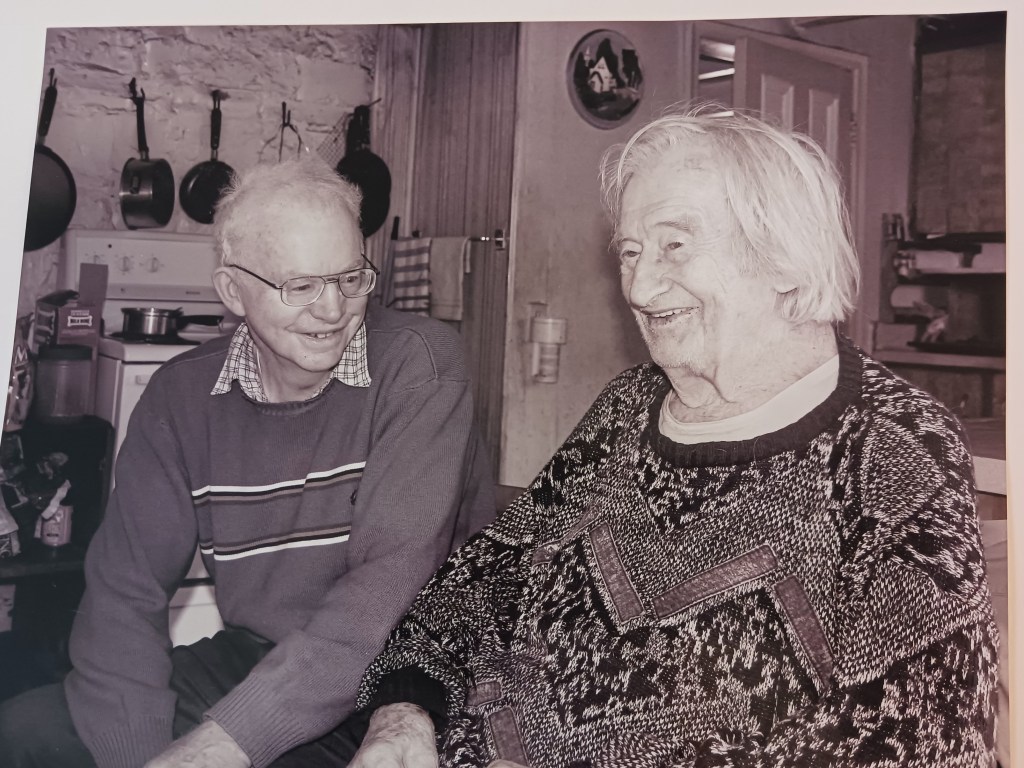
(photo courtesy of author)
My Irish first language teacher, Aly (Aloysius) O’Brien, always said that if you want to learn any language you must hear and speak it every single day. I mentioned to him that I lived in the suburb of St John’s Newfoundland and few people knew much about the Irish language. Aly told me to shout a few words of Irish into a barn barrel and then listen to the echo coming back to me.
Aly was born on June 16 (Bloomsday)1915 and he died on August 6, 2008 at the age of 93.His mother’s family came from Waterford and his father’s family from Ballyhale, in County Kilkenny.
Aly never married and he lived all his life on the family farm which is now a heritage farm (O’Briens Farm Foundation) He was self-taught and had no teacher training or any academic degrees, but at the same time Aly could easily demystify Irish grammar and really make language-learning fun. He inspired his students with his love of the language.
Aly’s house was a sort of Irish cultural center and I was a regular caller over the years. Every week I brought Aly my copy of The Irish Echo (published in New York). I had subscribed to that newspaper get the latest Gaelic football result from Ireland. However, Aly was not interested in football results, but he immersed himself into reading the Irish language column ‘Maccalla’ by the late Barra O’Donnabhain. When I retired, I mentioned to Aly that I was getting involved in my own writings and poetry. Then he paused and asked me. ‘Are you interested in learning the Irish language?’ Right there my journey with the Irish language started.
Class took place on Monday night around the kitchen table, and it was always a relaxing cultural evening. Afterwards the chat continued often to near midnight. Indeed, there were times I felt transported to a farm house in the Donegal Gaeltacht of the 1960s and that I was not in Canada at all. When local harpist Carla Furlong arrived, she provided food for the dogs as well as cakes and buns for tea. From time to time there were distractions, and James Mc Lean, a retired French professor, relates the night Aly’s cattle went missing. Class was abandoned as all hands went searching the fields and laneways of the city to look for the animals. At other times, when snowy freezing weather made it impossible in wintertime to drive up O’Brien’s steep hill, class had to be cancelled.
Dorothy Milne, a librarian at Memorial University provided countless reading materials for our group. She was the lead teacher for the Monday night group as Aly got older. But they worked together as team teaching duo. Occasionally, when we struggled for an Irish word or phrase and seeing that Aly was half asleep, we looked to Dorothy, but Aly was more alert than any of us. He would perk up at the hesitation, and then go on to tell a story about the word. Aly’s sense of humor added to his teaching approach and he had a beautiful singing voice, a favourite was Thomas Moore’s ‘Let Erin remember her name.’ He learnt songs from the LP records of Sean O’Siochain and Martin Dempsey of Gael Linn Records. He also had copies of Eugene O’Gowney’s Irish lessons and several recordings of the Buntús Cainte language lessons.
Aly always stressed that the word order in Irish was different from English: verb, subject, object, and he taught us to note each word in a sentence. Having done that, he also cautioned it might still be difficult to get the exact meaning of a sentence unless you had a context.
For textbooks we used Progress in Irish by Mairéad Ni Ghráda and we parts of Na Gaeil i dTalamh an Éisc by Aiden O’Hara. Aly entertained us with his vast storehouse of words now in the Hiberno English but that were once part of the Irish language. One of his favorites was seachrán. He would say ‘The O’Briens were on the seachrain’, (meaning on the tear). He used all teachable moments and was a great lover of Irish proverbs.
Before class started, the animals in the house needed Aly’s attention: his little dog Spot tried to move Aly out of his usual chair, and the cats crawled behind the sofa and occasionally snatched at our legs with their sharp claws. But the highlight of the evening was the tea break, with biscuits and cake. This was still a teachable moment, as they say today. Once, a discussion took place about the proper Irish name for a tablecloth, as Aly used the term braillín that is used for a sheet. Generally, the conversation over tea was wide ranging, from Newfoundland politics, religion, folklore, farming and international issues. Of course Aly contributed greatly and impressed us always with his humility and his roguish sense of humor. Above all there was great feeling about Irish life and culture: being a botanist, Aly naturally had an Irish dictionary for Irish flowers and plants.
Two things really pleased Aly. First of all, he was very proud that our teacher Dorothy Milne was teaching Irish classes for credit at the University. Aly was also delighted that thanks to the International Canadian University Foundation, young students from Ireland would be coming out from Ireland every year to teach students at our local university. My son Patrick benefited greatly from this I.C.U.F. Program when he was a student at the University of Toronto.
My own experiences with the Irish language are not unique, but the whole learning experience opened new doors for me in visiting with the Irish language groups at Kingston Ontario and Prevost in Quebec. One amazing catalyst and mentor for my learning was Aralt Mc Giolla Chainnigh, a Canadian with fluent Irish. In turn he introduced me to Gus O’Gorman and Sean Tierney. When the Internet age came this was a huge game changer for learners in Newfoundland as we could listen to Irish language radio live and in color from Ireland. Another modern way of learning Irish is face-to face contact with a native speaker and I have been able to do Skype sessions with Padraic O’Donoughue in Fergus, Ontario. The biggest influence was, of course, being able attend an Irish class at Oideas Gael in County Donegal. In one of my first classes was Joe McHugh who later became Minster of the Gaeltacht. One year I traveled to Ireland with my son Patrick and we participated in the Feis An Carn near my home town of Maghera in County Derry. There was a great welcome at the Feis from Leonne Ni Loinsigh and she introduced us a B.B.C. Northern Ireland film crew that was astounded to see a father and son coming from Canada to do test for the fáinne (the test is no longer compulsory, and you can simply purchase and wear a silver or gold fáinne).
In 2013, Aralt Mc Giolla Chainnigh organized a three-week bus tour of nearly all the Gaeltachts in Ireland. When we were on this-Irish speaking tour, the welcome from Irish speaking communities in Mayo, Derry, Rath Cairn, and Carna was humbling. Doing Irish in Aly’s indirectly introduced me to Irish language folks in Ireland and Canada, folks like Liam O’Cuinneagain , Neil Comer, Linda Ervine and Ferghal Mc Guigan. In 2018 a bus tour of Irish language speakers visited the Southern Shore, Cape Shore, Placentia and Kings Cove.
Learning Irish has helped my writing pursuits, but much more it has been a gateway to poetry, music, history and literature and discovering that his language is part of Newfoundland heritage and culture. This was a far cry from the time when once learning Irish in Ireland as an adult, someone told me that learning Irish was only for youngsters at school
Some of what I have learned
1- Learning Irish requires effort and dedication. It will take time and most of all do not be afraid to make many mistakes. Learning a language on your own, means that you always have gaps in learning and you need to be able seek opportunities to listen and speak the language.
2- It is crucial for a learner to have measurable goals and targets. This is not always easy. But I have been lucky enough to participate in the TEG program from Maynooth College. I feel this program could be re developed and made more accessible to learners abroad.
3- Learning Irish with Aly was a welcoming and fun experience. This is should be a hallmark of all Irish Language teaching. I have felt that encouraging and giving learners self-confidence to speak the language is key, regardless of mistakes. Irish President Micheal Higgins suggested that everyone who has even a cúlpa focal (few words) should use them. Ireland’s new president Catherine Connolly is even more encouraging.
4- One of the important facts that emerged from the Easter 1916 commemoration was the important role of women in the Rising. The Irish language efforts of women in Ireland and abroad have not been fully recognized. Even though Aly was a bachelor, he too noted the huge role women in St John’s have played in supporting and promoting Irish language.
5- One of the biggest problems for the language is not that of hostility but something more insidious, namely indifference. This can be found in individuals and in academic institutions, that still do not recognize Irish as a credit course for degree programs.
6- The Irish language needs to forge more partnerships with other Celtic and Indigenous languages. In the environmental world today, we have seen animal, insect and bird species disappear. So too we see languages decline and vanish as well. Is there any way to forge linkages with like-minded groups. Or will we all decline together? This is the challenge.
Some ten years before Aly O’Brien died, I wrote this poem as a tribute to his work as being a long time one-man-Irish-Studies-Department for Newfoundland.
OUR VOICE for Aly O’B
‘English is a perfect language
to buy pigs or sell a quintal of fish.’
Our tongues were silenced
to icy tilts and shacks up the Shore.
Neglected, ignored and forgotten
by Bishops and Governors,
who lived on the big houses on Military Road,
and by Water Street merchants.
But you- kept the space warm
-A spark in the darkness
now a flickering flame of desire
that will not be destroyed.
This single strand survives and grows
–Preserved safe
only just for now.
You showed us how to dance and sing
and my voice echoes into the barn barrel
as I float along
happy to be part of the small stream.
Michael Boyle is a native of Lavey, Derry, Ireland. His poems have appeared in the The Antigonish Review, Dalhousie Review, Tinteán and New Ulster Writing. He lives in St John’s New Foundland, where he conducts a historical walking tour and has recently published a memoir On New Turf about his life in Ireland and in Newfoundland
 Tinteán