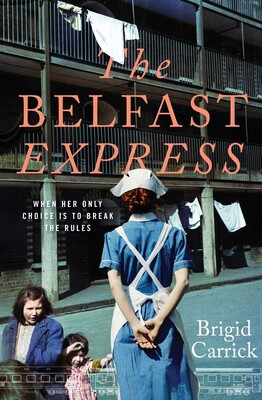
The Belfast Express by Brigid Carrick
Published by Ventura Press
ISBN 978-1-922923-32-5
Brigid Carrick’s novel writes of life as a young woman training as a midwife in the Dublin of the early 1970s, and though the book’s blurb describes it as ‘in the spirit of Call the Midwife,’ its reality is grittier, smellier and more confronting.
Our protagonist, Brianna Robinson, is a feisty, irrepressible one, struggling against an indifferent mother, a weak father and an oppressive Catholic church. She gets herself to London and passes the qualifying exam to train as a nurse, but her mother won’t hear of it. Instead she trains in Dublin, where she witnesses firsthand the horrors of large families, squalid tenements, feckless drunken husbands and the malign influence of a Church that prohibits contraception and preaches that yet another infant is yet another blessing from God. Skewered between the laws of the Irish Government, which criminalises contraception, and the Catholic Church, which deems it a mortal sin, the women of the Dublin and the Ireland of The Belfast Express are denied control of their own bodies, let alone the opportunity for education and a fulfilling career.
In particular, Carrick paints a vivid portrait of Corporation Place, against stiff competition perhaps the worst of the slums:
In front of us was a five-storey compound of tenement flats covered in grey render and surrounded by high concrete walls. The only way in was through two huge iron gates at the front. But the walls and gates weren’t designed to keep people out. We were told the police would lock the gates to keep the inhabitants inside when fights broke out, which was often. No wonder Dubliners knew it as ‘The Cage’… As we made our way up some filthy stone steps, the stench was almost overpowering and it took all the restraint I could manage not to gag… From two sets of bunk beds behind Mrs Murphy, children began to emerge. There were no sheets on the beds and the covers seemed to be old coats.
Robinson experiences for herself the Church, in the form of Fr Buckley, and the establishment, in the form of the hospital’s administration, working hand in glove when she challenges their authority. It appears little has changed since the world of James Joyce’s Dubliners, some seven decades earlier. Writing to his new girlfriend Nora Barnacle in August of 1904, Joyce recalls looking at his mother’s face in her coffin: ‘I understood that I was looking on the face of a victim and I cursed the system which had made her a victim.’ Carrick shows us ‘The System’ alive and well.
Robinson, however, emphatically refuses to be a victim. Quite where she musters the resilience and determination to fight and keep on fighting is anyone’s guess, but it’s enough to win her as close to a victory as anyone could get against Fr Buckley and The System. She gets herself into further trouble when she helps out at a private women’s clinic, where well-intentioned efforts to deal with the consequences of banning contraception and abortion result in tragedy.
All of this paints perhaps a grimmer portrait of the book than is just. The story is a compelling one, Robinson an amusing innocent abroad and the novel a well-told tale of a vivid Dublin very different from the liberal world of today. The trainees stick up for each other – with some notable exceptions – and lifelong friendships are formed.
Brigid Carrick is the pen-name of Bridget Hertaeg, herself a retired midwife born and raised in Dublin, who moved to Melbourne in 1969. The Belfast Express is her first novel, and I hope it’s not her last.
The Belfast Express is launched at an event at The Society of Women Writers Victoria at 11am on Friday 20th March at Ross House in Melbourne. Tickets at www.swwvic.org.au/events
Steve Carey is the Treasurer of Bloomsday in Melbourne and President of Kingston Writers Centre
 Tinteán