le Séamus Krumrey-Quinn
There are Irish language community schools around Australia from Brisbane to Adelaide and the twice yearly daoinscoileanna or immersion schools on the East coast. Whilst these schools tend to focus on instruction for adults, a new initiative in Naarm/Melbourne, called Gaelscoil Mhelbourne, is set to change this. I was recently in touch with the man in charge, Lonán Ó Lorgnáin to find out more.
Who is Lonán and what does he do?
I am a primary & secondary school teacher, born & raised in Australia/Mareggae, by Irish parents, with an interest in preserving the earth’s biodiversity & cultural diversity, which often overlap if one thinks of Manchán’s (go ndéana na déithe trócaire ar a anam uasail) Thirty-two Words for Field or Michael Cronin’s Irish and Ecology / An Ghaeilge agus an Éiceolaíocht. Admittedly, the impact of my frequent travel between Ireland & Australia/Mareggae conflicts with my ecological interests and is a challenge for me.
What is Gaelscoil Mhelbourne?
Gaelscoil Mhelbourne – whilst yet to be realised – hopes to be a small (initially primary-only) school operating through Irish & English (approx. 80/20% class-time language split in Prep. until 50/50% class-time language split by Grade 6). It would be fantastic to work with Pamanyungan speakers to include Australian language learning in our weekly timetable.
What inspired you to create it?
Is minic a bheireann dua bua. Good things often comes from difficulty. Casual jokes around excessive drinking, the silliness of Irish names, the ways in which family members spoke English and, more significantly, the lack of access to formal education in Irish language interpretation training & literacy in Australian educational institutions’ multilingual departments coupled with the wisdom of Irish phrases from my parents plus eye-opening experiences in non-English speaking countries & the establishment of the likes of Deutsche Schule Melbourne, led me to seek solutions to this inequity. Cumann Gaeilge na hAstráile has done incredible work over several decades in providing Irish language education to predominantly adult students and we would love to build on this through offering it through to school-aged students. The Pop-Up Gaeltacht in Melbourne serves to work in fostering social spaces which welcome people to socialise through Irish is also most inspiring – and hope continues.
Gaelscoil Mhelbourne is launching classes for children in 2026. How will the classes work?
In partnership with the Victorian School of Languages – although we are still awaiting final confirmation – the Irish language classes for school-aged students are planned to run from 9a.m – midday on Saturday mornings in University High School in Parkville, Melbourne/Naarm. Whilst this is not quite Gaelscoil Mhelbourne in the sense it is not a Monday-Friday bilingual primary school, it is the best we have been able to implement so far for providing formal Irish language education to interested school-aged students.
How much interest have you had in the classes?
Since the concept of Gaelscoil Mhelbourne was first raised publicly in early 2020, people have shown interest in the school. More specifically, the parents of approximately 28 children have filled out our Irish language learning expression-of-interest form.
Are there any obstacles you have faced in establishing Gaelscoil Mhelbourne and the Irish language classes for children?
The overarching obstacle is a lack of certainty – interested families end up enrolling their children in English-only schools & lose interest due to the lack of certainty around facilities & dates for running either Irish language classes or primary education in general through Irish & English.
Initially passionate Irish-speaking teachers don’t know will if there be work for them through this so end up accepting other, English-only work. Individuals in Irish & Australian governmental & educational positions of authority speak about supporting diversity & education, but we need them to reply to our e-mails & phone calls about providing specific financial support so that we can pay for the rent of school facilities available & pay the staff.
By contrast, Conradh na Gaeilge, Foras Pátrúnachta na nGaelscoileanna and COGG (An Comhairle um Oideachas Gaeltachta agus Gaelscolaíochta) – three separate (educational) support organisations for Irish speakers & learners – have supported our efforts as much as they have been able to date.
We are also hopeful that Ireland’s new Consul General, Ms Marie-Claire Hughes, may take specific steps to assist us to avail of an affordable classroom & pay the staff to offer the option of Gaeloideachas to the families of interested school students in Melbourne/Naarm.
Could Gaelscoil Mhelbourne and the Irish langauge classes for children be exported to other parts of Australia?
The number of francophone schools in Australia/Mareggae and in many other countries outside of France demonstrates that providing the option to study a country’s language abroad to school students is possible when the government sees the significant educational, employment, trade (e.g. educational resources) & social/diplomatic benefits from the stable delivery of multilingual school education over several years.
What other projects are Gaelscoil Mhelbourne/ Lonán working on?
Whilst realising Gaelscoil Mhelbourne’s goals are challenging enough, I would love (if I had access to affordable land0 to help to preserve Melbourne/Naarm’s biodiversity through growing indigenous edible plant varieties (especially Solanum Laciniatum / muyakirt, Billardiera Scandens / Garawang & Rubus Parvifolius / Eepa-eep varieties) to be sold as tasty, nutrient-rich jams & chutneys, similar to Folláin’s work in Ireland.
Listen to Lónán at the links below.
Éist le Lónán ag caint ar Raidió na Life anseo maidir le Gaelscoil Mhelbourne, ag caint anseo ar na Gaeil i gcéin, agus léigh alt a scríobh sé anseo
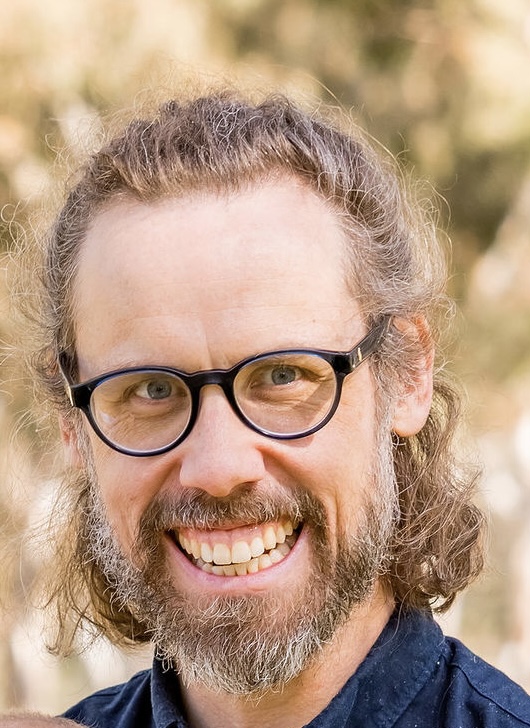
Séamus Krumrey-Quinn is a guest contributor from Mparntwe/Alice Springs and is chair of South Australian Irish Language organisation Gasra na Gaeilge.
_________________________________________________________________________________________________________
 Tinteán