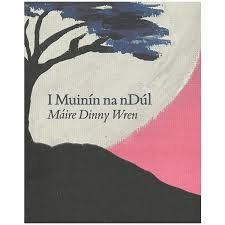
This collection of 115 Irish language Haiku poems is available from An Siopa Leabhar, the Conradh na Gaeilge shop in Dublin. it is cheap enough to buy, 10 euro if you are there, but for another 20 euro it can be sent by post. I have written a few bilingual Haiku poems, so I was curious to read this collection. What I like about writing Haiku is the challenge of capturing a moment in three lines of defined syllables, five, seven, five. I began this during the Covid lockdown, grateful for the chance to leave the world of uncertainty to something I can control. I have since learned that the five, seven, five rule is not always adhered to.
Máire Dinny Wren is an award-winning Donegal poet who spent many years in England. Her moments of capture in I Muinín na nDúil are Irish flora and fauna, mostly Irish trees and birds, some connected to Irish legend and mythology. Here is one about the birch tree (all English translations below are my own)
Coróin de chraobhóga
ar an bheith bheannaithe –
banrion na coilleadh
A crown of birch twigs/on the blessed tree/queen of the wood
…
The oldest tree in Ireland is said to be in Maynooth where Silken Thomas played his lute before surrendering to Henry V111.
Crann Thomáis an tSíoda
an crann is sine in Éirinn –
Crann iúir i Maigh Nuad
Silken Thomas’s tree/the oldest tree in Ireland/a yew tree in Maynooth
…
The legend of Finn MacCool and the Salmon of Knowledge is captured in
Cnónanna an crainn choill
thíolach aigne cinn ar Fhionn
ar bhruach na Bóinne
hazlenuts/ bestowed intelligence on Finn/on the banks of the Boyne
This small book of poetry brought me much satisfaction, not least in attempting English translations for my own learning and for Tinteán readers. I learned the Irish words for a variety of trees. I was aware of the salmon of knowledge but did not know that the salmon received that knowledge from that contained in the hazlenuts that dropped into the water.
The final section of I Muinín na nDúl are 33 Haiku in sets that follow the Irish seasons: Ó Imbolc go Bealtaine; Ó Bhealtaine go Lúnasa; Ó Lúnasa go Samhain; Ó Shamhain go hImbolc.
While we have summer-a-comin’ here in Australia, we can still relate to a traditional view of the Christmas season in
Caorga dearga ar chrann cuilinn
sneachta gléigeal ar an talamh
coinnle na n-aingeal ar lasadh
Redberries on a holly tree/bright snow on the ground/angel candles lighting
…..
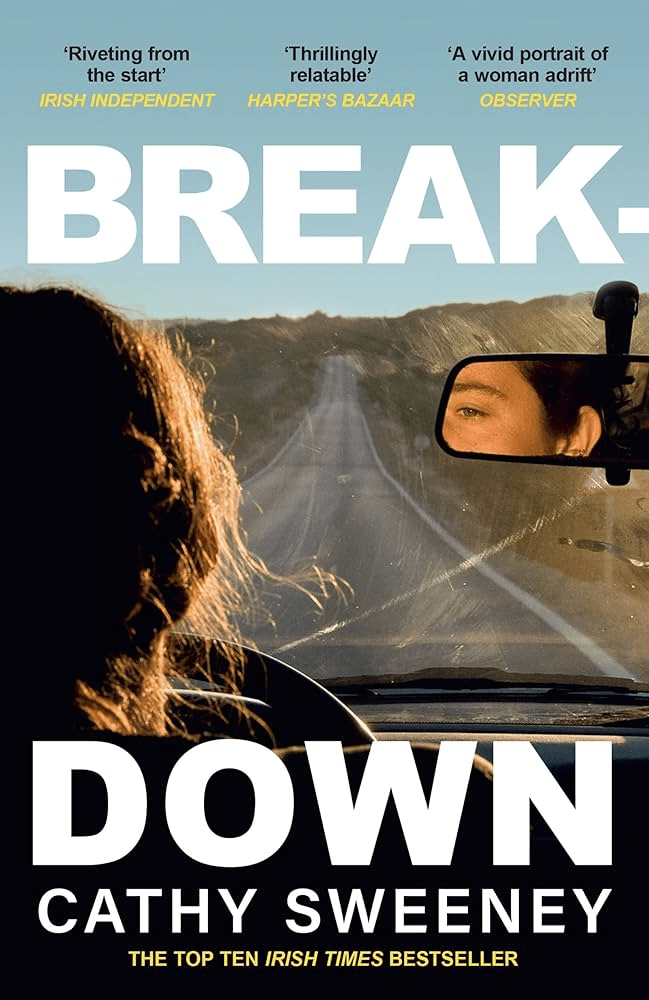
Becoming painfully aware of overconsumption and the shallowness of her own life, a woman sets out on a road trip and does not return. At the outset of Breakdown by Cathy Sweeney, I am reminded of another Irish novel, Nesting by Roisín O’Donnell reviewed here in October about a woman who leaves home having had enough. Both women intrigue and horrify, putting themselves in jeopardy and traumatising others, especially children. This is less so with Breakdown by Dublin author Cathy Sweeney because that protagonist’s children are grown up. Her husband is not abusive and controlling. She has everything you might think of as representing a successful marriage, but she chooses to leave it all.
‘Mothers are not supposed to go on road trips.’ is Cathy Sweeney’s opening sentence. The idea continues: mothers may leave home for work or to do the shopping but they are expected to return home the same day. The unnamed woman in Breakdown has had enough of the so-called perfect marriage.
As she drives away from her life, we are in her head, noting the signage along the way that is presented in all capitals: TIREDNESS KILLS TAKE A BREAK; CHANGE IS POSSIBLE; SAY NO TO AUSTERITY. We are also presented with lists, at one point the 18 items in her handbag as if they will give us both a clue to who she is. How can we understand her decision? What is clear is that her life now is one long response, whether to the needs and wants of family and friends or to social media and the ever-present mobile phone. We travel with her down along the east coast of Ireland, on to the ferry at Rosslare, and over to Wales as she breaks down what she has become by interrogating language.
The language in Breakdown is plain and direct at times as if the protagonist is trying to express what has happened:’…women can disappear right in front of you. My mother began disappearing in her fifties, and by seventy she was completely gone…My best friend, disappeared into a story called My Perfect New Life.’
Another time we are presented with the mechanics of using a toilet on the train, ‘flush,’ ‘suction’,’ compact-sink-cum dryer’ that is immediately followed by:
Beads of rain streak the window beyond which there is a violet tint in the sky as dusk begins to fall. Dim telegraph poles slip by. Then the chequerboard of yellow and black at the edge of a small town, and bubbled letters caught in the floodlights of an AstroTurf pitch.
In an interview with South Australia’s Matilda Bookshop (https://www.matildabookshop.com.au/cathy-sweeney), Sweeney explains how she uses language in Breakdown
The style of a novel, for me, is not separate from the content; the more in tune they are with one another, the more powerful the overall effect. From the outset, I wanted Breakdown to read like a report from experience rather than a ‘well-made’ novel, and so I took the familiar and plain style of the personal essay as a model, allowing myself some poetic flourishes here and there, as well as incorporating text as it is used in the contemporary world.
Margaret Meyer has summed Breakdown as ‘poignant’ and ‘unsettling.’ Danny Denton found it ‘dazzling’ and ‘startling.’ I concur with all.
Dymphna Lonergan
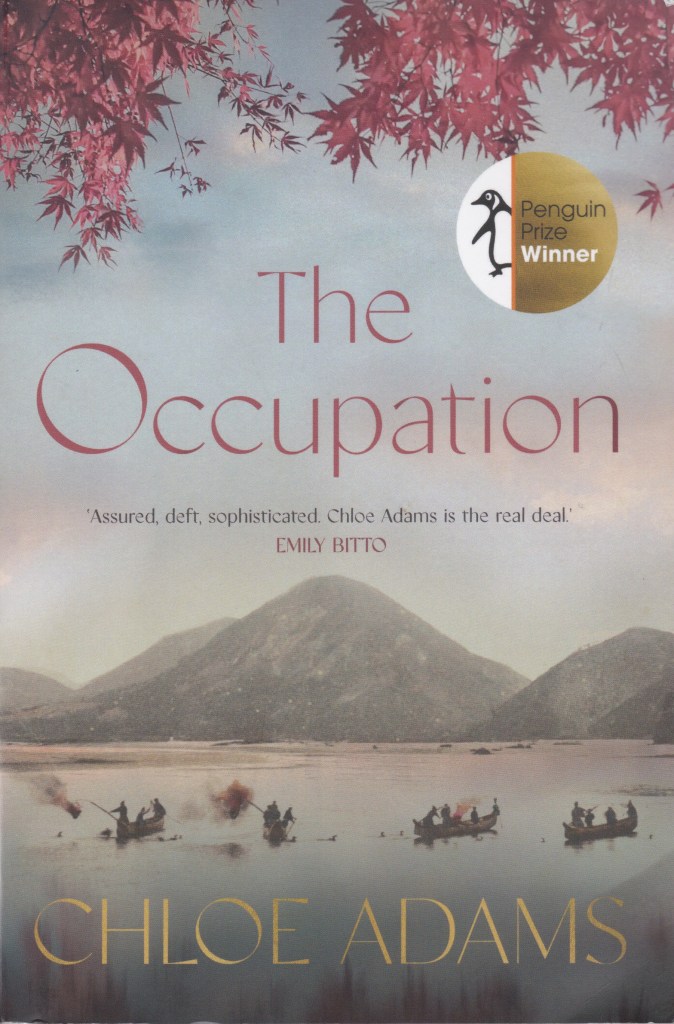
This fictionalised memoir has a tenderness about it, being a tribute to her grandmother and mother. I knew her mother as a child, at university in Queensland, and in Melbourne as a Bloomsday theatre director, actor and a fellow broadcaster about theatre. I heard part of the story from the author’s mother in my (and her) fifties as the story of her adoption was first unfolding, but the story then had not reached its climax, and lacked the context which daughter Chloe has provided. It’s a story that combines delicacy with the worst of what human beings have inflicted on others they have managed to demonise. It deals with the race issues raised very sensitively. And it’s a quintessentially Irish-Australian story in that it documents the shame then attaching to having a child out of wedlock. The author blames puritanical Irish Catholicism for her mother’s adoption by an aunt, and her realisation that the woman she called aunt, who visited her often, was in fact her grieving mother.
The context is extraordinary. The memoir/novel is set in an island off Hiroshima soon after the bomb was dropped. Chloe’s grandmother was an ex-nurse deployed in a canteen feeding Occupation forces. The sexual union that resulted in my friend’s birth was an act of passion and pain triggered by her mother’s first exposure to the catastrophic damage wrought by the first Atomic bomb. Hiroshima today, and I’ve revisited it in the last month after two visits 20 years ago, is a place that quietly promotes peace and advocates for a nuclear-free future. I find it a profoundly moving and extraordinarily zen position for its citizenry to prosecute, but I know it’s not been arrived at without a lot of suffering, having met a hibaksha, a bomb survivor and her anguished son who carried the grief in a way his mother didn’t. Something of the ambivalence of Hiroshima people’s commitment to celebrating and defending life is to be found in this novel. The reader is encouraged to understand why a deeply Catholic girl could so far transgress the moral ethos of her family in an act of anarchy, exuberance and defiance of the bomb’s utter destructiveness. In Chloe Adams words, Mary’s sensitive response to mass destruction serves to heighten her sense of what is sacred in life:
Most peculiar of all, there were dead bodies, many of them, piled up along shores and in jungle landscapes, humans who were not so lucky as her. but here she was, life, ascending from the ashes. She should take this happiness, clutch it, embrace it, possess it. She should acquiesce, wide-eyed and giddy, to the wonders of this mortal cage.Let him press his fingers into the soft animal of her body until she released a skittish little gasp. Let him enter her. Make them a union. Indivisible. Consecrated under the great yawning canopy of the Japanese sky (p.150).
Frances Devlin-Glass
 Tinteán