Meeting of the Waters: Echuca and beyond
Val Noone
I enjoy watching river junctions, the flowing and mingling water, peaceful and calming, yet thought-provoking. Last month I experienced a nice synchronicity of two writers on that very topic.
As many of you know, ‘The Meeting of the Waters’ is the title of Thomas Moore’s beautiful 200-year old song about the Avoca valley in Ireland. For Moore, ‘there is not in the wide world a valley so sweet, As that vale in whose bosom the bright waters meet’, namely where the Avonmore meets the Avonbeg to form the Avoca River. His song celebrates the beauty of nature in the valley and the importance of friendship.
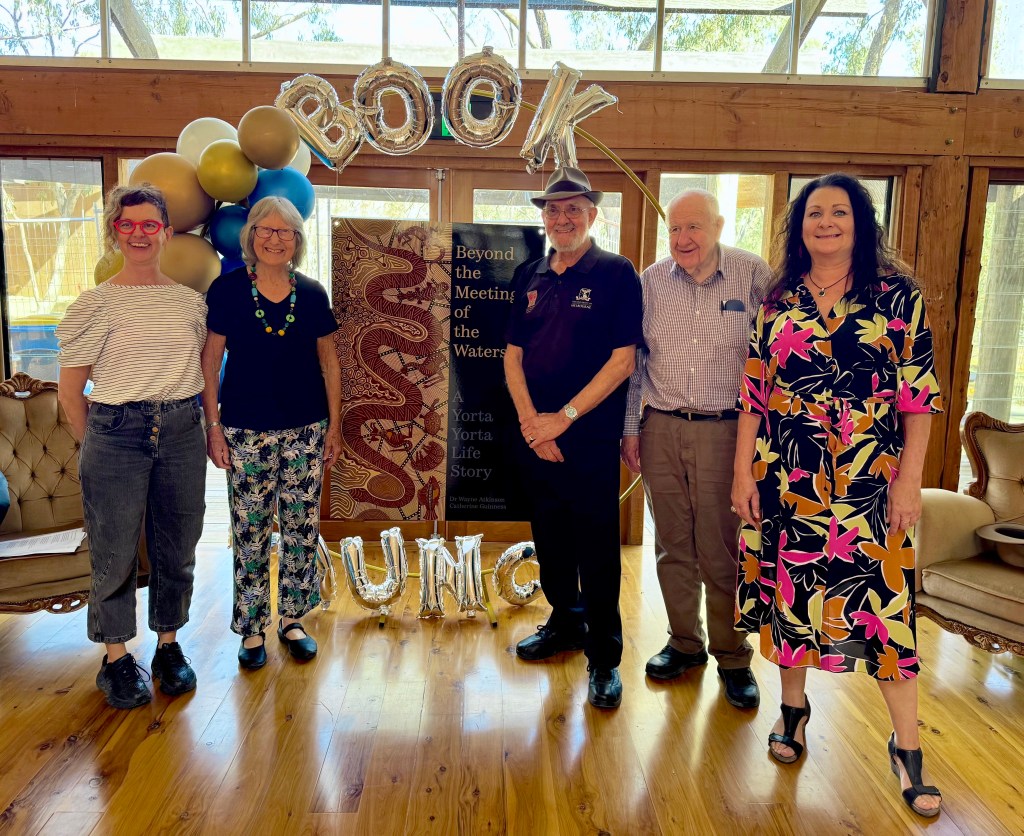
However, this same phrase occurs in the title of Wayne Atkinson and Catherine Guinness’ new cutting-edge book, Beyond the Meeting of the Waters: a Yorta Yorta Life Story. Here is a report on its launching on Wednesday 15 October 2025 at the newly renovated Dharnya Centre on traditional land in the Barmah Forest, before a hundred-plus crowd, many of them Yorta Yorta.
The MC was Andrea James, artistic director of Australia’s longest running First Peoples theatre company, Ilbijerri Theatre Company, and a kinswoman of Wayne. Following a smoking ceremony led by Ralph Hume, those present gave an enthusiastic welcome to Wayne and each of six other speakers: Leon Atkinson, head of Yorta Yorta Nation Aboriginal Corporation; Robert Nicholls, grandson of Pastor Sir Doug Nicholls; Catherine Guinness, co-author; Gabrielle Atkinson, daughter of Wayne; Bryan Andy, grandson of leading land rights activist Colin Walker; and myself as family friend and historian.
Wayne, proud Yorta Yorta elder, began his speech with a departure from conventional book launches – he sang Jimmy Little’s ’Yorta Yorta Man’, accompanying himself on guitar, with audience support and to great applause.
He then explained that he had chosen the title because Itchica (Echuca) means ‘the meeting of the waters’: in this case the meeting near Itchica of Dungula (Murray) with Kaiela (Goulburn) and Yakoa wala (Campaspie) and Baala wala (Broken River). Victorian readers may remember Wayne was lead researcher of their still-denied land claim on the banks of Dungula.
Among other things, Wayne said: ‘For thousands of generations, these rivers have been more than geographical landmarks; they are the lifeblood of our cultural identity, the keepers of our stories, and the witnesses to our history. They have seen our ancestors fish, gather, and nurture the land. They have seen us resist, adapt, and survive. And now, they watch over us as we reclaim our cultural history and narratives to share with the world.’
‘This book is not just my story,’ he said, ‘it is our collective story in the category of goopna ngarwul meaning a time for deep listening and learning. This book is my journey from the riverbank to the wider world, and back again, to the sacred homeland that calls us at the end of our journeys.’
‘Today is also a double celebration. From heart-break to rejuvenation, Dharnya is back where it rightfully belongs, thank you Yorta Yorta Nation Aboriginal Corporation and all contributors.’
Co-author and partner of Wayne, Catherine Guinness, of Irish and English parents and long-time teacher in Indigenous education programs, said: ‘I feel honoured to stand here with Nations to celebrate this Yorta Yorta life story. I have always been welcomed by your community and writing this book is a way of saying thank you for sharing so much with me. Of course I can’t say I have met all the cousins, but belonging to Wayne’s large family has given me a fulfilling life. We have been together for 45 years and over that time I have seen the many occasions you have had to stand up for your inherent rights to land, heritage and indeed your very identity.’
Catherine is a direct descendant of Arthur Guinness who started the stout, (she and Wayne got special treatment at the brewery), and a grand-daughter of Harry Guinness who was a leader alongside Roger Casement and Edmund Morel in opposing Belgian slavery in the Congo. (In 2017 Catherine wrote a stunning book, Rubber Justice, about him.)
There are many stories for another day from this exceptional occasion at Dharnya Centre, but I will turn now to a summary of the book’s contents. It is a sensational story of Wayne’s packed life in 23 bite-sized and fascinating chapters, handsomely presented by Melbourne University Press in their Miegunyah series.
The book shows that Wayne and Catherine’s lives are not about self-promotion: they pursue the higher moral values of mutual aid in pursuit of group self-determination, they believe in working for the common good.
The first person named in the book proper is Granny Kitty who was born in 1834. Then come the searing experiences of proud ancestors at Moira Station, Maloga and Cummeragunja. The reader does not get to Wayne’s birth on the river bank at Mooroopna in 1943 until page 77. The family moved into Itchica, Wayne left Echuca Tech at 16, worked at various jobs such as the rice mill and Readymix, shone as a footballer and was a leader of the Shades dance band, married Wendy and they had two beautiful daughters, then with a change of direction he followed his younger brother Graham into tertiary studies, did exchanges with Maori and Native American peoples, and worked hard on Koori oral history.
The book tells how Wayne then laboured mightily on the Yorta Yorta land claim, was part of the success with Barmah National Park, became an outstanding lecturer in political science at Melbourne Uni and in OnCountry learning, and then a Yoorrook commissioner, and much else.
There are items of Irish interest. The book exposes the racism of Tipperary-born premier of Victoria, John O’Shanassy. In 1862 when O’Shanassy took over the lease of Moira Station on the New South Wales side of Yorta Yorta Country, he failed to stop the immoral exploitation of women, and, in his own words, he ‘opposed granting any reserved land to Aborigines’. Thanks to Wayne and Catherine, O’Shanassy’s role will now be better known and it is the duty of Irish Australians to make reparation.
Wayne and Catherine also note positive Yorta Yorta-Irish links. For instance, Wayne and Paddy Malone were mates from school days in Echuca. A turning point came twenty years ago when Wayne was a key person in a Royal Society symposium about the Barmah forest. Over lunch he mentioned that he and Catherine were planning a trip to Ireland. When Geoff Lacey, a friend of Wayne, heard this, he asked me for contacts in Ireland. The two main people we turned to, Louis de Paor and Tadhg Foley, plugged Wayne into University College Galway, as well as the music scene, as you can read.
In his lectures there about settler colonialism, Wayne emphasised the pattern of English killing and displacing of First Peoples in Ireland, and in Virginia in North America, and then in Australia. He discusses this further in the book.
In a congratulatory email to Wayne and Catherine, Tadhg Foley, their mate in Galway just mentioned, quoted Thomas Moore’s melody with which this article begins. With a couple of changes, Moore’s last verse will make a closing wish for Wayne and Catherine: ‘Sweet Dungula valley, how calm could we rest, In your bosom of shade, with the friends we love best, Where the storms that we feel in this cold world should cease, And our hearts, like your waters, be mingled in peace.’

Beyond the Meeting of the Waters: a Yorta Yorta Life Story is well worth reading, and an extra copy will make an ideal Christmas present for someone else.
Val Noone is a friend of Wayne Atkinson and Catherine Guinness, and a colleague of Wayne from when they both taught at University of Melbourne. In 2013 the National University of Ireland awarded Val the degree Doctor of Literature for his contribution to Irish Studies in Australia. He can be contacted at <valnoone@iinet.net.au>.
 Tinteán