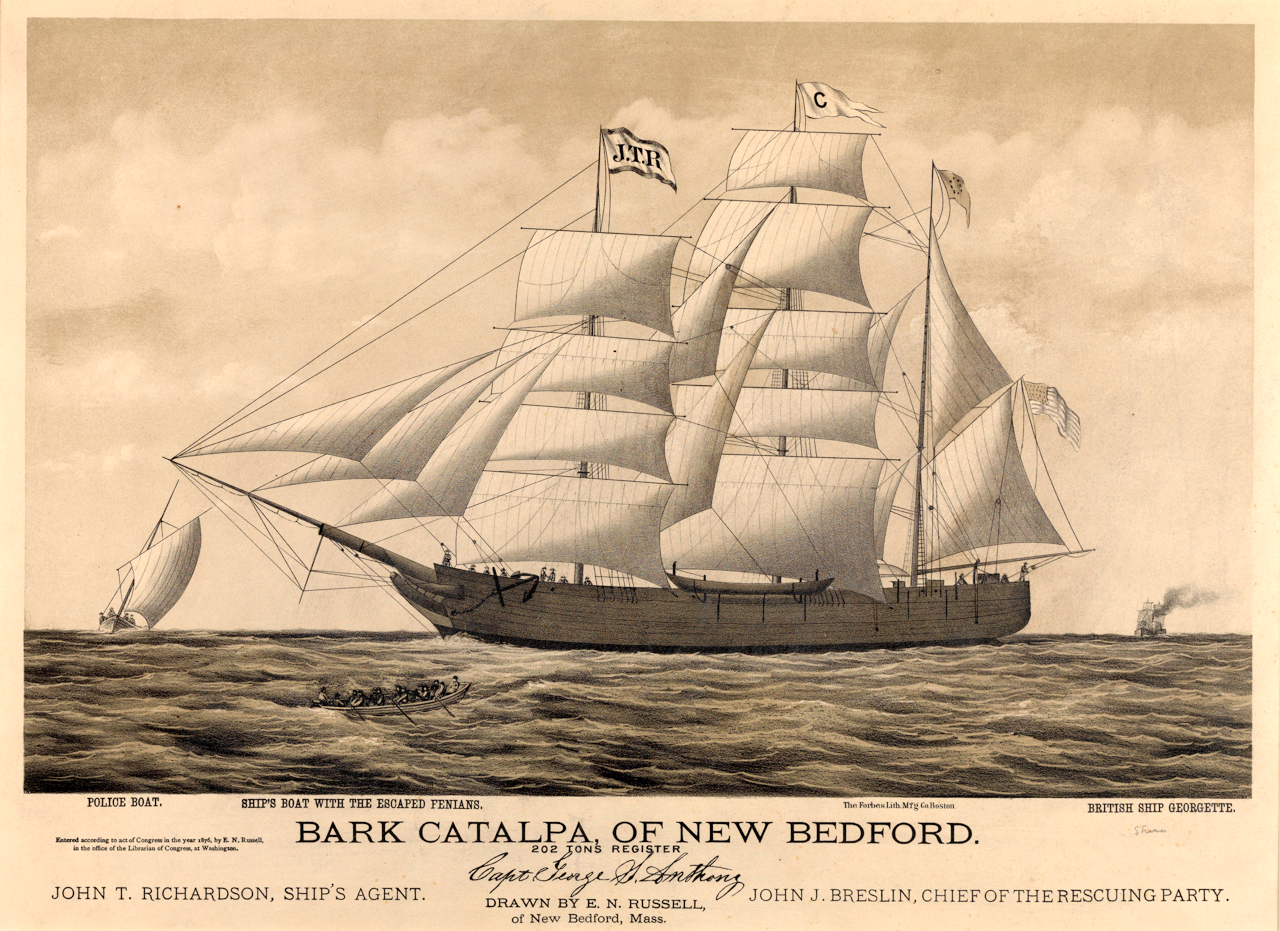
A Commemorative Feature by Bernie Brophy
On 12 October 1867, 320 criminal convicts and 62 Fenian prisoners were marched out of Portland Prison in England towards the harbour. They were loaded onto the frigate Hougoumont. It was to be the last ship transporting prisoners to Australia.
The Fenians were Irish political prisoners who had sworn allegiance to the Irish Republic and were prepared ‘to take up arms to defend Ireland’s integrity and independence’. The writer of this article is a descendant of Hugh Brophy, one of the Fenian prisoners.

Amongst the political prisoners were nine military Fenians. They were Irish men who were career soldiers and who were members of the British Army who had secretly joined the Fenian Brotherhood to fight for Irish independence. They included John Boyle O’Reilly who subsequently managed to escape from W.A. on a whaling ship in March 1869 to the U.S. where he pursued a brilliant career as a journalist, poet, editor and novelist. The other military Fenian prisoners were not to escape for several more years.
The Hougoumont arrived in Fremantle on 10 January 1868, and the prisoners were marched to Fremantle Gaol. They were put to work in quarries, in road gangs and on government building sites.
In due course, the British Government decided to grant a Free Pardon to the civilian prisoners, and in March 1871 the last of these prisoners were set free. However, the military Fenians were to be left in prison because of their active treason against the Government .
The Fenian Brotherhood had been established in the U.S. in the 1860s and it was approached to explore the question of assisting the escape of the military Fenians. John Boyle O`Reilly and more particularly John Devoy (a leading Fenian who had been released from goal in England on condition that he could not return to Ireland and who had gone to U.S.) devised a plan to rescue the prisoners. It involved the raising of funds to purchase a whaling ship and the engagement of a captain to sail the ship to Fremantle with a view to carrying out a rescue of the military Fenians and bringing them back to America.
In February 1875, Captain George Anthony of New Bedford, Massachusetts, met with John Devoy and others and the rescue plan was explained to him. A whaling ship had to be purchased and he would sail it, keeping up a pretence of whaling, all the way to Fremantle. He was to wait off the coast of W.A. and a boat containing the Fenian prisoners would approach his ship and he would take them on board and sail back to America. Other people in Fremantle sympathetic to the Fenian cause were to be engaged to ensure that the prisoners were working outside the prison walls at the time of the proposed rescue mission. Captain Anthony had no connection with the Fenian movement, but having heard the history of the movement and the fact that that the prisoners were political prisoners fighting for their nation’s freedom, he agreed to consider whether he would play a significant part in such an audacious expedition. After due consideration, he agreed to take on the captaincy and, in due course, a whaling ship called the Catalpa was purchased.
On 30 April 1875, it set off from New Bedford bound for Australia. A crew had been enlisted in the belief that they were to go whaling. It was not explained to them that they were on a rescue mission which could end up with them being locked up in a British prison. The plan was for the ship to arrive off Western Australia in January 1876.
The Rescue Plan
John Breslin was an active Fenian in Ireland. In 1865, he moved to America. John Devoy made contact with him there and explained to him the proposed plan to rescue the military Fenians. The Rescue Committee in New York agreed to finance Breslin’s trip to Australia where he would be masquerading as a businessman looking to invest money in Australian gold shares, timber farming or grazing land. In fact, he would be the man on the ground in Fremantle to facilitate the escape. In due course, he set sail for Australia and arrived in Fremantle on 16 November 1875.
In the meantime, the Catalpa successfully made it to the Portuguese Colony of Azores and thence to the Spanish Colony of Tenerife off the coast of Africa. It had succeeded in taking several whales. It then proceeded down the west coast of Africa, around the Cape of Good Hope and then east to the Indian Ocean on course for Bunbury on the south-west coast of Western Australia.
The six military Fenians to be rescued were Michael Harrington, James Wilson, Martin Hogan, Thomas Henry Hassett, Bob Cranston and Thomas Darragh. They had all been sentenced to life imprisonment.
Breslin advised Father Patrick McCabe, a Catholic priest in Fremantle sympathetic to the Fenian cause, that an American whaler would soon arrive to collect the prisoners off the coast and arrangements would need to be made to have all the prisoners outside the prison walls at the pre-arranged time. Father McCabe surreptitiously passed this information onto James Wilson who let the other proposed escapees know.
As a consequence of unfavourable winds, the Catalpa did not reach the Bunbury coast until 28 March 1876. Captain Anthony disembarked and met up with Breslin to discuss the rescue.
On Easter Sunday, 17 April, Captain Anthony lowered the whaleboat from the Catalpa and with selected crew members rowed to the shore of Rockingham Beach (the pre-determined landing spot) and camouflaged the boat. It was night-time and the crew were told to rest overnight on the beach,
Twenty miles north in Fremantle, Breslin rose early on Easter Monday. He had a team of horses and a wheeled trap. Tom Desmond (who had come out from the U.S. to assist Breslin) also had a trap. The escapees were all working outside the Fremantle gaol walls. Wilson, Cranston and Harrington jumped into Desmond’s cart and Darragh, Hassett and Hogan jumped into Breslin’s cart and they headed south in the hope that the prison guards in the watchtowers were otherwise occupied. The escapees all arrived safely at Rockingham Beach, boarded the whaleboat and rowed out towards the Catalpa.
When the report of the escape reached the authorities early in the afternoon, a heavily armed contingent of police was assembled to go aboard the Georgette, a Government gun boat with a twelve-pounder cannon. The steamer took off from Fremantle around 9 pm.
In the meantime, the weather had turned and a storm blew up. The mast on the whaleboat snapped and fell into the sea. The boat was taking in water and was making little headway in reaching the Catalpa.
During the night the storm abated and there was an easing of the heavy seas. The whaleboat had the Catalpa in sight. However, the Georgette had now located the Catalpa and was steaming towards it. The Georgette, fortunately, had not seen the whaleboat. Superintendent Stone of the water police yelled that he intended to board the Catalpa to search for ‘Irish prisoners.’ Sam Smith, the First Mate whom Captain Anthony had left in charge of the ship, refused to allow him on board. The Superintendent decided to return to Fremantle (as the steamer was running low on coal) to refuel and at the same time search for the missing whaleboat before the boat reached the Catalpa.

The Georgette on its way back to Fremantle also met the water police cutter (which had come to assist the Georgette) and it was told to search for the whaleboat.
The whaleboat in the meantime headed for the Catalpa. The cutter saw the boat and there was a race to try and reach the boat before the boat got to the Catalpa. The whaleboat got there first and was secured to the Catalpa. Captain Anthony told Smith to hoist the ensign, and the American Stars and Stripes was hoisted up the main mast. Anthony and the whaleboat crew and the prisoners climbed aboard. The crew of the cutter observed this and decided to return to Fremantle for further instructions.
At daybreak, the Georgette was observed steaming towards the Catalpa. A shot from its cannon was fired across Catalpa‘s bow. Through his speaking trumpet, Superintendent Stone demanded that the Catalpa ‘heave to.’ Captain Anthony refused. Stone said: ‘I will give you 15 minutes in which to heave to. If you do not, I shall blow the masts out of you and sink you.’ Captain Anthony replied: ‘This ship is sailing under the American flag and she is on the high seas. If you fire on me, I warn you that you are firing on the American flag.’
The Catalpa sailed away followed by the Georgette, but after a short period of time the Georgette stopped as Superintendent Stone determined that firing a cannon into the ship on the high seas would be a breach of international law. The Georgette steamed back to Fremantle.
The Catalpa sailed westward across the Indian Ocean, rounded the Cape of Good Hope and thence to the Atlantic Ocean.
Much to the chagrin of the British Government, the escape made news all over the world, particularly in England, Ireland and the U.S. In June 1876, up to 100,000 people marched in a wild torchlight parade in Dublin to honour the Catalpa Six and their rescuers.
On 19 August 1876, the Catalpa arrived in New York harbour and the political prisoners disembarked. Captain Anthony took the Catalpa to New Bedford Harbour, Massachusetts, arriving on 24 August. A gala reception was held the next night in New Bedford, addressed by John Boyle O`Reilly with a huge crowd was in attendance. Thereafter, large crowds attended receptions for the prisoners across the U.S. over a long period.
In 1920, Eamon De Valera, President of the Irish Republic, toured the U.S. He travelled to New Bedford and laid a wreath and the Irish Tricolour on George Anthony’s grave.
The story of the escape of the Fenian prisoners has become more well known since Peter Fitzsimon’s book The Catalpa Rescue was published in 2019. It is a well-researched and detailed account of the escape and of the historical context in which it occurred.
In preparing this article, I have particularly made use of the book The Voyage of the Catalpa by Peter Stevens published in London in 2003 by Weidenfeld & Nicholson History. It is also worth reading for those interested in more details of the escapade.
March/April 2026 will mark the 150th anniversary of one of the greatest prison escapes in the history of Australia and Ireland. The Fremantle Fenian Freedom Group is arranging to celebrate the occasion over three weekends in three places. Firstly, in Bunbury on 21/22 March, there will be Irish music and Mr. James Ryan, the great grandson of Captain Anthony, plans to visit Western Australia and will give a talk at the Bunbury Historical Museum. There will also be a tour of the John Boyle O`Reilly escape site.
On the weekend of 27/29 March, events will take place in Fremantle. There will be a history symposium on Friday 27 March, a ‘History in the Pub’ day in various locations around Fremantle on Saturday 28 March and a Family Day at the W.A. Maritime Museum on Sunday 29 March. It is proposed to hold a major music concert on either the Friday or Saturday night. Fremantle Prison will also hold an exhibition.
On the weekend of 5/6 April, events move to Rockingham. The play Catalpa: Flight to Freedom will be staged and there will be a carnival on Easter Monday, 6 April .
A number of these events are still being finalised and the organisers are hopeful of many visitors, including from the Eastern States . Further information can be obtained by going to the website www.fremantlefenians.com.au
Bernie Brophy
Bernie is a great great nephew of Hugh Francis Brophy, one of the 62 Fenians transported to Australia on the last convict ship, the Hougoumont, which arrived in Fremantle in January 1868. The Fremantle Fenian Freedom group arranged a commemoration of the 150th anniversary of this event in Fremantle in January 2018. The writer and other Fenian descendants from Australia and Ireland participated in these commemorative activities, along with many other interested members of the general public.
 Tinteán