In eagar ag Éamon Ó Céileachair
(A folklore collection in Irish from Kerry, edited by Éamon Ó Céileachair)
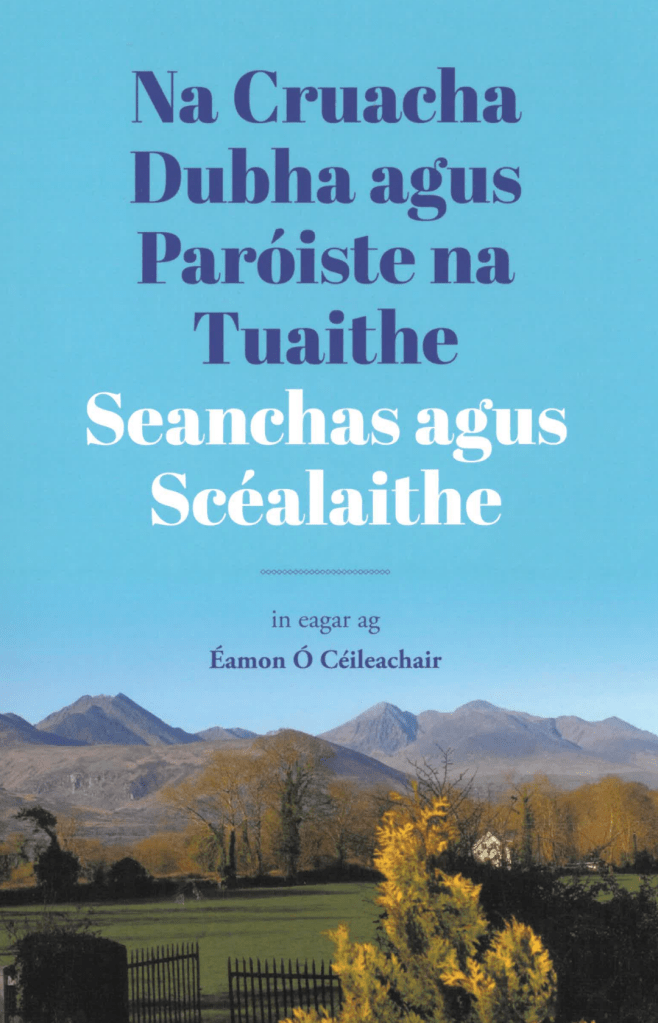
by Colin Ryan
Between 1936 and 1940 the collector Tadhg Ó Murchú made several visits on behalf of the Irish Folklore Commission to the broad parish called Paróiste na Tuaithe, virtually coterminous with the baronies of Dún Ciaráin in south-west Kerry, with the highlands of the Cruacha Dubha within it. Here he gathered what he could of stories, local beliefs, and songs in the Irish language. The language was in decline there, and his informants, both men and women, were elderly. There would be little further opportunity to harvest the remarkable local traditions of this corner of the Gaelic world.
The collection of such material in the thirties and forties was a late manifestation of the Revival emphasis on folk material as an mark of cultural authenticity. Revival Irish had also found a home in the cities, but to the folk tradition belonged the immemorial memory of the Irish people, as constructed by the Romantic imagination. This left Ireland with one of the largest collections of folkloric material in western Europe, both in Irish and English.
Ó Murchú recorded his informants with notes and on the wax cylinders of an Ediphone, a machine which came to be christened locally as ‘Újon’. He lodged in the district and traversed the roads by bicycle, no easy task, for, as he said: ‘Talamh ana-chruaidh, ana-chlochach atá ar fuaid na Tuaithe’ (throughout the parish the land is very rough and stony).
We are indebted to Éamon Ó Céileachair for the retrieval of this material from the archives of the Commission. The book that resulted is Na Cruacha Dubha agus Paróiste na Tuaithe: Seanchas agus Scéalaithe. A glance at the listed topics gives some idea of the variety of material: stories about animals, the Fianna, magic, spirits, places, the way people lived, the Famine, and nature, with local songs included. The storytellers, all vividly described by Ó Murchú, were mostly men, but included four women (of whom one was Cáit Bhean Uí Fhoghlú – see below).
The transcription of the material is generally faithful to the dialect of the area, which has a number of distinctive features. Typical forms are thána (for ‘tháinig mé’ – I came), bhraitheas (‘bhraith mé’ – I felt), raghad (‘raghaidh mé’ – I’ll go), as thobán (‘as tobán’ – from a tub), go dtí a mhnaoi (‘go dtí an bhean’ – to the woman). What strikes one in the transcriptions is the easy, natural, colloquial flow of the language, something to be envied by those who come to Irish as a second language.
The introduction gives us the socio-linguistic background encountered by Ó Murchú, with statistical tables showing the progression in the area from Irish to bilingualism and then to English monolingualism from the mid-19th century on. Referring to one such table, showing the changes between 1851, 1871 and 1891 in the barony of Dún Ciaráin Thuaidh, the editor remarks:
‘Tá an chuma ar na torthaí mar atá siad léirithe sa tábla go bhfuil pobal na barúntachta tar éis teacht ar aon aigne athrú ó Ghaeilge go Béarla ar chúis amháin nó ar chúis eile. Is é an teaghlach anois, chomh maith leis na scoileanna náisiúnta, láthair an athrú teanga de bhrí go bhfuil mórchuid na dtinteán dátheangach mar atá léirithe sa dara colún, Béarla agus Gaeilge. Is follas go bhfuil cuid de na tuismitheoirí ag labhairt Gaeilge eatarthu féin agus Gaeilge agus Béarla leis na leanaí agus cuid eile ag labhairt Gaeilge amháin leo.‘
‘It appears from the results as shown in the table that the people of the barony have all arrived at the same decision to switch from Irish to English, for one reason or another. Now it is the household, along with the national schools, which is the site of language change, because most of the households are bilingual, as shown in the second column, ‘English and Irish’. It is clear that some parents are speaking Irish between themselves and both Irish and English with the children, with others speaking just English to them.’
An example of the material is this extract from ‘Diarmán na Bó agus Capall an tSagairt’ (‘Diarmán of the Cow and the Priest’s Horse,’ p. 140). The priest’s horse (evidently a mare) collapses inexplicably, and he is told that the horse has been afflicted by ‘ciorrú’ (the evil eye) and that only Diarmán na Bó can help. The priest asks that Diarmán be sent for.
Ghluais sé ar stealladh lena chois is dócha nuair a ‘nis sé an scéal do. Well, do tháinig sé is d’fhéach sé ar an gcapall is chonaic sé í is bhí sí sínte. Well, bhí an sagart lena ais. Well, nuair a bhí beagán ráite aige: ‘Well, a athair,’ ar seisean, ‘bean a chiorraigh do chapall,’ ar seisean, ‘bean a chiorraigh í,’ ar seisean, ‘ní haon fear a chiorraigh í,’ agus dhírigh sé ar chaint arís. Ba gheairid gur chorraigh sí. Nuair a bhí an focal déanach ráite aige, léim sí agus chroth sí an srian chomh maith is bhí sí riamh.
He set off at full speed on foot when the story was told to him. Well, he came and looked at the horse and saw her and she was stretched on the ground. Well, the priest was beside him. Well, when he had recited some words of a charm: ‘Well, Father,’ he said, ‘it was a woman who cast the evil eye on your horse,’ he said, ‘a woman did it,’ he said, ‘not a man,’ and he began to recite again. It wasn’t long before the horse stirred. When he had finished reciting, she leapt up and shook the bridle as well as she ever was.
A story like this casts light on the comfortable coexistence of traditional folk magic with conventional Christianity as represented by the priest, who seems quite accepting of Diarmán’s powers in this matter. It also reminds us of the traditional power, for good or ill, of the ‘wise woman,’ the cailleach or bean feasa.
Irish, not English, was the first language of a large number of 19th century emigrants to Australia, the majority from Munster. With them they brought an inheritance of stories, beliefs and song. Little of that inheritance was recorded in the new country, but books like this give a vivid impression of what came and what was lost. The Australian links in the material presented here are interesting. In one story a landlord declares that if any of his workers steal even a lamb they will be transported. One of his workers takes advantage of this.
‘Ghoid sé an t-uan is cuireadh dlí air, is deineadh transporting air go hAustralia. Sin mar a chuaigh sé sin go hAustralia gan aon phingin a dhíol as. Ach bhí sé ina dhuine uasal ina dhiaidh in Australia. Bhí.‘
‘He stole the lamb and was tried, and he was transported to Australia. That’s how he went to Australia without having to pay a penny. But he was a gentleman after that in Australia. Yes indeed.’
In 1939 Ó Murchú visited Cáit Bhean Uí Fhoghlú (mentioned above), an elderly woman he described as tall, slender, hardy and red-haired. She was outgoing, a source of many songs, and danced to the fiddle music of Father Tom Jones, an accomplished musician (and athlete) who had spent time in Queensland immediately after his ordination, from 1897 to 1905.
The book includes maps of the area, a bibliography and a catalogue of the sources, though an index would have been welcome. The occasional typo should not detract from enjoyment of the book for those of us who have enough Irish to tackle it.
It would be remiss of this reviewer not to acknowledge the assistance of Margaret Coffey, who not only drew his attention to this book but supplied additional information.
 Tinteán