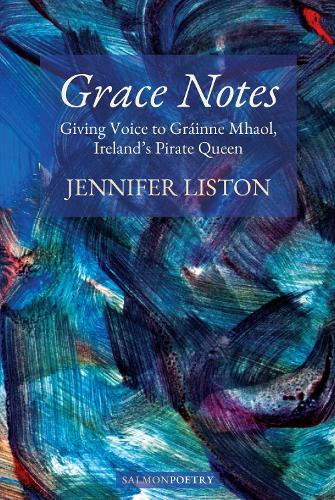
Grace Notes by Jennifer Liston
Grace Notes is a book of poetry by the poet Jennifer Liston, exploring themes of the legendary Irish pirate queen, Gráinne Mhaol (Grace O’Malley). Gráinne Mhaol was head of the Ó Máille (O’Malley) clan and was known for her defiant nature and bold feats becoming a symbol for independence and rebellion, a fearless leader on both land and sea.
The author notes in her introduction that there are Gráinne Compositions, ‘rescued’ poems and ‘found poems’ in this book – with the titles indicating what they are – which combined, adds all sorts of styles and flavours to the book. She notes in the introduction:
‘The Gráinne compositions in Grace Notes place Gráinne at different points in her life and also situate her in a mediaeval past and a borrowed future via her dreams, or aislings. Close to death, Gráinne is encountering
iarsmaí (relics) of her life that become very real to her. Each composition shows her reconstructing a moment or feeling intensely and vividly –whether in her past, present or future – and sharing it with us. I drew on the stories about her that I’d heard, or that were discussed in her biography by Anne Chambers, or mentioned in passing elsewhere. The re-worked and re created stories from her past and future are a form of apology to her for having been written out of history.‘
The ‘rescue’ and ‘found’ poems mingle with these compositions. These are written, according to the author via a:
‘replicable, repeatable process I developed to ‘make heard’ voices hidden within prose texts. A rescued poem is considerably different from a found poem; a found poem consists of blocks and phrases of text that are taken from one or many print or online sources such as books, newspapers and street signs, and represented or reorganised as a poem.’
Jennifer Liston grew up in Gort, Co Galway. She has returned to live in Ireland after more than 30 years in Australia (Sydney, Canberra and Adelaide). Grace Notes is her fourth collection and is the outcome of the creative component of her PhD. Jennifer performed some of the poems and songs from this collection in her five sold-out solo shows ‘Grace O’Malley, Irish Rebel, Pirate Queen’ at the Adelaide Fringe Festival 2020 and in regional South Australia. Jennifer’s poems have appeared in several journals and anthologies including Jacket2, The Canberra Times, The Australian Poetry Anthology, The Found Poetry Review, Cordite Poetry Review, Transnational Literature and Best Australian Poems. Jennifer has performed her poems at numerous Irish and Australian poetry events and on radio in Ireland and Australia.
More information can be found on Jennifer’s website at https://jenniferliston.com/categories/27-Grace-Notes
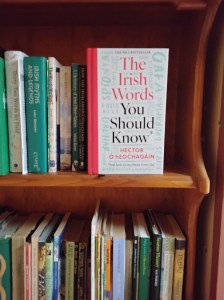
The Irish Words You Should Know by Hector Ó hEochagáin Gill Books 2024
I was delighted to receive The Irish Words You Should Know as a present from my niece visiting Adelaide from Dublin recently. She knows well my interest in the Irish language, Irish English, and words in general. What, I wondered, were these words I should know? How many did I know already?
Ó hEochagáin’s words are set out on individual pages with English translations and suggested pronunciation with the Connemara dialect pronunciation if relevant.
I was intrigued straight away by the first entry: ‘call-and-response’ phrases you say ‘to someone you know well’.
Aon scéal agat/ad?
Any stories?
Aon scéal agat?
[ayn shcale ah-gut or ayn shcale att]
Diabhal scéál muna bhfuil scéal ‘ad fhéin.
Any stories?
I’ve no story unless you’ve a story for me yourself.
And so it goes, for 415 pages. As I made my way through the book, I became aware of how ‘masculine’ this Irish word world is. In discussing the word for ‘eyebrows’, fabhraí agus malaí, Ó hEochagháin states ‘We have great eyebrows as a nation’ and cites a half dozen famous Irish men, Brendan Behan and Brendan Gleeson included. Then later, the word bísire, a screwdriver is a word Ó hEochagáin remembers from his schooldays.
What I am learning are words that struck Hector Ó hEochagáin in his early exposure to the Irish language and as he became immersed in Connemara Irish. Naturally, the best place for a newcomer to pick up the local Irish dialect would be the pub, and the book includes many such words and sayings. I am familiar with the Irish English term á fine thing’ applied to an attractive male, but now I know its Irish language equivalent: a staic for a male or a stumpa for a female. I suspect, however, that these words might be slightly derogatory outside of a certain setting.
For word lovers who enjoy going down rabbit holes you will find such intriguing entries such as ioscaid, the word for the hollow at the back of the knee and its accompanying phrase beidh mé ina hioscaidí agat I’ll be right behind you/I’ll back you all the way, followed by the word ascaill/underarm, armpit. If someone puts their arm under someone else’s, they are what we term ‘linking arms’.
Ó hEochagáin takes us then to the word ascaill as used in street naming: an ascaill is an avenue. My vision of an avenue is of a wide street lined with trees, and I saw few of these when I was living in Ireland. Now the ascaill, ‘avenue’ can be part of a housing estate division.
Just like the author of this book, I remember certain words and phrases from my schooldays that stayed with me, often for their sound sense. I was delighted to find one of these in The Irish Words You Should Know: ag stealladh báistí in Irish English is ‘lashing rain’. Those harsh ‘sh’ sounds in Irish captured the pain in my face when making my way to school and the rain ag stealladh báistí into it. Ó hEochagáin wryly suggests that Irish car windscreen wipers should have special settings to cater for the variety and intensity of the rain: ‘slow, medium, fast, Irish’. He then moves on to the word aiteall, ‘the gap between two showers’. Growing up in Dublin, I had no word for the occasional break in the rain that would afford a quick dash to the next safe place, although I remember that quick dash between places if you were not wearing rain gear. The West of Ireland, perhaps, has greater need for such a word.
Overall, The Irish Words You Should Know is a peek into Hector Ó hEochagáin’s world of Connemara Irish especially. The title does not capture the passion the author has for the Irish language and Connemara. Nor does it capture his humour. It should be called something like ‘Hector loves Irish, and so will you’. It is an excellent gift for anyone with an interest or even half an interest in the topic.
Dymphna Lonergan is a member of the Tinteán editorial group. She holds academic status at Flinders University, South Australia.

That Old Country Music by Kevin Barry
‘Here’s a very old joke – Cause of death: the West of Ireland’. This is a line from ‘Old stock’, a story about driving north to Donegal to visit Uncle Aldo who is on his way out. Though ‘dampness’ is the likely cause of Aldo’s demise, it is surprising that he lasted until eighty odd. A woman-chasing, car crashing, fool for the drink, Aldo once fell out of a hotel room onto the roof of a taxi.
The backdrop of this collection of stories is rural Ireland. Death both literal and metaphorical is a bit of a recurring theme. In ‘Who’s dead McCarthy’, the title character McCarthy is asked why he is obsessed with death, ‘I find it impressive,’ he says.
It’s not all death in rural Ireland though. There is love, sex and magic in the mix too. My favourite story is ‘The coast of Leitrim’, a love story between Seamus and Katherine. Seamus believes he and Katherine have a telepathic connection, but the thought of going out together terrifies him, ‘he took Imodium against the thunder of his insides’. Though the connection is extraordinary, there is something quite ordinary in Seamus’ attraction towards Katherine, somewhat smitten, he remarks approvingly that she ‘seemed to know her way around a head of cabbage’.
An internet search of ‘Here’s a very old joke…’ returns many reviews of That old country music. West Ireland and death are a big part of these stories, but it is the joke that is the best part. Speaking of the countryside in which he lives, Kevin Barry said, ‘it’s kind of spacey and weird’, and somehow he captures this perfectly in his storytelling. Throw in a good dose of humour, and that about sums up this collection.
Linda Rooney is a member of the Tinteán editorial collective.
 Tinteán