by Dymphna Lonergan
Ancestral Homes and Plaques
In an article on Young Irelander Kevin O’Doherty’s years in Australia, mention was made of the sugar plantation in north Queensland that he bought in 1880 and named ‘Inishowen’ after the Doherty ancestral home in Donegal. (see The Australasian Journal of Irish Studies, Vol. 24, 2024, p. 11). I am reminded of the O’Halloran brothers of Limerick whose homes in South Australia were named Lizard Lodge and Clanfergil after the image and words on the O’Halloran family crest (see ‘Cultural Capital and Irish Place Names’ in Irish South Australia, Wakefield Press, 2019).
Portable Irish place names
The connection between place naming and belonging was promoted in Ireland by the Australian Emigration Society in 1839. Landlords who wished to depopulate their lands could ‘purchase 100,000 acres of land; call it ‘New Dublin,’ ‘St. Patrick’s Land,’ or any other patronymic.’ The inference was that Irish emigrants to Australia and arriving to a destination whose name reminded them of ‘Home’ would accelerate their sense of belonging.
Over a century later, a sense of belonging was also seen to lie in Irish place names. In the 1960s, there were many recordings of the song ‘If We Only Had Old Ireland Over Here’, its composer is unknown, but the song may have been written in the 1950s, a period of high Irish emigration
If the Blarney stone stood out on Sidney Harbor
And Dublin Town to Melbourne came to stay
If the Shannon River joined the Brisbane Waters
And Killarney’s lakes flowed into Botany Bay
If the Shandon Bells rang out in old Fremantle
And County Cork in Adelaide did appear
Erin’s sons would never roam all the boys would stay at home
If we only had old Ireland over here
Second to the fanciful idea of emigrating with your entire native place would be to land in a place that reminded you of home.
Acknowledgement
Irish place names in Australia can be found in populated places, farms and homesteads, and geographical features such as mountains and rivers, creeks and rivulets, caves and gullies, bays, and inlets. They are a palimpsest of indigenous names and a continued reminder of that loss, but there is also some recovery of indigenous place names in Australia. In 1873 the famous monolith in the Northern Territory was named Ayers Rock. In 1993 it was officially renamed Ayers Rock/Uluru. In 2002 it was renamed again but this time with the indigenous name prominent as Uluru/Ayers Rock. A significant departure from the dual naming practice is the decision by the Queensland Government in 2023 to rename Fraser Island K’gari.
A Home Away from Home
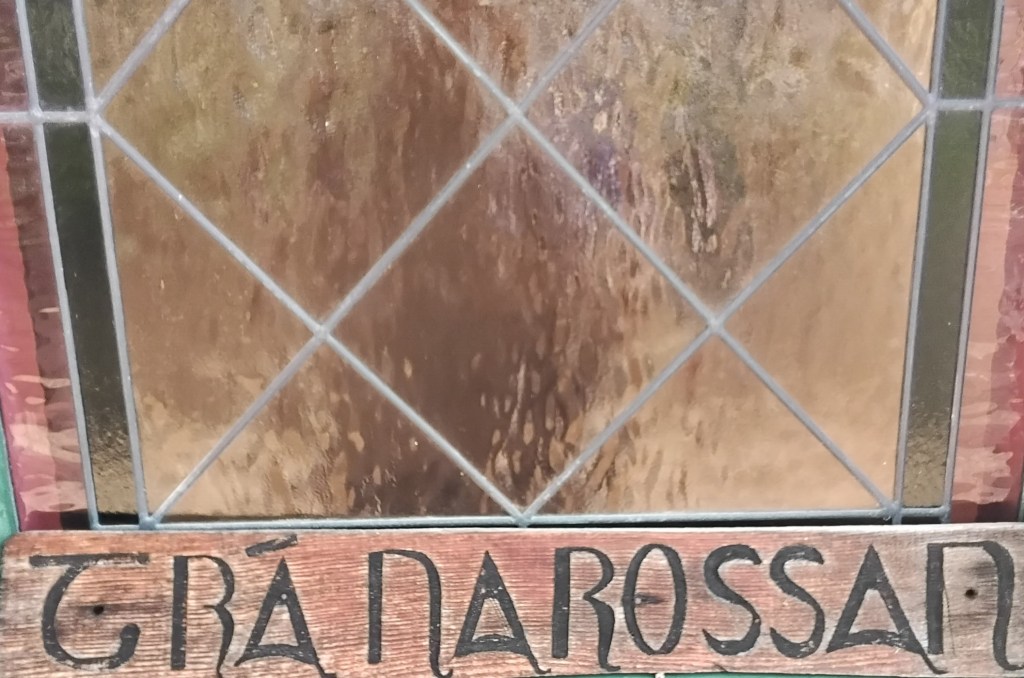
While some Irish migrants in Australia appreciated the existing indigenous name and had respect enough for that history to retain it, others expressed their hopes for attachment to new places by simply appropriating the name of their Irish townland, county, or favourite holiday spot. In my own case, a homemade wooden plaque has graced all the homes I have lived in since arriving in Australia. It is a reminder of Trá na Rosann, at the top of the Inishowen Peninsula in Donegal, where I spent many a long weekend in the hostel there when I was a member of An Óige. In my early days as a migrant, it represented a promise to return to Ireland one day. I did that, but it was a long time before I managed to get back to Trá na Rosann. However, its remoteness endured that nothing had changed.
Digital Records
Over the years, I have collected the names of Irish places in Australia and found over 500: localities and populated places, geographical features, and homesteads. I began a digital recording of the collection using government geographical data that was available online. My digital collection was lost, however, at one point. Today there are many online placename sites that are easily accessible.
Much of my original research can still accessed via articles and conference papers, see https://researchnow.flinders.edu.au/en/persons/dymphna-lonergan-2/publications/
Updates: Homesteads/Farms/Stations

While many Irish place names in Australia remain unchanged, especially those of populated areas and permanent geographical features, the names of homesteads are more likely to change. A homestead in Australia is usually a house and pastoral property. Some placename websites separate the homestead from the land, and some call a homestead a ‘station’.
While there are hundreds of Irish place names in Australia, this list represents homesteads and where they are found (Northern Territory NT; Queensland QLD; New South Wales NSW, South Australia SA; Tasmania TAS; Victoria VIC, Western Australia WA. I have included information on the Irish language origin, using Dictionary of Irish Place Names, by Adrian Room as a resource in providing the Irish language equivalent of the place name. Another useful resource was the Irish language place names website https://www.logainm.ie/en/
2024 Update Irish-named homesteads
Antrim (QLD): Ir. Aontroim ‘one house’ both a county and a city in the province of Ulster
Armagh (QLD, SA): Ir.Ard Mhacha ‘Macha’s height’ is both a city and county in Ulster, founded by St. Patrick and known as the burial site of Brian Boru, the last high king of Ireland. Macha was an Irish queen
Athlone (NSW, QLD): Ir. Áth Luain ‘Luan’s ford’ sits between Westmeath and Roscommon, is an important crossing of the Shannon River and the geographical centre of Ireland
Avoca (QLD, NSW, WA, VIC): Ir. Abhóca ‘the name for a stretch of the Avonmore River in Wicklow.’Its popularity as a placename probably stems from the 19th century poem ‘The Meeting of the Waters’ by Thomas Moore and the subsequent song of the same name
Ballygar (QLD): Ir. Béal Átha Ghartha ford mouth of the enclosed garden’ a small town on the road between Galway and Roscommon
Carrigeen (VIC): Ir. Carraigín ‘little rock’ there are several places in Ireland with this name
Carlow (QLD): Ir. Ceatharloch ‘four lakes’ It is both a county and a city in the province of Leinster. There is no trace of these four lakes
Cashel (QLD) Ir. caiseal ‘a circular stone fort’ the most renowned of which is the Rock of Cashel in Tipperary
Cavan (NSW, VIC): Ir. An Cobhán ‘the hollow’ is both a county and a town in the province of Ulster.
Clare (QLD, NSW): Ir. an clár ‘the level place’ the name of an Irish county in Connacht
Clonard (QLD, VIC): Ir. cluain ard ‘high meadow’ a town in County Meath
Clonmel (QLD): Ir. cluain meala ‘meadow of honey’ of which there are several in Ireland
Clontarf (QLD): Ir. cluain tarbh ‘meadow of the bulls’ a Dublin suburb and site of the battle where King Brian Boru was killed
Coleraine (NSW, QLD): Ir. cúl raithin ‘the recess of ferns’ a town in County Derry
Connemara (QLD): Ir. cuain na mara ‘harbours of the sea’ is the name of the mainly Irish-speaking area of Galway
Curragh (NSW, QLD): Ir. currach ‘wet bog’. The name is found in many Irish counties. The name ‘The Curragh’ is famous as Ireland’s premier racetrack in County Kildare
Dunmore (NSW, VIC, QLD): Ir. Dún mór ‘great fort’ a name found in both Ireland and Scotland
Erin (NSW, VIC): Ir. Éireann the dative form of the Irish word for ‘Ireland’
Galway (QLD): Ir. Gallaimh ‘stoney river principal city on the west coast of Ireland
Glendalough (QLD, VIC, SA) Ir. gleann dá loch ‘glen of the two lakes’ in County Wicklow site, of a famous 6th century monastic site founded by St Kevin
Kildare (NSW, QLD):Ir. cill dara ‘church of the oak’ a town and county in Leinster and associated with the St Brigid legend
Kincora (QLD, NSW): Ir. ceann cora ‘head of the weir’
Killarney (NSW, VIC, QLD): Ir. cill airne ‘church of the sloes’ a popular tourist destination in Kerry and famous for its lakes
Killeen (QLD, WA): Ir.an cillín ‘the little church’ 130 places in Ireland ar so named
Kilrush (QLD): Ir. Cill Rois ‘church of the peninsula,’ a harbour in County Clare
Leinster (QLD, WA): Ir, Laighin ‘place of the Lagin people’ an eastern province whose capital is Dublin city
Leitrim (QLD): Ir. Liatroim ‘grey ridge’ a town and county close to the Shannon River
Listowel (QLD): Ir. lios Tuathil ‘Tuathal’s ring fort’ a town in County Kerry
Mayo (NSW): Ir. Maigh Eo ‘the plain of yew trees’ a county in the province of Connacht
Navan (SA, WA): Ir. An Uaimh ‘the cave’
Newry (SA, NT): Ir. An tIúr ‘the yew tree’ town in County Down
Raheen (NSW, WA): Ir. ráithín ‘little ring fort’ the place name is found in Carlow, Cork, Dublin, Galway, Kerry, and Limerick
Rathmore (TAS): Ir. ráth mór ‘a large ring fort’ a place name found throughout Ireland
Roscrea (SA): Ir. ross Cré ‘Cre’s wood’ a town in Tipperary
Roscommon (NSW, SA): Ir. Ros Comáin ‘St Coman’s Wood one of the five counties of Connacht
Rostrevor (NSW, SA, QLD): Ir. ross Treamhair ‘Trevor’s wood’ a village in County Down
Shamrock (WA, SA): Ir. seamróg ‘shamrock’ a three-leaved plant,’ one of the symbols of Ireland
Shandon (QLD, VIC): Ir. sean dún ‘old fort’ a district in County Cork
Shannon (QLD. NSW): Ir. an tSionna ‘the old one’ Ireland’s longest river
Tara (QLD, NSW, VIC) Ir. Teamhair ‘elevate place’ in County Meath was the gathering site of the ancient kings of Ireland and famous for its megalithic tombs
Tipperary (NSW): Ir. Tiobraid Árann ‘well of the Ara River’ in the province of Munster, one of the main source counties for most Irish migration. (the World War One song ‘It’s a Long Way to Tipperary’ has increased the county’s fame)
Tralee (NSW, QLD): Ir. trá lí ‘strand of (the river) Lee’ a town in County Kerry
Tullamore: (QLD, SA): Ir. tullach mhór ‘big hill’ a town in County Offaly
Tyrone (QLD, NSW): Ir. Tír Eoghain ‘Eoghan’s land’in the province of Ulster
Waterford (NSW, QLD, VIC): Ir. Port Láirge ‘bank of the haunch’ referring to the river in the province of Munster. The English name is of Norse origin
Wicklow (SA, NSW): Ir. Cill Mhantáin ‘Mantan’s church’ in the province of Leinster. The English name is of Norse origin
Conclusion
In 2009, I found 104 homesteads with Irish names; this update has found only 43. The state and territory representation of Irish place names has also changed.
| 2009 | 2024 | Percentage change |
| NSW 61 | NSW 23 | 38% drop |
| QLD 51 | QLD 34 | 67% drop |
| SA 37 | SA 14 | 38% drop |
| WA 19 | WA 33 | 57% increase |
| VIC 29 | VIC 13 | 45% drop |
| TAS 13 | TAS 3 | 23% drop |
| NT 10 | NT 1 | 10% drop |
These changes may represent an ageing population with homesteads changing hands and changes names as a result.
Queensland has had the greatest drop in numbers, followed by Victoria. Western Australia is the only state to have increased the number of Irish-named homesteads.
Today, Glendalough is a suburb in The City of Stirling, six kilometres from Western Australia’s capital Perth. The City’s website explains the name: ‘Glendalough means ‘valley of the lakes, as it is located between lake Monger and Herdsman Lake’. There is no mention of the name being Irish; however, any Irish person would recognise this name and perhaps be more inclined to consider this suburb than another when looking to settle in Perth.
Further research into 21st century Irish settlement patterns in Australia may shed further light on these Irish place name changes.
Dymphna Lonergan is a researcher with academic status at Flinders University and also a member of the Tinteán editorial collective.
 Tinteán