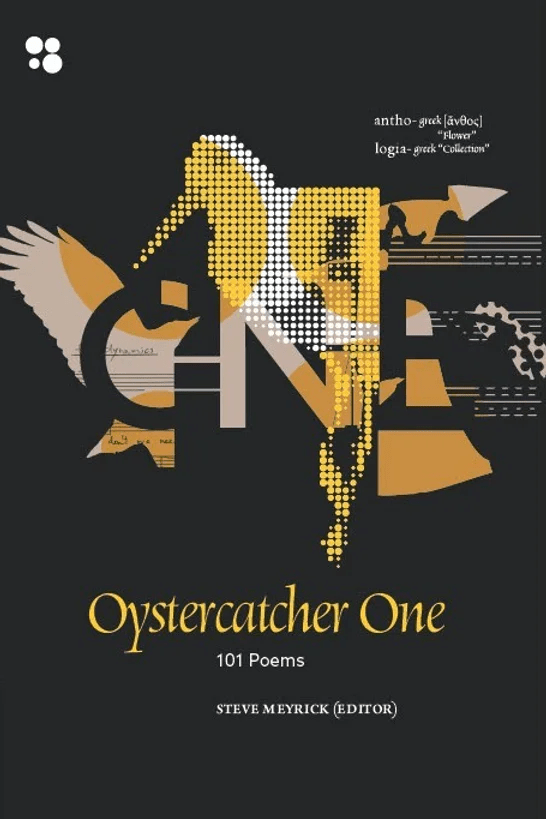
Poetry anthologies are always a favourite of mine, particularly those that don’t focus on a particular theme and allow all styles and colours to flow freely. Something new and exciting on every page, a book that can be dipped in and out of as you sit down for a cuppa, varied voices and styles that are unique in presentation and hue which serves to widen literary horizons and showcase distinct voices. It seems there is always something in anthologies to inspire, or to transport a reader to somewhere new.
Oystercatcher One is no exception. Edited by Steve Meyrick, the preface suggests that this anthology was borne out of a response received from 5 islands Press in April 2024 from a submission call. Steve, is the Commercial Director of Oystercatcher Enterprises. His biography at 5 Islands Press describes his role as ‘staving off the inevitable insolvency of a small poetry press for as long as humanly possible. The target for Oystercatcher Enterprises is to ensure that it survives at least as long as the founders – and neither is intending an early departure from this beautiful world.‘
Oystercatcher One presents 141 pages of thought provoking and language rich poems on a wide range of subjects. Some introspective in nature, conveying emotions ranging from joy to pain and all in between. Some focus on the environment, some on political and social challenges, some are poems of love and affection, hard cold poems and tender ones, some are presented in rhythmic verse and form, others are blocks of prose poetry and some minute and forceful in haiku style. Each one leaving its own particular taste for the reader to enjoy.
Many poems here have caught my eye, particularly ‘Late Tarantella’ by Janet Upcher, a Tasmanian Poet. A poem of chances missed, and a life lived in ‘caution,’ a poem that comes to a shocking and abrupt conclusion. Another being ‘Re-entry’ by Melanie Jansen, whose biography reads ‘poet, ethicist, intensive care doctor, and mother. Reflection happens inside spaces that poetry opens up for her.’ This particular poem outlines the poet’s struggle with working in the area of intensive care, and particularly in dealing with confronting loss. Other poems, in contrast, have beautiful simplistic styles and themes.
Oystercatcher One is available from the publishers at the link below:
https://www.5islandspress.com/post/the-oystercatcher-get-ready-to-fly
Julie Breathnach-Banwait
_________________________________________________________________________________________

What happened to Nina? is the latest of Dervla McTiernan’s crime novels and the first I have read. Dervla McTiernan was born in County Cork, lived and worked in Dublin and Galway, and now lives in Western Australia. I was surprised that this story is set in Vermont, USA. We are introduced to Nina by way of a prologue. Nina describes her relationship with Simon, a good looking, entitled young man from a wealthy family. Nina also describes the surroundings where she was last seen. There is a remote country house, on four hundred acres, a lake and rocks, a lot of rocks. We are treated to a lesson in rock-climbing, with particular attention paid to simultaneous rappelling which we learn can be diabolical if not done correctly. The red flags were flapping furiously at this point.
The rest of Nina’s story is told through the narratives of those who are either implicated or invested in knowing what happened to her. Each chapter is dedicated to the viewpoint of one of these characters. Simon’s parents go into full protection mode and Nina’s parents push hard for the truth. The cover of the book has ‘a thriller’ written up the side. This book is not so much a thriller but more an analysis of how far people will go to protect their families and reputations. Expensive lawyers are hired and a PR firm launches a vicious campaign on social media. Journalists and true crime fans descend on the small Vermont town where Nina lived. In the background, the police work patiently with the different personalities to ascertain what happened to Nina.
I powered through this book; it is well written even though some parts stretch credulity. I imagine this book could be adapted into a TV mini-series. It reminded me of The perfect couple, a book by Elin Hilderbrand which was adapted into a TV mini-series. That story was also set in New England and exposes the outrageous behaviour of some rich folk.
Linda Rooney
 Tinteán