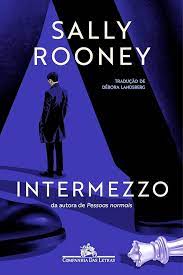
I was just a couple of chapters into Sally Rooney’s Intermezzo when I wondered if I should read her first hit, Normal People, to see if I could see glimpses of Intermezzo characters there.
I had seen the Normal People drama series during lockdown, and since then had read Beautiful World, Where Are You. On reading Intermezzo, I think I have found my new Edna O’Brien with intriguing characters and a unique writing style. Speech patterns set the two male characters apart: the younger male, Ivan, with his repetitive use of that speech filler, ‘like’. His older brother Peter’s impulsivity and erratic personality is captured in a stacatto style – ‘She aught to know. Ask her. Don’t. ’ Rooney eschews quotation marks and favours taking us inside the character’s unfiltered mind.
Reading Normal People was enlightening, but it did not prepare me for Intermezzo. It is clear that Rooney likes to create characters at a particular time in their lives and to present them to us as they wrestle with how to be in the world. And how she presents them, cinematic style, in scenes, is arresting, reminding me of when I first read with admiration the procession scene in Ulysses. Her interior monologues also allow for literary and philosophical references that catch the reader’s heart as the originals do – Philip Larkins ‘In whose blent air…’; W.B. Yeat’s’ ‘in their autumn beauty’. These are explained at the end of the novel, but I suspect there are others that I missed – the mathematical and chess themes embedded in the novel and reflected in the cover and title will gladden the heart of another kind of reader. Did Rooney write the unexplained Czech phrase for Duolinguists? Yes, I went there.
As I continued to read Intermezzo and saw the characters develop I could see the Rooney trope of the emotionally stunted male and the emotionally intelligent female. I found myself questioning my distaste of the two main whining and whinging male characters, the space they took up compared with the female characters. The age gap between Margaret and Ivan was more acceptable because Margaret was a character who is presented as a woman knowing her own mind. Naomi, by contrast, is vapid and manipulative. But there I go again, judging.
What kept me reading were those scenes, the Dublin ones especially, and Rooney’s bird’s eye camera style that zooms in on micro details, showing, not telling. However, I questioned the dog’s role as a plot device in bringing everything together. I was reminded of how I fretted about the children left behind when widower Clint Eastwood strapped on his gun for one last time in the movie Unforgiven. In the wrap-up of Rooney’s Intermezzo, I kept wondering what happened to the dog.
Despite my annoyance at some of the characters in Intermezzo, in the end, I felt compassion for them and Rooney’s capture of the human condition: how we all seem to just stumble through life before we come into ourselves. I read this novel with appreciation, and admiration for this writer.
Dymphna Lonergan is a member of the Tinteán collective.

A lot of ground is covered in The Alternatives, both geographically and in subject matter. This is the story of four sisters, orphaned in childhood, all of whom now have doctorates and all of whom are still connected yet separated by distance and mindset. This novel is humorous and brainy. The story starts in Galway and there are snapshots of London, North Dublin and New London (Connecticut) but most of the story is set in County Leitrim. We are introduced to many quirky characters and some corresponding behaviours along the way. Each sister is presented in their professional capacity. All are accomplished experts in their fields. Though not didactic, we are the audience for several academic classes and discussions. We learn that Ireland is the result of the collision of two giant rocks (chipped off from ancient continents, Gondwana, Queensland, and Laurentia, Canada) now fused together with a seam that runs between Dingle in the west and Clogherhead in the east. Apparently, the University of Connecticut Library has a ‘handkerchief with a love haiku written in lip-liner that Susan Sontag used to clean her nose.’ Limes don’t grow in England and when in Northern Ireland ‘don’t say southern Ireland’ and ‘don’t say Derry’. Trivia aside, this is the story of four independent women brought together out of familial concern. Presented with concepts of varying depths, they make their way to their alternative universes.
Linda Rooney is a member of the Tinteán collective

I read an article in the Guardian newspaper recently about a film that had just been nominated for various awards. Its name had a familiar ring to it. It was only when I was later dusting my cluttered bookshelves that it jumped out at me; a book gifted to me back in 2019 when I had just embarked on my sober life, The Outrun by Amy Liptrot. With over five years of sobriety under my own belt, I was ready to delve into this painfully honest memoir of addiction set against the salty winds of the Orkney Islands. I absolutely loved the exhilarating journey that it took me on during the five days that I spent immersed in its sublime writing. The author skilfully illustrates the link between mental health and addiction by drawing you into her world through her awe-inspiring nature writing, inviting you to experience the extreme emotions that so often underpin those desperate urges to escape reality. That’s addiction for you. This book held a mirror to me with its stark reminder of how lucky I’ve been to have stepped back from the precipice that I’d also found myself standing on. There are many precipices in this book, described so beautifully and starkly as the author explores the wilderness of the islands, some of which are uninhabited except for colonies of birds such as kittiwakes, guillemots and shags that make their home there. This book taught me things about birds that I feel all the richer for knowing. Take for example the Arctic tern, it has the longest migration of any bird, travelling some ten thousand miles back from Antarctica to the Orkneys each year. It sees two summers per year and more daylight than any other creature on the planet. What I love most about this book is summed up in this quote, ‘I stopped drinking to do things, rather than to spend my time talking about stopping drinking.’ By the time I’d finished reading this book I felt that I had been on an adventure. I’m looking forward to seeing the film starring the American-born Irish actor, Saoirse Ronan who I understand, for the part, learned to lamb a sheep and build a drystone dyke. She froze herself in the Atlantic and learned what she could about seaweed. It must feel surreal for the author, Amy Liptrot, to see herself portrayed by this talented actor and for the fruits of her labour to be projected onto the big screen. A truly life-affirming outcome of what I know from experience would have once felt impossible.
Gill Kenny
http://www.gillkennywriter.com
Would you like to share with Tinteán readers what’s caught your fancy on the bookshelves?
It could be full-length (about 1000 words) or short ones (500-600) like the teasers above. (See ‘Would you like to write for us? in this issue’ for other writing submissions).
 Tinteán