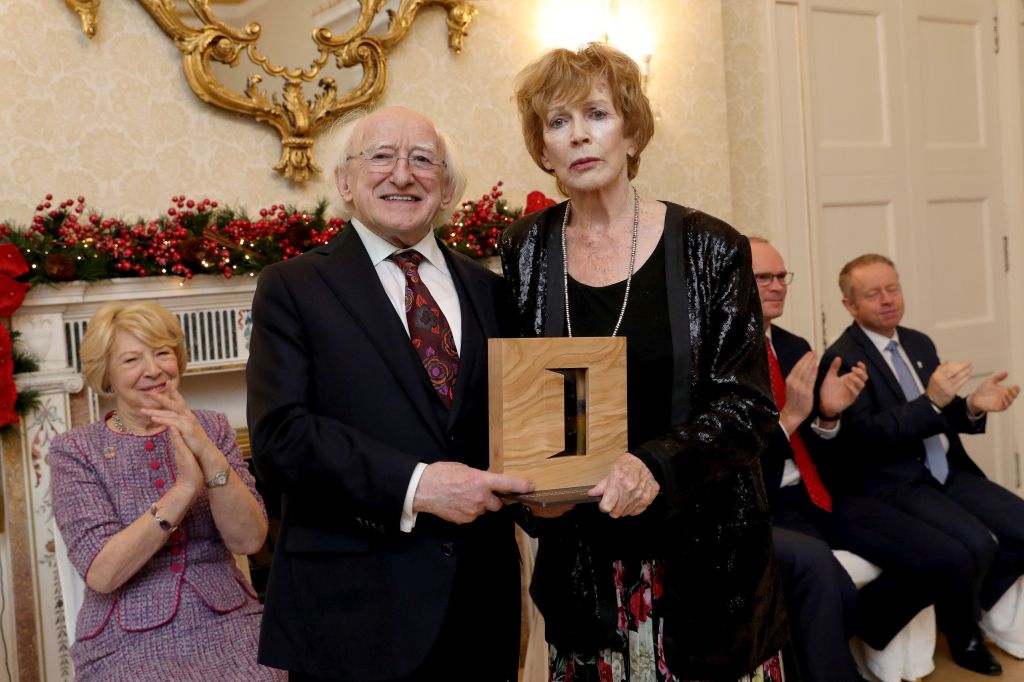
Following Edna O’Brien’s recent passing, President Michael D. Higgins of Ireland said on behalf of the nation:
Edna was a fearless teller of truths, a superb writer possessed of the moral courage to confront Irish society with realities long ignored and suppressed.
Through that deeply insightful work, rich in humanity, Edna O’Brien was one of the first writers to provide a true voice to the experiences of women in Ireland in their different generations and played an important role in transforming the status of women across Irish society.
While the beauty of her work was immediately recognised abroad, it is important to remember the hostile reaction it provoked among those who wished for the lived experience of women to remain far from the world of Irish literature, with her books shamefully banned upon their early publication.
Thankfully Edna O’Brien’s work is now recognised for the superb works of art which they are. As President of Ireland, I was delighted to present Edna with the Torc of the Saoi of Aosdána in 2015, and with a Presidential Distinguished Service Award in 2018. Her election as Saoi, chosen by her fellow artists, was the ultimate expression of the esteem in which her work is held.
On an individual level, many readers of Irish literature will also be sad that we will no longer see a new book from Edna O’Brien. Often when we discover a new writer gladdens our hearts we wait in anticipation of the next work. Hearing of O’Brien’s passing, my mind returned to Easons bookshop in Dublin when I was a teenager furtively reading from the latest John Steinbeck book on the shelves, unable to afford it. Then came that excited bus ride on the 56B one ensuing Saturday with the price of that book in my pocket after weeks of saving.
Edna O’Brien was another discovery, but hers was a female voice and an Irish one. In her honour this month, Tinteán reposts below part of a tribute I made to Edna O’Brien in September 2023.

An Irish Girl (extract from Tinteán September 2023)
I am a child of the Irish Republic with all that that entailed, religious and societal oppression and censorship. On rereading Edna O’Brien’s, The Country Girls, I still recognised that world. I still recognised the protagonist. If on rereading Wuthering Heights I found I was no longer Cathy, I found in The Country Girls that early literary female guide in Caithleen Brady who showed my teenage heart how to find my way through the often confusing and frightening world of romantic love.
The movie I Was Happy Here (1965) was based on O’Brien’s novel, and seeing that movie led me to the novel. I was unaware of censorship of movies and novels at that time, but I can still recall the day my mother saw me reading The Country Girls and admonished me with,
‘You shouldn’t be reading that book. It’s on the Index.’
‘What’s the Index?’ (like Caithleen Brady I was interested in new words and concepts).
‘It’s a list of books banned by the Catholic Church.’
‘But I bought it in Eason’s on Saturday!’ I resumed reading.
Sensing my mother’s unease, I felt empowered for the first time in our relationship. I was becoming an independent thinker. And as I continued reading The Country Girls, I knew that I had found a literary voice that I wanted to follow, and I have done so ever since, having read all of Edna O’Brien’s novels.
I was a city girl, a Dublin city girl, and you would imagine that I would have been more sophisticated than a country girl, but I was not. Rereading The Country Girls today, I can see why it was banned in 1950s Ireland. Caithleen Brady and her friend Baba are aware of their burgeoning sexuality as early as age fourteen. I do not think I noticed this on my first reading. Rather than mooning over boys their own age, they are shown mostly reacting to approaches by older males, some of whom are married. Caithleen’s first romantic awakening is for a local married man, Mr Gentleman. I had no concerns about the marital status of Mr Gentleman on first reading The Country Girls. Not knowing anyone like him, I did not have this experience. Besides, my focus was on Caithleen, and what I could learn from her about life’s joys and pitfalls. Much, I was sure, because we had so much in common.
Caithleen is a dreamer, a reader, and looking for romance She is a wordsmith, noting new words such as ‘affectation’ and ‘mortgage.’ People are ‘lonely.’ Others are ‘lonesome.’ She has literary aspirations, that is she aspires to being in the literary world: in Dublin she buys a pair of black nylon stockings because they are ‘literary.’ She reads her English school text book for pleasure, quotes from Thoreau, and makes references to Goldsmith. She has read Dubliners and Wuthering Heights (both of which I would not read until university). She loves the farmhand Hickey and falls in love with Mr Gentleman who is always ‘gentle’ in his approaches to her.
Caithleen’s home life is unstable, with an alcoholic father who is violent towards her mother, her only other possible protector. But Caithleen has a friend Baba whose family takes Caithleen in when she can no longer live at home. Hope arrives in the form of a scholarship that means Caithleen can go to boarding school with Baba and escape village life and her threatening father.
Baba, short for ‘Bridget’ is bold and beautiful, flamboyant in action and words: ‘You’re late, you’re going to be killed, murdered, slaughtered.’ It is clear why the more introverted Caithleen is attracted to her personality, but also her more stable and luxurious home life. Baba’s father is a vet. They have a maid. Baba wears her white cardigan over her shoulders, her skin is beautiful, she is pleasantly plump, she has luxuriant black wavy hair, and, above all, exudes confidence. Caithleen by contrast is thin, undernourished, ‘ashamed’ of many things, even on seeing Baba’s parents embracing. She needs Baba because she has no one else she can trust, even though Baba is always putting her down and betraying her.
While Baba is the more dominant of the two friends, Caithleen has a quiet confidence in her ability to attract male attention in her search for romance. She knows the difference between the gauche and cack-handed approaches of the farmhand Hickey and the shopkeeper Holland, and the shyer and more gentile Mr Gentleman who also has a car and can take her for romantic drives and for afternoon tea. Mr Gentleman is part of the social elite in the village, along with the doctor’s wife and the Connors who are Protestants. He spends the weekdays in Dublin.
O’Brien does not provide a physical description of Mr Gentleman, rather, we see him through Caithleen’s emotional responses: at the village concert although she can only see ‘the back of his neck and his collar,’ she feels ‘glad that he is there.’ He, perhaps, represents the father figure she should have had. Mr Gentleman is sitting ‘next to the younger Connor girl.’ O’Brien provides this first breadcrumb for the adult reader of this man’s nefarious intentions. It is in this chapter that Caithleen learns of her mother’s untimely death, and Mr Gentleman being near at hand proves to be ‘the only one’ who can keep her’ calm.’
The novel progresses with the steady grooming of Caithleen whose heart flutters at the sound of his voice and his eyes that were ‘tired or sad or something.’ O’Brien succinctly and poignantly captures the young girl’s inarticulation when overwhelmed by emotion. He offers her his cigar. He drives fast. He invites her to ‘tea and cream-buns.’ Mr Gentleman’s ploy from when Caithleen was fourteen is to groom her until she has reached the right age and is away from parental or in locus parentis control in Dublin. In case you have not read The Country Girls, dear reader, I will not reveal any more of the novel.
Edna O’Brien’s The Country Girls loses none of its charm on a reread. I have reread it twice now, finding on each read more to like: O’Brien’s attention to detail, her humour, her lyricism, the evocative landscape, the keen delineation of even the slightest characters in this rural village in 1950s Ireland, and those memorable country girls, Caithleen Brady and Baba Brennan.
Today it is so much easier to find out about new Irish writers. I have recently discovered IrishCentral Book Club Facebook page that has a Book of the Month focusing on Irish writers past and present. I like its eclectic nature, a combination of old and new Irish writers and writers, the self-published alongside those who have published through mainstream publishers. I am looking forward to reading Gráinne Lyons’ travelogue Wild Atlantic Women: walking Ireland’s West Coast that follows the lives of Ellen Hutchins, Maude Delap, Edna O’Brien, Granuaile and Queen Maeve among others. And so writers’ lives live when they have finally rested their pens through subsequent writers and readers. Vale Edna O’Brien.
Dymphna is retired with academic status from Flinders University. She is a member of the Tinteán editorial collective. An Irish language teacher in Adelaide, she has written two collections of Irish language short stories with translations. As Gaeilge was published in 2022 and Scéalta Arís in 2023. Both are published by immortalise.com.au.
 Tinteán