by Dymphna Lonergan
New Irish/ Irish English words in the Oxford English Dictionary
The OED’s Release Notes in 2022 in include many new Irish language words used in Irish English. Here are a few:
blas, n. (first attested 1906) ‘an accent, a distinctive way of pronouncing a language’.
(We went to the Gaeltacht ‘to get the blas’. It is also the name of an annual music festival. See https://www.blas.ie/programmes/music-song/)
ciotóg, n. (1832) ‘the left hand; a left-handed person’.
(The first Irish word in English I heard as my parents discussed my left handedness. I knew they were talking about me, but I did not know why)
grá (1833) ‘a feeling of affection or love; a fondness or liking for someone or something’.
It appears earlier in William Carleton’s Traits and Stories of the Irish Peasantry (1830). It is usually heard as having a grá for something.
bualadh bos (1908) ‘clapping, applause; praise’.
(This can be heard frequently as a call for applause for someone: ‘let’s a a bualadh bos for …’)
cúpla focal
This is often used as a derogatory term for politicians who give lipservice only to the language. However, if you ask an Irish person if they speak the language, they may reply ‘níl ach cúpla focal agam’, I only have a few words. If you probe a bit more, and gently, you will get more.
bockedy(This comes from the Irish word bacach ‘a lame person’. In Irish English slang it is usually applied to something that is not functioning correctly such as a bockety chair or a bockedy table)
ráiméis
(if you are speaking ráiméis you are speaking ‘rubbish’)
a chara (1829), ‘my friend, my dear’
(as ‘dear’ when used as a polite address if you need one to start an email or letter; as ‘friend’ in a birthday card greeting, lá breithlá shona, a chara, ‘happy birthday, friend)
For more examples, see https://www.oed.com/discover/world-englishes
Bilingualism in Irish Life
On my recent visit to Dublin, I noticed an increase in bilingualism in broadcasting: TV advertisements in Irish only such as one for discoverireland.com; others had an Irish language voice over and English subtitles. or an English language voice over and Irish subtitles. This is likely to be results from the Irish government’s 20-YEAR STRATEGY FOR THE IRISH LANGUAGE 2010 – 2030 that had aims such as ensuring that Irish becomes more visible in Irish society. Also the Department of Tourism, Culture, Arts, Gaeltacht, Sport and Media Advertising Provision released on 10 October 2022. Under this provision all public bodies are now obliged to do at least 20% of their annual advertising in Irish and to spend 5% of their advertising budgets on advertising in Irish in the Irish language media.
Also of interest is this notice from Teachingplans.ie
Signage in Irish throughout the school – Irish is a living language to be seen and used through the school day. Bilingual signage should be in place throughout the school e.g. signs on classroom/ office doors, information posters etc.
I noted that the Dublin airport security announcement about left baggage was delivered in Irish first and then in English; television advertisements all in Irish or in Irish with English subtitles that are not exact translations; RTE 1 morning presenters using terms such as cúpla focal, go raibh míle (a shortened form of go raibh míle maith agat, thank you); ag a trí a chlog (announcing when an upcoming programme would commence at three o’clock; gabh mo leathscéal (excuse me).
Comhar
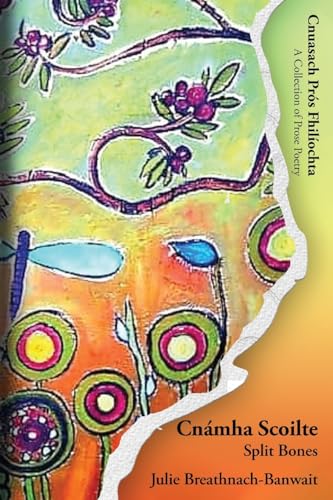
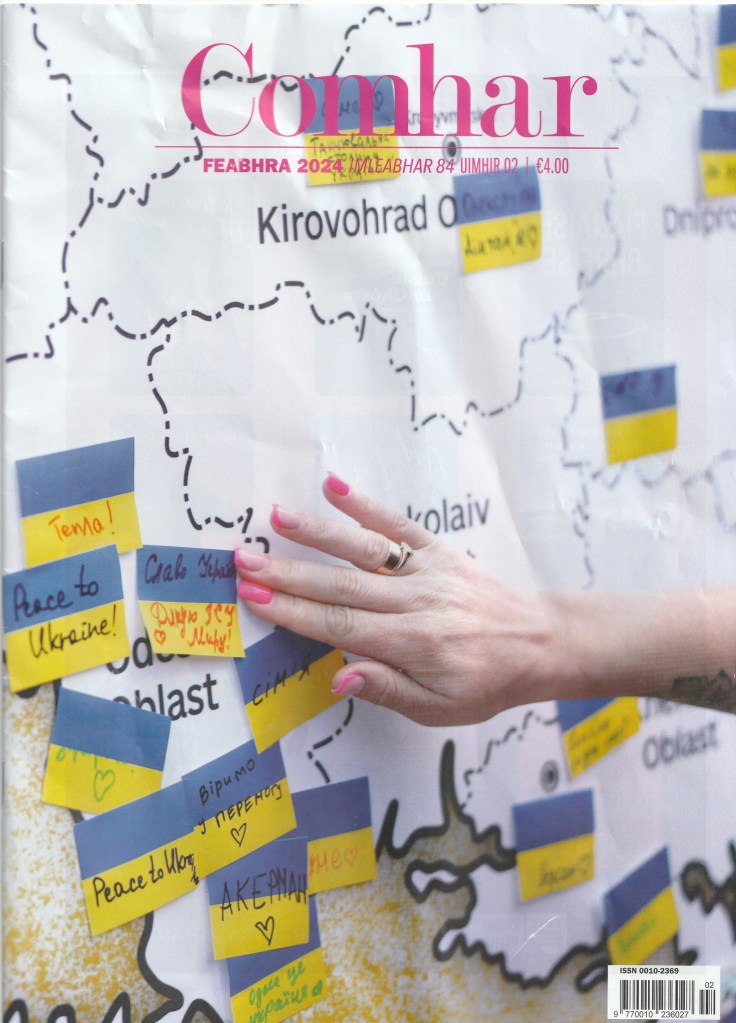
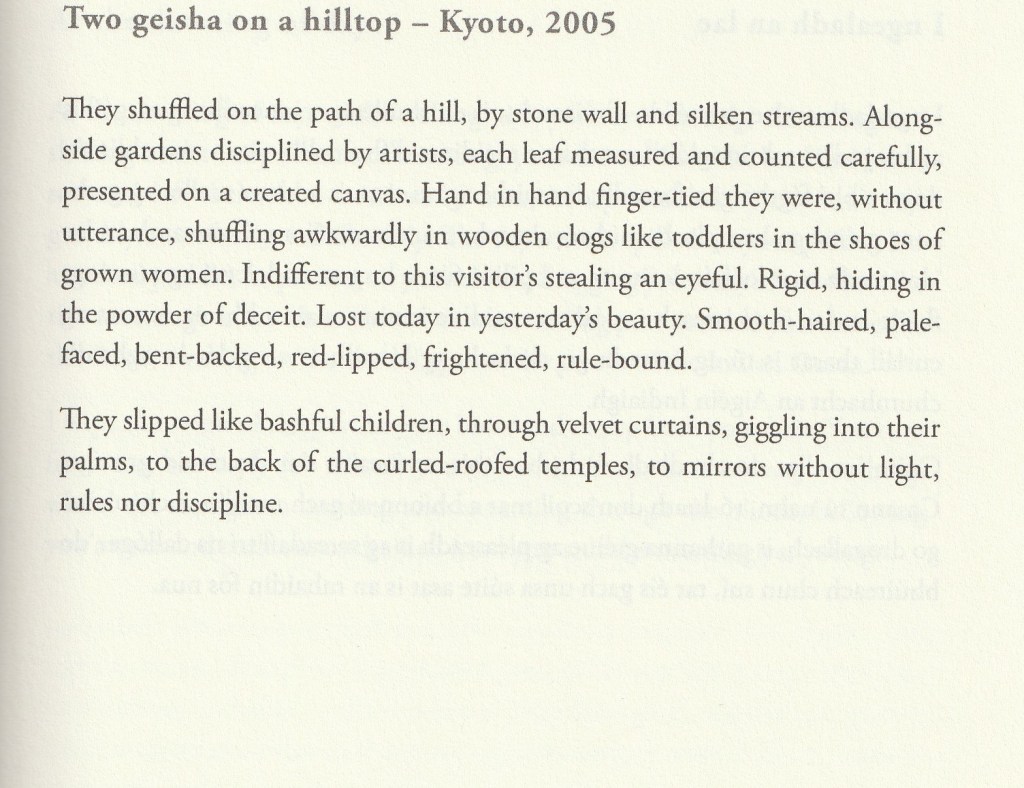
Ireland’s foremost Irish language magazine is Comhar https://comhar.ie. They recently published two prose poems from Julie Breathnach-Banwait’s bilingual collection Cnámha Scoilte in the Irish language version only. I have provided the English language version of the Geisha poem below. Cnámha Scoilte/Split Bones is available from Bobtail Books https://bobtailbooks.com.au/ and at The Hobart Bookshop, Salamancar Square for anyone visiting Tasmania where Julie lives.

 Tinteán