
from Hermathena: a Dublin University Review, no. CXXIV (Summer 1978). Reproduced with permission.
Theodore William Moody (1907-84)
by
Vincent Comerford
The names Moody and Edwards are jointly synonymous with the emergence of history as an organised academic discipline in Ireland in the late 1930s. Their influential collaboration, and their common affectation of longish hair, cannot obscure the fact that in so many ways they were as different as chalk and cheese. Readers will have seen Michael Laffan’s memoir of R. Dudley Edwards in the May 2023 issue of Tintean.
Born in Belfast in 1907, Theodore William Moody (familiarly Theo) was the son of an iron turner at the shipyard of Harland & Wolff, and of a teacher at Belfast Technical College. Both parents were adherents of the Plymouth Brethren, a Protestant sect strict in faith and discipline. Theo’s schooling was at the Royal Academical Institution, which despite its title had a reputational association with the radical Belfast past, a link that pleased Moody.
At Queen’s University Belfast from 1926 to 1930 Moody studied medieval and modern History. In later life he would recall how at Queen’s he had for the first time met and mixed with Catholics, and how he and they came to see one another as ‘fellow countrymen’. This personal experience was the basis of his subsequent dedication to the message of the nineteenth-century Young Irelander, Thomas Davis, about a nationality that would rise above confessional division.
Following graduation Moody chose to go for doctoral level courses to the Institute for Historical Research in London. This institution, founded in 1921, was known to be influenced by the best practice of continental schools of history and was seen in the early years as a more business-like alternative to Oxbridge. Moody’s time there, from 1930 to 1932, overlapped with that of the young graduate from University College Dublin, R. Dudley Edwards. At the IHR Moody began research on the plantation of Ulster leading to the PhD (1934) and to his first monograph: The Londonderry plantation, 1609-41: the city of London and the plantation in Ulster (1939).
In 1935 Moody was appointed lecturer in history at Queen’s University Belfast, with special responsibility for Irish history. Meanwhile Edwards was making his mark in Dublin on the route to a lectureship and eventually the chair of Modern Irish History at UCD. Their joint enterprise in the second half of the 1930s was, so to speak, to secure for Ireland its place in the League of History-writing Nations. Their training in London made these two Irish historians conscious of their country’s lack of a national history framework of the kind developed in other countries in the nineteenth-century, typically culminating in a high-status journal, as for example the English Historical Review.
The cause of Irish deficiency in this regard was not any want of active historians over the previous hundred years, but rather the same confessional dissension that had blighted the country’s political life. It would have been tempting in the late 1930s to create a nationalist historiographical scheme based on the southern state and to register on this basis as a national entity with the Comité International des Sciences Historiques. Instead, Moody and Edwards devised, with the assistance of others, a scheme designed to include the entire island without requiring anyone to make a politically unacceptable option. The Irish Historical Society, based in Dublin, would be open to membership of historians anywhere on the island. The Ulster Society for Irish Historical Studies, based in Belfast, would be open to any resident of the nine-county province. Each society would nominate one of the two joint editors of a new journal, Irish Historical Studies. Responsibility for the management of the new journal would be shared equally by the societies. This arrangement rescued historical institutions from the hazards of contemporary politics and is still in place over eighty years later.
The new journal, which appeared in 1938, was a showcase for current research, but was also much more than that. Its house style was soon adopted in history departments, and mastering ‘Rules for contributors to Irish Historical Studies’ (a much more challenging task in the days before the advent of electronic word processing) was to become a rite of passage for aspiring research students. Annual lists of theses in progress and of theses completed, supplied by the university history departments, provided students of Irish history everywhere with a running overview of developments across the discipline. An annual listing of writings on Irish history was a boon to scholars at every stage. This service, adapted to the changes in information technology, and long since separated from the journal, continues to be openly and freely available in regularly updated cumulative form at www.irishhistoryonline.ie , hosted by the Royal Irish Academy.
In 1939 Moody was elected to a fellowship in Trinity College Dublin, the first fellow in the long history of the college who was not a graduate of Dublin, Oxford or Cambridge. In the same year he was appointed to the Erasmus Smith’s chair of Modern History. He played an active part in college affairs as a representative of the junior fellows on the Board. From 1958 to 1964, he was a very active senior lecturer (TCD’s equivalent of registrar or chief academic officer).
When in 1960 the government established a commission to examine and report on all aspects of higher education, Moody’s reputation inside and outside Trinity secured him a place among the appointed membership. Theo and others saw the commission as an opportunity to reform the system, and the government can have had no anticipation of the complexity and inventiveness of the commission’s proceedings. Committees visited and physically inspected the various colleges, meeting staff, taking copious notes, and reporting back to general meetings. Return visits were made as deemed necessary. Meetings were held not only during working hours but also on Saturdays, and occasionally even in the early morning or at evening time. Moody was among the foremost fomenters of this maelstrom of activity and he saved every scrap of evidence. After his death, looking at the yards of shelf space taken up by Theo’s Commission of Higher Education files as they awaited removal to TCD Library, his widow Margaret remarked that the commission had constituted the most trying episode of their lives together.
One of the objectives adopted by the commission was to set standards for academic life, in terms of staffing, facilities, internal structures, resources and academic appointments. At TCD this required the introduction of a faculty of arts. Moody became the first dean of the faculty (1967-69). To help ensure a better future for Irish university institutions the commission recommended the setting up of a Higher Education Authority. This was done in 1968. The HEA was subsequently given statutory status and became the point of reference of university administrative life, moving eventually to centre stage.
That many of the recommendations of the commission were implemented has been largely forgotten, but one that was overturned is widely remembered. Following extensive deliberation, the commission had concluded that the National University of Ireland should be disbanded and that its three constituent colleges at Dublin, Cork and Galway should become independent universities. Within weeks of the publication of the commission’s report the minister for education, Donough O’Malley, announced out of the blue that, far from granting University College Dublin independence, he was determined to merge it with Trinity College. This provoked consternation in both institutions and left nobody more appalled than Moody. Theo had taken the commission as an opportunity to hammer home what he and many others saw as the lack of sense and equity behind the Catholic church’s ‘ban’ on its adherents attending Trinity (except with individual permission from the archbishop of Dublin). He believed that it was at best a measure to advantage University College Dublin in the competition for students. The proposed merger could be seen as a more direct threat to the survival of Trinity. Moody was perhaps the most forceful objector. Opposition initially stalled the proposed merger, and eventually led to its abandonment. Dublin in 2023 has four universities.
Moody and Edwards realised that however successful they might be at promoting undergraduate study, the conducting of extensive research on Irish history would not be possible without dedicated funding. The Dublin Institute for Advanced Studies, a pet project of De Valera’s, provided such support for Celtic Studies and Theoretical Physics. Edwards promoted the idea of a similar institution dedicated to historical research. Nothing permanent came of it, but he did secure government funding for an important collection of essays, edited with Desmond Williams: The Great Famine: studies in Irish history, 1845-52.
In the early 1960s Moody devised a scheme for a multi-volume history of Ireland that eventually gained state funding and significant support from private sources. The first volume of A new history of Ireland was published in 1976, the final volume in 2003, nearly twenty years after Moody’s death. The New History project produced not merely seven hefty volumes of narrative, but five volumes of ancillary reference works – covering everything from a comprehensive chronology by way of medieval episcopal successions to twentieth-century election results – that have now been standard reference works for Irish historical researchers for forty years.
Theo cultivated links with broadcasters in Dublin and Belfast, and from the early 1950s he was behind several series of scholarly talks, mainly about history, broadcast on BBC Northern Ireland and similar series carried on Radio Éireann (designated Thomas Davis lectures). Most were subsequently published as inexpensive paperbacks. The formula went visual in 1966 when RTÉ televised twenty one lectures covering sequentially Irish history from the beginnings to 1966. Each of the papers was written by an expert, and all were presented on screen by the most accomplished newsreader of the day, Andy O’Mahony of RTÉ. The lectures were subsequently published in a paperback, The course of Irish History, edited by Moody and F.X. Martin, professor of medieval history at UCD, that enjoyed outstanding success.
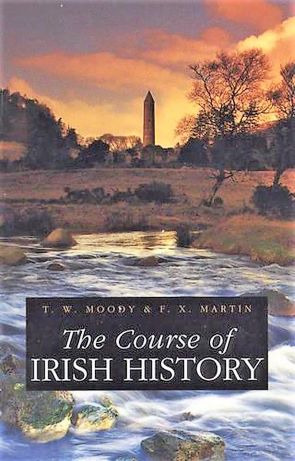
Moody’s selection of Martin as co-editor here and for A new history of Ireland, consolidated a breach with Edwards for whom his fellow UCD professor was a rival and persona non grata. Moody had similar issues with a colleague or two at TCD. Surviving data do not allow for measurement of comparative levels of aggravation.
Moody’s personal research in the latter stages of his career was focussed on Michael Davitt and was to result in a study of remarkable thoroughness and insight: Davitt and Irish revolution, 1846-82 (1981). Also on the stocks was an edition of the writings of Wolfe Tone, embarked upon along with R.B. McDowell, and eventually completed with the inolvement of Christopher J. Woods, long after Moody’s death.
From the mid-1940s Moody had supervised the PhDs of students including F.S.L. Lyons, Conor Cruise O’Brien and David Thornley, but research numbers were small until the 1960s. By the early 1970s, numbers were such as to justify a research seminar, meeting weekly during term. Here I first became acquainted with Bill Vaughan, Brian M. Walker, Roy Foster, Jacqueline Hill, Elizabeth Malcolm, Christopher J. Woods, Richard Hawkins, Helen Mulvey, William Lowe, James S. Donnelly Jr, Sally Warwick-Haller, Padraig Lane and many others. The participants were primarily Moody’s students, together with a changing array of visiting scholars.
The research paper might be delivered by a student or a visitor. The proceedings were standard: the paper, followed by a break for tea and informal discussion, then a formal question and answer session with the speaker, chaired by Theo. The proceedings and attendance were noted in a large ledger. Afterwards others might move to O’Neill’s public house, but not Theo. However, the Moodys were generous hosts at home in Terenure, and in his latter years Theo took to enjoying a glass of white wine on such occasions.
Immediately on the conclusion of a seminar paper by Dr John Vincent purporting to expose duplicity on the part of Gladstone in respect of the first Home Rule bill, Moody, without waiting for the formal discussion, felt it necessary to declare: ‘I am bloodied but unbowed’. Theo believed that everyone without exception had a contribution to make to the common good, but some were exceptional landmarks along the way, and none loomed greater than Gladstone.
As a supervisor Moody was thorough but not intrusive. In this as in all other matters, he was kindly, reliable, and honourable, although he was never squeamish about taking a clear decision. His movements were always purposeful. A visiting Australian academic noticed his skill, when crossing Front Square, at avoiding the eye of a lost tourist seeking directions to the Book of Kells. Ultimately, it was a superabundance of intellectual and physical stamina that enabled Theo Moody to deploy his other gifts so effectively and extensively.
The Moodys raised their five children as non-denominational Christians. In the early 1960s Theo and Margaret themselves joined the Society of Friends in whose fellowship they could bear witness to their pacifist convictions and honour the transcendental without the distractions of credal contention.
Vincent Comerford is a graduate of the national University of Ireland (Maynooth) and a PhD of Dublin University (Trinity College, 1977) supervised by T.W. Moody. He was appointed to the department of Modern History at Maynooth in 1977, and was professor and head of department from 1989 until 2010.
 Tinteán