A Feature by Tomás Ó Dúbhda
In November 2021, we published part one of Tomás Ó Dúbhda’s feature on community gatherings in Ireland, old and new. Here is part two.
Fulachta Fia Food gatherings
The very earliest communal gathering and feasting for which we have solid evidence are known as fulachta fia. These were the locations where an animal, probably a deer or boar, was cooked following a hunt. The sharing of food is a social act that creates and maintains bonds and obligations within a group or community, which seems to have been the entire function of these feasts. This form of indirect cooking, involved a system of using hot stones immersed in water. Stones capture and hold the heat, releasing it very slowly, causing the water to remain boiling long enough to cook meat fully. It is likely that this method of boiling emerged in the Neolithic Period, about 4,000-4,500 BC. Today, these sites are sometimes referred to as ‘burned mounds’ because of the build-up of heated stones over the years.
Turloughs Vanishing Lakes
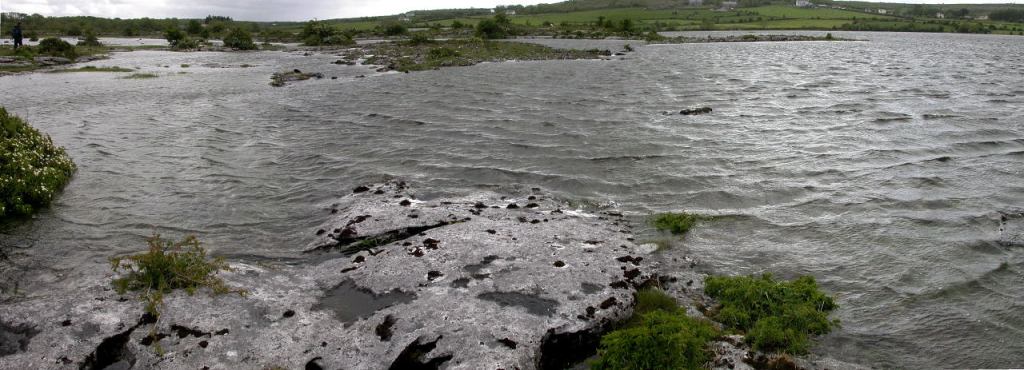
In these earliest Stone Age gatherings, the evidence suggests these were small family-type gatherings which took place on lower ground, often at what today we call turloughs. A turlough is described as a vanishing lake or, equally, as re-appearing land, in the limestone area in the Western counties of Clare, Galway, Mayo and Roscommon. In summer, the lake shrinks becoming partly, or almost fully submerged in the cave system which underlies the limestone. Because of the high labour input in continually adding freshly heated stones, and the relatively low numbers involved, the turlough was an ideal setting for these gatherings. Roughly 140 of these burnt mound sites had been discovered by 1980, suggesting that these ceremonial feasts were a part of Neolithic culture in Ireland from the earliest times. We know that these were only ceremonial as it required a large amount of stones and fuel to heat the water to boiling point initially. This was labour intensive and one further large stone needed to be added every ten minutes to keep the water at boiling point.
As ancient Ireland lacked any central system of rule, and allegiances of groups were prone to shift from one local or regional ruler to another, these bonding occasions were vital in maintaining a sense of community and belonging. In fact we see this volatile allegiance as a central factor among the Old Irish chieftains right up to the 17th century, suggesting these bonds were as fragile then as they probably were thousands of years earlier.
Sacred wells and pilgrimages

We will see evidence later of Medieval gatherings, especially the summer festivals like Lughnasa, at turlough sites, with some continuing well into the 20th Century. From the 5th century onwards, most of these Celtic occasions were gradually Christianised. As pagan beliefs gave way to Christian ones, their old sacred sites were usually dedicated over time to the founding saint, or patron of the local monastery. So we came to have wells named after Brigid, Kieran and others, as well as Patrick, of course. In most cases, this led in time to a type of pilgrimage taking place, involving rituals like walking, barefoot, seven times clockwise, then seven times anti-clockwise around the well, reciting a set number of prayers in each passing.
Pattern Day
These became known as Patron, later Pattern, Day and were usually the biggest community event in each parish or district apart from the fair day(s), more so as the old Irish nobility declined. In some cases, a relic(s) of the patron saint, which were looked after by another hereditary family through the generations, were present. To touch the sacred vessel containing the relic was something pilgrims would walk miles for in the days when walking was the only means of transport for all but the wealthy. This was particularly true in Penal times when all churches were closed, it was illegal to attend Mass and priests were forbidden.
Mass Rocks

Mass rocks became a new gathering place, in lieu of churches, during this time. To attend the Patron Day which, unlike Mass, was not forbidden, was a great relief to people who wanted to express their faith in some way, any way. In fact, records show that one such event in North Co. Clare regularly drew large numbers by boat across the sea from the Aran Islands. No doubt, the social interaction and feasting may have been part of the attraction, and indeed the reason the Church eventually distanced itself from these sometimes over-exuberant events.
Similarly, Féile Mhic Dara, the Feast of Saint Mac Dara, off the the coast of Carna, in Connemara is held on July 16 each year as is the pilgrimage to Caher Island in Clew Bay off Co. Mayo on Aug 15, the Feast of the Assumption. It is almost certain that each of these has a pre-Christian origin. Considering these long-abandoned places, like the very hard to reach Skellig Islands, off the coast of West Kerry, have no proper pier, and access is far from easy, the numbers who attend, and the distances travelled, are impressive.
In pre-Viking Ireland, up to 800 AD, the oénach/aonach, was the assembly of the general body of people where laws and royal pedigrees were announced, taxes collected, sporting and social events held and also included trading of animals, crafts etc. Such assembly places were a feature of the various layers of power to be found in early Ireland. Each local kingdom had such a site, as did the regional kingdoms which comprised several such local kingdoms, and finally the provincial over-kingdoms. Many such sites were located on royal land, often on hill-top locations, as well as the older ones near turloughs. These often featured pre-historic burial mounds and other indicators of long usage as assembly places. Due to the large population growth from 500 AD onwards, with a consequent increase in agricultural output, there was a need to move from lower, more fertile to the poorer soil of the higher ground.
As native forests were still plentiful, and these were home to wild boar, boar hunting was often a prelude to the feast, and provided the main source of food. Other sports may have included tests of strength and skill such as tug of war, and throwing of weights, displays of rope making, tossing of horse shoes and sheaves etc. Music, singing, storytelling, from the Seanchas, were other sources of entertainment that usually followed after the feasting. Of course, all legal and political matters had to be proclaimed and dealt with before the trading, hunting, fun and games could start.
Aonaigh Fairs
We find the word aonach still survives in placenames today. The town of Nenagh, Co. Tipperary was originally Aonach Oir Mumhan/The Fair of Ormond, or East Munster. Desmond/South and Thomond, North were the other regional kingdoms of the province/over kingdom of Munster. We also find the placename Killanena/Cill an Aonaigh/The Church of the Fair and Knockanena/Cnoc an Aonaigh/Fair Hill in various parts of the country. We find Mainistir an Aonaigh/Monasternenagh, a Cistetercian abbey founded in 1151 on the site of a fair, near Croom, Co. Limerick. We also find the name Cnocán an Aonaigh/Fairhill in Cork City today. Of course, we find spelling variations from one region to the next but also at times within the same county.
The Killanena above is in North East Clare, close to the Galway border but we also find Killenagh in West Clare. As they are no more than thirty miles apart, one might expect the spelling to be the same but the reason for this is unclear. Although it is more likely to do with slight dialectic differences than with the people who recorded placenames for Griffiths Valuation in the 1830s or it may be for some other reason. For those trying to trace family history in Ireland, it is important not to assume a standard form of spelling, or indeed translation. Although this land survey was done at the behest of the British, there were some Irish scholars like George Petrie, Eugene O Curry and John O Donovan in charge of the whole process to ensure not just that the anglicised spelling was accurate but also to record the original meaning of each townland and village, as far as possible.
The words Dáil, the name of our Parliament, and Tionól/Tynwald, the name of the Manx Parliament also denote a gathering. We find placenames such as Tulach na Dála, Tullinadaly, the Gathering Hill in Tuam, Co. Galway, Cnoc an Tionóil, Knockatinnole, another variation of the Gathering Hill, Ballina, Co. Mayo, as well as three townlands called Tullynadall in counties Donegal, Tyrone and Fermanagh. We also find Tuar an Dáil/Dooradoyle, Limerick. It is worth noting that the Knockatinnole recorded in Griffiths Valuation is more commonly referred to for the past fifty years and more as Knockatonnel. As the Irish language receded, so did the former understanding of the meaning of placenames, leading to the above situation, which has no connection at all to the original.
Tragedy before the fair
We also have Cnoc an Dalláin/Fairhill, Claddagh, the Irish part of Old Galway, where we know a market/fair took place well into the 19th century. It was to this fair on an autumn day in 1828 that thirty one people set off by boat from Annaghdown a few miles upriver before a sheep put its hoof through the floor of the boat, leading to the loss of nineteen of those on board. This tragedy inspired the lament Anach Cuan by the famous poet Raftery, still widely read, and sung, to this day. [See [https://www.youtube.com/watch?v=KboBAZFfjUQ]
We find the placename Suí Finn/Seefin, or a variation thereof, in 13 locations in Ireland today. This refers to Fionn Mac Cúmhaill/Finn McCool, leader of the legendary Fianna, the link to whose name automatically lent authority and status to such places of power. We can have no doubt that royal decisions and changes of law were announced here and that the associated hunting, racing and trading took place nearby, if not on the actual sites. As indicated above, it is probable that many place names with Tubber, Oran or simply Well as part of the name, were old Celtic gathering places. These alone run to hundreds!
Cultural and other changes

With the arrival of Christianity in Ireland, some subtle, gradual changes start to take place. Rather than try to get the people to forsake the wells, springs and such places, which had been sacred to their old pagan/Celtic culture, the early Christians simply started to refer to them by a saint’s name and slowly the old name became less used until eventually the new one was fully accepted. The next step was to try to persuade them to abandon the old traditional ancestral burial places. Some who converted to Christianity moved to the new cemetries where the founder of the monastery was interred. This, again, was a very gradual process and archaeological evidence from many burial sites in this period suggest that these were divided between the old, pagan, and the new, Christian, at least up to 1,000 AD. Much of this evidence has only come to light during motorway developments in the past thirty years or so.
As the links to the old burial places weakened, and trades and other buildings developed close to monasteries, in many cases substantial modern towns like Armagh, Downpatrick, Kells, Kildare, Kilkenny, Trim and Tuam emerged from such early monastic settlements. As these developed, and the link to the ancestral graves diminished, it is easy to see that ceremonial gatherings only continued where the old royal sites remained intact. Whereas the trading activities may gradually have moved to the new towns, the political and ceremonial element remained at the ancient sites.
This ends part two.
Tomás Ó Dúbhda grew up on the Mayo/Galway border in the 1960s. He studied Archaeology, History and Irish at the University of Galway and has maintained an active interest in each of these areas throughout his life, including the derivation of placenames, the Great Famine period, and the Land Ownership question. He has been involved with a number of heritage and historical groups, attending seminars and field trips in counties Clare, Galway, Longford, Mayo, Offaly, Roscommon, Sligo and Westmeath.
 Tinteán