John A. Murphy: 1927-2022
by
Tom Dunne
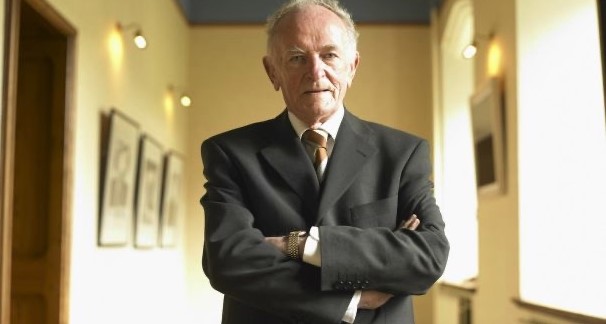
Professor John A. Murphy photographed by Andrew Bradley (2007)
As Queen Elizabeth was about to finish her tour of the high-tech Tyndall Institute, University College Cork, in 2011, she was introduced to the Professor Emeritus of Irish History, John A. Murphy, who, in turn, introduced her to the statue of her great-great grandmother, Queen Victoria. It had been erected over the Aula Maxima when UCC, then ‘the Queen’s College’, opened in 1849, but was taken down in the nationalistic fervour of the 1930s, and buried in the President’s Garden, to prevent it doing any further cultural harm. John A. had led the campaign to reverse this attempt to bury the past, and as part of the University’s 150th anniversary the statue was put on public display. He told this ‘symbolic story’ to the current Queen with characteristic clarity and seeming artlessness, and remarked later that the reception of the Queen in Cork ‘said a lot for our people’s development’. He himself had played a major role in the transformation of public opinion that it represented, through a more inclusive and complex understanding of the Irish past. The fact that he came from a traditional nationalist background and understood it thoroughly was crucial in this.
His upbringing in Macroom was, as he put it, ‘in the Faith and Fatherland tradition’, but it was also a house of song, ranging widely from sean-nós to Moore’s Melodies, to Victorian music hall and light opera, reflecting the hybridity of Irish culture. He was to transcend his political inheritance, but he retained and celebrated this diverse musical tradition all of his life.
When he went to UCC in 1945 on a County Council scholarship he was, he said, ‘a very quiet, conformist boy’, even to the point of serving mass occasionally in the Honan Chapel, then attached to the Honan Hostel, where he lived as part of his scholarship, and experienced as an academic hothouse. College life, and the life of the city were ‘a liberation’; ‘coming from Macroom I saw anarchic freedom!’.
He was a brilliant student, his ‘chief influence intellectually’, as he put it, being the Professor of Irish History, James Hogan, at the time a leading example of a public intellectual, with a colourful political background – active in 1916, Collins’s Director of Intelligence during the Civil War, briefly a leading figure in the Blueshirt movement, but when John A came under his influence no longer party political, but known as a prolific writer on European as well as Irish politics and with a high profile in public policy-making as a Catholic conservative – on top of his extensive academic contributions. (An excellent collection of essays on Hogan, edited by Donnchadh Ó Corráin was published in 1998). Hogan kept in touch with his star student after John A. joined the teaching staff at Farrenferris seminary, and persuaded him to do an M.A. part-time, and ultimately to move to UCC to teach as his assistant. John A.’s years as a secondary teacher were also formative, laying the foundation for his remarkable success as a dynamic lecturer, and for the conviction that teaching was the primary role of the academic. While his politics were to diverge radically from Hogan’s, he may have owed to his academic mentor the ambition to have a public role.
He had a parallel education in intellectual debate in an informal group of Cork intellectuals and artists who met, mainly on Friday evenings, in the Palace Bar of The Everyman Theatre – ‘a virtual salon of sparkling conversation and original ideas in a city characterised by the conservatism of its middle classes’ – as John was to describe it. He called it ‘The Friday Night Court’, in the commemorative issue of The Cork Review on Seamus Murphy, portraying the immensely gregarious and humorous sculptor as a counter-weight to the other leading member of the group, Sean Hendrick, its ‘grey eminence’ and staunch defender of Daniel Corkery, whose ideas were a major focal point of debate, with John A. a leading critic. Seamus Murphy also did busts of many of his friends, and UCC had that of John A. cast in bronze to commemorate his ninetieth birthday. Done in 1973, when John A was 46, and a few years before I came to work with him, it gives a sense of his lively personality – and indeed, he was a remarkable character as well as a leading academic – known to all as ‘John A’, and self-identifying, only half jokingly, with ‘the bold Thady Quill’.
While John A. became a critic of Corkery’s writings, he remained a Corkeryite in his commitment to connecting the College to the city, and the Palace Bar meetings were also an important coming together of town and gown. John A.’s many contributions to the life of the city were marked by his being voted ‘Cork Person of the Year’ in 2005. Another important aspect of John’s linkage of city and University was his regular participation, often as the featured singer, in crowded sessions of the Singers Club in the Spailpín Fánach pub. For his eighty fifth birthday, as I recall it, he performed a long, notoriously difficult sean-nós song in praise of Napoleon Bonaparte, newly learned for the occasion. Some months before his death, a decade later, he told his son Hugh, with a mischievous smile, that he would like on his gravestone only the words: ‘John A.Murphy. He sang’.
He could have added ‘and taught’. He was a charismatic, unforgettable lecturer. When I started to lecture in UCC we shared a weekly two hour slot with the B.A. class, with him starting. As I waited outside the lecture theatre to take over, I would listen mesmerised to his finale, often a poem, theatrically declaimed, or the verse of a song sung with melodious exuberance. As he came out, I would get a friendly “off you go”, which to me also seemed to say, “match that”, and I would go in and give my carefully written out lecture, which had to appear pedestrian by comparison. But that was my beginner’s insecurity, as he was endlessly encouraging and supportive as a colleague and head of department.
UCC’s singular honouring of John A. with the bust (he had previously been proclaimed ‘University Historian’ for life by the Governing Body) was, above all, a response to his extraordinary devotion to ‘the College’ and his contribution to its sense of identity and community, in a series of books beginning with the widely admired The College: A History of Queens/University College Cork 1845-1995 (1995), which was followed by three further books on UCC. He was for many years a very active member of its Governing Body, and represented UCC on the Senate of the National University. I succeeded him on the latter body where he was fondly remembered for his wit as well as his wisdom, as when he finished a vehement speech against giving an honorary doctorate to the horse trainer, Vincent O’Brien, who had recently had a Derby winner, “and if you are to honour anyone, it should be the horse – like Caligula!’
While he published some important articles on his early research area of seventeenth-century Ireland, his greatest contribution as an historian was as a communicator of modern historical research to the wider public.

He remains best-known for his hugely influential Ireland in the Twentieth Century (1975, 1989), but his contributions as a public intellectual were far more extensive, beginning with his deep involvement over many years with the Cork Historical and Archaeological Society and its excellent Journal, through various Thomas Davis radio lectures and many other contributions to the media, especially his very popular weekly columns in the Sunday Independent (1984-2003).
His election to the Irish Senate (1977-1983, and 1987-1992) gave him a new platform in his campaign to challenge simplistic nationalist orthodoxies, and he is widely acknowledged to have played a courageous and valuable part in the development of the Peace Process. This came at the cost of public vilification and personal abuse, and indeed threats, at the height of the violence in Northern Ireland, but his courage, the clarity of his thought, and his empathy still with the traditional nationalism of his youth encouraged many to broaden their understanding of Ireland’s complex past and polarised present.
In the 2005 festschrift in his honour, which I edited with Larry Geary, the listing of his publications included his own choices of a sample of his Sunday Independent columns, and his Senate speeches, and it will not be long, I feel sure, until complete listings of these and other writings and speeches are made, as he himself becomes the subject of biographies and theses, and is regarded as an important part of the history of his time – and one of its most important witnesses.
He was much loved across the UCC community for his wit, his outspokeness and wonderful singing voice, and as the great proponent of the historic mission and proper modus operandi of the University as a community of scholars, comprising both staff and students, rather than a business, as government and business pressures dictate increasingly.
From the medieval song , “Gaudeamus igitur”, famous for its articulation of that communal sense, John A. often sang one verse with particular brio, when giving the address at graduation ceremonies. It summed up his philosophy of University life.
Vivat academia!
Vivant professores!
Vivat membrum quodlibet;
Vivant membra quaelibet;
Semper sint in flores. Long live the academy!
Long live the professors!
Long live each student;
Long live the whole fraternity;
For ever may they flourish!
.
Tom Dunne is a Professor Emeritus of Irish History, who worked with Professor Murphy for many years and edited his Festschrift: History and the Public Sphere. Essays in Honour of John A. Murphy (Cork University Press, 2005)
 Tinteán
I’m so happy to have read this. It has brought back memories. John A was a frequent visitor to Ballyferriter and there weren’t any barriers to his communication with us as his Irish was every bit as good as the rest of us. When My Mary Ellen RIP and I started our regular visits from New York we, of course started every evening in the pub in Ballyferriter. My Dad Paddy Brick was more than é willing contributer. After the closing everyone was invited to our home in Gorta Dubha for a session of music songs recitations or whatever added to the jollity of the time. At the time they were known as Ball Nights. I remember John A being there a few times in the 70s. I even remember the song he often sang Roddy McCurley and he would waive his arms erratically to have us all join in. He certainly was the Belle of the Ball. And most of us didn’t know of his academic background. He was one of us. Great for the Craic. Thanks for this lovely narrative of a super intellectual and a true man of the people.