A Feature by Mervyn Ennis
In 1990 the sessile oak was declared to be Ireland’s national tree. This choice is testimony to its beauty, to the supreme quality of its timber and to more than two thousand years of veneration as a sacred tree. Maybe in hindsight the government choice of the oak as an emblem of Ireland was prophetic. It is again opportune for the Irish people to draw resilience from this national emblem that signifies strength and endurance.

Oak Tree
The oak tree is native to Ireland and special to the Irish people for its strength, hardiness and unique features. It was not named ’Robur’=‘sturdy, by the botanists for nothing. Until humans devised iron cutting tools the oak resisted all attempts to fell it. The oak tree stands mighty solid with great branches, matched only by still greater roots. When struck by lightning, the force of the strike and the heat bursts the sap and the stem apart leaving the trunk gnarled and withered. Yet it still manages to survive, over the years, decades and centuries. Its growth is slow but sure. It is a marker point, a cornerstone and a refuge in the forest. Oaks have been used to mark the boundaries between one area and the next. In Faerie lore the ‘Oaken Door’ is an entry into the realm of the faerie. The oak is the doorway between worlds, the tree you climb up to go to another world.
Druids held the oak tree sacred, and gathered mistletoe from its boughs for their secret rites. They preached under its mighty form, gaining power and tradition from its strength. The Roman writer Pliny pointed out that the Druids ’perform no sacred rites without oak leaves, so from this custom they are called druids’. Some etymologists argue that the word druid comes from the Greek word ‘drus’, which meant ‘oak’. The word druid literally means ‘people of oak’, or ‘wise in the oak’, or ‘having knowledge of the oak’.
To the Celts the oak represents primeval strength and the ability to overcome and survive, while at the same time an essential protection for the less able and weaker who require security in order to strengthen their characters. In the Celtic Calendar Duir, the strong fertile oak stands for May, commencing the spring fertility festival of Beltaine, or Mayday.When left for over five thousand years beneath the bog the oak becomes Bog-Oak a fine black, self-lubricating wood.
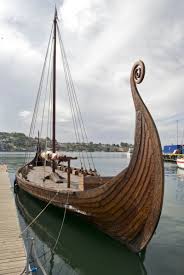
Viking Ship
The Vikings were the first invaders to realise the potential of the oak. The Vikings arrived in Ireland in 795 AD and by the 840s AD, began to over-winter and created fortified bases. Best known of these is Dublin (Baile atha cliath – the town of the foreigners), but also towns such as Wicklow, Arklow, Wexford, Waterford and Limerick were founded by the Vikings. Their origins apart from winter quarters and possibly slave markets later blossomed as trading towns with a great production of everyday consumer articles and extensive international trade. This trade was in turn enhanced by the Viking use of Irish oak for by 1042 the Vikings were harvesting the oak forests to produce their distinctive long boats and war ships with a thriving boat building enterprise near Dublin. Indeed, it was in one such craft that in 1066, after the battle of Hastings, that King Alfred’s twin sons Harold and Ulf were brought to Denmark in a long boat named Skuldalev 2 made in Dublin of oak harvested from Glendalough.
It was a true-born warship – built to transport large numbers of warriors at great speed to attacks on foreign shores. In a good wind, the ship will probably out sail most modern sailing ships, and even without the aid of the wind, the 60 oarsmen could make it travel at a comparatively fair speed.
 Tinteán